
Search results
 2D-022-016
DRS/NTS GREEN CLASS 68 'PRIDE OF THE NORTH' 68006
 'N' Gauge
 Released: 25/01/24
 DCC Ready (Next18)
 Era 11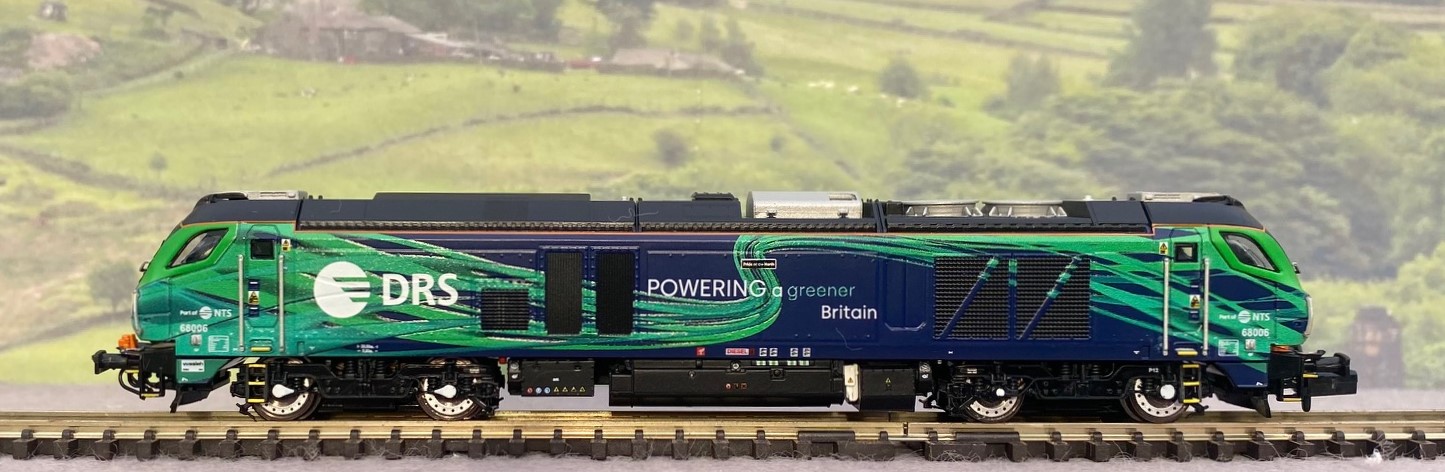
Our Price:
£127.50
£127.50
 35-361
Class 20/0 Disc Headcode 20088 BR Railfreight Sector Unbranded
'OO' GaugeReleased: 24/01/24DCC Ready (PluX22)Era 8The British Railways Board's (BRB) 1955 modernisation plan called for a change to alternative forms of traction and manufacturers were asked to produce trial or initial designs for evaluation. English Electric adapted an existing design based on an export model for a 1,000bhp diesel and 20 were built as a pilot scheme for assessment.
The first batch was built in 1957 and the diesels were assigned to work from Devon's Road depot, East London. The design was a success from the start and by 1962 a total of 127 had been built. Following assessment of all the Type 1 diesels, BRB placed a further order increasing the total to 228 by 1968 and the design became the BR standard for 1,000bhp diesel locomotives. With the introduction of TOPS the locomotives were designated Class 20 and renumbered 20001 to 20228. The locomotives were principally designed for freight work but also saw service on summer passenger trains where train heating was not required. The Class 20s worked over the Eastern, London Midland and Scottish regions as well as into Wales and were commonly associated with coal traffic. The only drawback the Class had was its single end cab, unlike modern designs that have a cab at each end. BR resolved this problem by regularly operating the Class 20s as pairs, nose to nose, and with the combined power of 2,000bhp they were able to haul the heavier block freight trains.
BR's decision to switch to Type 5 and in particular Class 60 diesels in the late 1980s started a gradual withdrawal of the fleet, with just 28 left by 1994. A tribute to the design is that after 45 years the Class is still in service with DRS on mainline duties following refurbishment, the resulting locomotives being designated Class 20/3s. At least 28 of the class are now preserved.

Our Price:
£191.20
£191.20
 371-858
Class 158 2-Car DMU 158844 Northern
'N' GaugeReleased: 24/01/24DCC Ready (Next18)Era 9The British Rail Class 158 Express Sprinter is a Diesel Multiple Unit (DMU), built specifically for British Rail's Provincial Services sector between 1989 and 1992 by British Rail Engineering Limited (BREL) at Derby Litchurch Lane Works and outshopped in Regional Railways Provincial livery. They were built to replace many locomotive-hauled passenger trains, thereby reducing cost of operation, and to allow cascading of existing Sprinter units to replace elderly 'heritage' DMUs. The majority of the 182-strong fleet of Class 158 units were built as two-car sets, with 17 three-car units constructed specifically for use on Trans-Pennine services. Similar three-car units were built for use by Network SouthEast but these were converted to Class 159 specification before introduced into service, with toilet retention tanks and other modifications to operate over the third-rail network.
All but one of the Class 158s remain in service today (2023), with operators including ScotRail, Northern, Great Western (GWR), East Midlands Trains (now EMR), and Transport for Wales (formerly Arriva). Former operators include Central Trains. The Class has worked extensively across the UK network, even into East Anglia as far as Stansted Airport and Norwich. Some 158s have been converted to additional Class 159s and now operate for South Western alongside their original classmates.

Our Price:
£220.95
£220.95
 R30281
LMS, Class 8F, 2-8-0, No. 8310
'OO' GaugeReleased: 08/02/24DCC Ready (21 Pin)Era 3The Stanier designed LMS Class 8F was many things, it was one of the most widespread 2-8-0 locomotive ever used in Britain, it was a war hero, an expat, but maybe more importantly it was a dependable servant of the freight industry. 852 examples of the class were built over an eleven years of construction with an example being built in almost every locomotive works around the UK.
This is quite unusual as a competing rail company would not wish to allocate valuable shed time to a competitors locomotive however the locomotive was chosen by the war department to be the standard freight engine of the war effort. This led to their construction on every part of the UK network, as at a time of war even the fiercest national competitors would need to put their differences aside to work towards the common goal of peace.
Examples of the 8F locomotive could, at their geographical peak, could be found in the UK as well as Italy, Turkey, Iran, Palestine, Israel and Egypt. 225 examples would find themselves in service overseas initially in Egypt and Iran before those locomotives were disseminated around the Middle East and parts of Europe as and where demand dictated. Most of these locomotives would not return to the UK and would continue to be used in revenue earning service well after the withdrawal of steam on the UK network.
Overseas examples would go on to be withdrawn in the 1970s and 80s, with most examples being scrapped. Back home in the UK, the last examples would be withdrawn at the end of steam on BR in 1968, a large number have been preserved. Two Class 8Fs represent a rare sight in the world of diving, going down with the SS Thistlegrom.
These locomotives are clearly visible on the seafloor with the ship, becoming a major tourist attraction in recent years. Locomotive 8310 was outshopped into LMS service in December of 1943, too late to enter war service as the stock shipped overseas ceased in January of 1942. The locomotive would be in service for 24 years before being withdrawn on the 30th December 1967.
The locomotive would then be stored for a short while before being scrapped before the end of the following year after a fairly unremarkable yet devoted service life.

Our Price:
£224.99
£224.99
R7326HM7040: Bluetooth® Legacy Dongle
Released: 26/02/24DCC AccessoryThis Bluetooth® Legacy Dongle allows the HM | DCC app to work with older DCC Controllers from Hornby.
Add Bluetooth and Smartphone/tablet control to your existing Hornby DCC Controllers! The dongle works with all Hornby DCC decoders - including the Elite, Select and Railmaster. This will allow the HM | DCC app to control of all your previous non-Bluetooth decoders.
The Legacy Dongle works via the XpressNet socket - this is a common socket included in many other brands of DCC Controller, however, Hornby are unable to confirm if the Dongle will work seamlessly with other brands of controller.

Our Price:
£35.99
£35.99
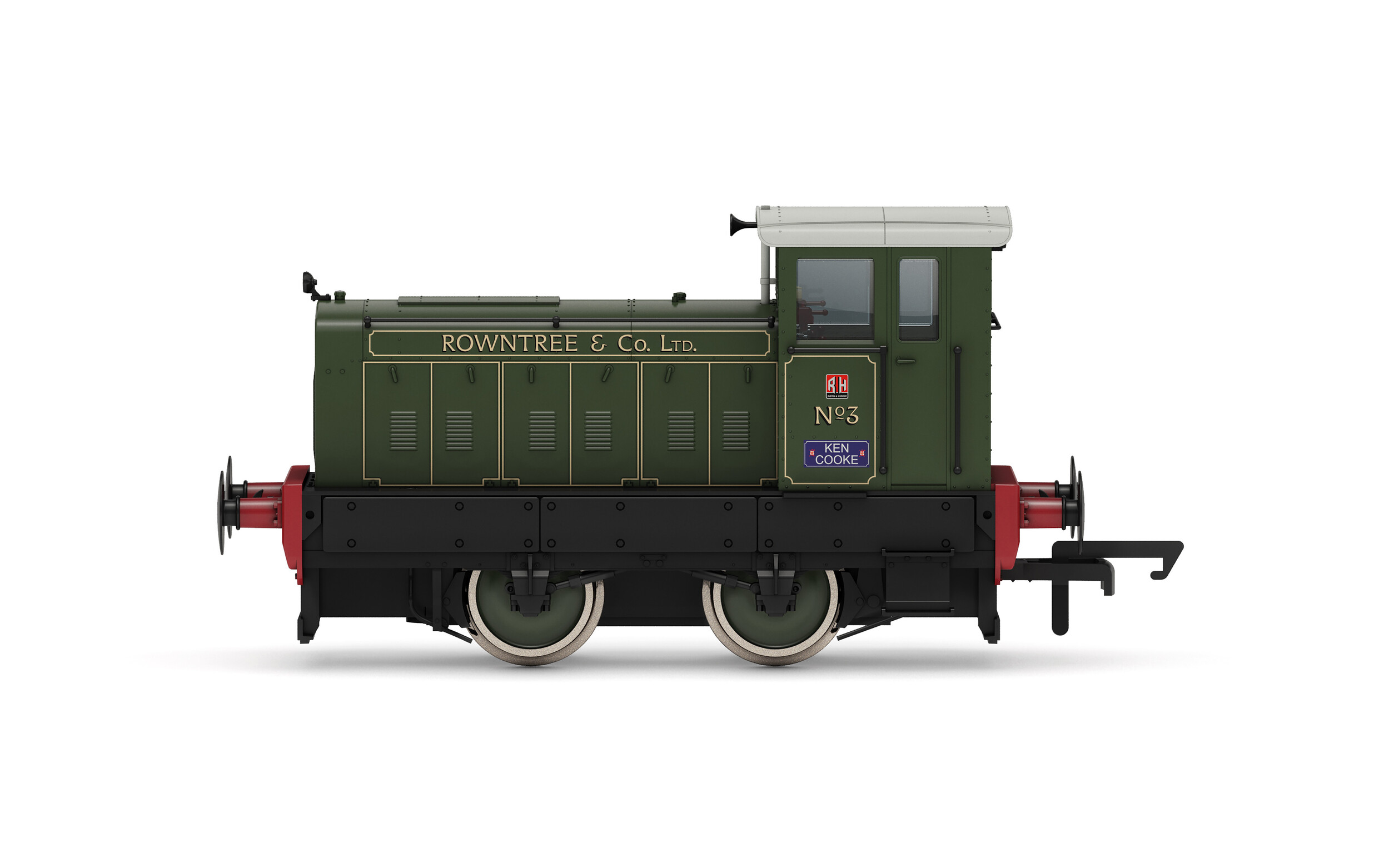
R3895Rowntree & Co., Ruston & Hornsby 88DS, 0-4-0, No. 3
'OO' GaugeReleased: 26/02/24DCC Ready (6 Pin)Era 6Ruston & Hornsby Ltd, of Lincoln, was formed as the result of the merger between Ruston, Proctor & Co. Ltd and Richard Hornsby & Sons Ltd on September 11, 1918 and their first narrow gauge diesel locomotive left the works on September 1, 1931.
In the summer of 1932, production was moved to the larger Boultham Works, where the firm were eventually to become Britain's largest builder of diesel locomotives, with over 6,500 being built by the time production ceased in 1969. Almost as soon as the firm's 44/48HP 0-4-0 locomotives were making an appearance, an upgraded, more powerful 0-4-0 was on the drawing board. Although many of the features of the 44/48HP were retained for the new 80/88HP, such as the chain drive and running gear, a new type of transmission was fitted, along with Westinghouse airbrakes. The new power unit, Ruston's own 4VPB, delivered 80BHP at 1000rpm and was later supplanted by Ruston's improved 4VPH that delivered 88BHP, but it required compressed air to be injected into the cylinders to be able to start.
While running, an air reservoir was kept charged via the braking system, but after standing idle for a period the reservoir depleted and a secondary source was required to recharge the reservoir. This was achieved by fitting a small, secondary 1½HP 'donkey' engine, giving rise to a distinctive raised cover on the right hand side of the engine compartment that differed in size and placement depending on the make of engine used. Two basic weight options were offered for the 80/88HP, of 17 tons and 20 tons, the difference being achieved by attaching weights to the outside frames, as well as to the front and rear buffer beams.
In 1941, Ruston's locomotive classifications were changed, with the 80/88HP becoming 88DS (with the narrow gauge versions being assigned the DSM and DSN suffix, and the broader gauges assigned DSW). Outward appearance changes to the 'standard' locomotives were mainly confined to the cab area, with examples from mid-1947 replacing the open cab with a fully enclosed cab that featured several ad-hoc styles of front window. The final 88DS, 518494, left Boultham Works on 29 November 1967, bringing to an end a production run of 271 locomotives.
Ruston 441934 was built new for Rowntree & Co. Ltd of York, being delivered in April 1960 to join R&H 421419/1958 and 432479/1959 in the confectionery company's fleet of locomotives as No. 3. In 1979, the York factory bought a new 0-6-0 locomotive and No.3 was transferred to Rowntree's Fawdon factory in Newcastle. Rail services at Fawdon came to a halt on 30 January 1987, with No. 3 being handed over to the North York Moors Railway for preservation. After some years being moved about it was purchased in 2013 by two members of the Derwent Valley Light Railway, Glynnis and Tony Frith. 441934 has now been named Ken Cooke, in honour of the former Rowntree's York employee, D-Day veteran and holder of France's highest military honour, the Legion dHonneur.
Our Price:
£102.59
£102.59
R3896BR, Ruston & Hornsby 88DS, 0-4-0, No. 84
'OO' GaugeReleased: 26/02/24DCC Ready (6 Pin)Era 6Ruston & Hornsby Ltd, of Lincoln, was formed as the result of the merger between Ruston, Proctor & Co. Ltd and Richard Hornsby & Sons Ltd on September 11, 1918 and their first narrow gauge diesel locomotive left the works on September 1, 1931. In the summer of 1932, production was moved to the larger Boultham Works, where the firm were eventually to become Britain's largest builder of diesel locomotives, with over 6,500 being built by the time production ceased in 1969. Almost as soon as the firm's 44/48HP 0-4-0 locomotives were making an appearance, an upgraded, more powerful 0-4-0 was on the drawing board.
Although many of the features of the 44/48HP were retained for the new 80/88HP, such as the chain drive and running gear, a new type of transmission was fitted, along with Westinghouse airbrakes. The new power unit, Ruston's own 4VPB, delivered 80BHP at 1000rpm and was later supplanted by Ruston's improved 4VPH that delivered 88BHP, but it required compressed air to be injected into the cylinders to be able to start. While running, an air reservoir was kept charged via the braking system, but after standing idle for a period the reservoir depleted and a secondary source was required to recharge the reservoir. This was achieved by fitting a small, secondary 1½HP 'donkey' engine, giving rise to a distinctive raised cover on the right hand side of the engine compartment that differed in size and placement depending on the make of engine used. Two basic weight options were offered for the 80/88HP, of 17 tons and 20 tons, the difference being achieved by attaching weights to the outside frames, as well as to the front and rear buffer beams.
In 1941, Ruston's locomotive classifications were changed, with the 80/88HP becoming 88DS (with the narrow gauge versions being assigned the DSM and DSN suffix, and the broader gauges assigned DSW). Outward appearance changes to the 'standard' locomotives were mainly confined to the cab area, with examples from mid-1947 replacing the open cab with a fully enclosed cab that featured several ad-hoc styles of front window. The final 88DS, 518494, left Boultham Works on 29 November 1967, bringing to an end a production run of 271 locomotives.
Ruston 432478 was built new for British Railways, being delivered in January 1959 to the North Eastern Region Civil Engineers Department at the Leeman Road Permanent Way Stockyard in York, one of six Ruston & Hornsby 88DS locomotives built for British Railways which were distributed between York, Dinsdale Depot, Etherley Tip, Crofton, Hartlepool and Darlington. As well as working shunting duties at Leeman Road, 432478 also worked at the York Central Concrete Depot, which is now the site of the Railway Museum's main visitor car park.

Our Price:
£102.59
£102.59
374-821BR Mk1 FO First Open 'DIANA' WCRC Maroon
'N' GaugeReleased: 20/02/24Era 9
Our Price:
£43.15
£43.15
374-821ABR Mk1 FO First Open 'ALEXANDRA' WCRC Maroon
'N' GaugeReleased: 20/02/24Era 9
Our Price:
£43.15
£43.15
35-352Class 20/0 Disc Headcode & Tablet Catcher D8032 BR Green (Late Crest)
'OO' GaugeReleased: 29/02/24DCC Ready (PluX22)Era 5The British Railways Board's (BRB) 1955 modernisation plan called for a change to alternative forms of traction and manufacturers were asked to produce trial or initial designs for evaluation. English Electric adapted an existing design based on an export model for a 1,000bhp diesel and 20 were built as a pilot scheme for assessment.
The first batch was built in 1957 and the diesels were assigned to work from Devon's Road depot, East London. The design was a success from the start and by 1962 a total of 127 had been built. Following assessment of all the Type 1 diesels, BRB placed a further order increasing the total to 228 by 1968 and the design became the BR standard for 1,000bhp diesel locomotives. With the introduction of TOPS the locomotives were designated Class 20 and renumbered 20001 to 20228. The locomotives were principally designed for freight work but also saw service on summer passenger trains where train heating was not required. The Class 20s worked over the Eastern, London Midland and Scottish regions as well as into Wales and were commonly associated with coal traffic. The only drawback the Class had was its single end cab, unlike modern designs that have a cab at each end. BR resolved this problem by regularly operating the Class 20s as pairs, nose to nose, and with the combined power of 2,000bhp they were able to haul the heavier block freight trains.
BR's decision to switch to Type 5 and in particular Class 60 diesels in the late 1980s started a gradual withdrawal of the fleet, with just 28 left by 1994. A tribute to the design is that after 45 years the Class is still in service with DRS on mainline duties following refurbishment, the resulting locomotives being designated Class 20/3s. At least 28 of the class are now preserved

Our Price:
£191.20
£191.20