Search results
 372-911SF
LMS/BR 10001 Black & Silver With DCC Sound Fitted
 'N' Gauge
 Released: 15/03/24
 DCC FittedDCC Sound
 Era 4
Era 4The LMS ‘Twins’ Nos. 10000 and 10001 were the first mainline diesel locomotives built in Great Britain. A joint venture between the London, Midland & Scottish Railway (LMS) and English Electric, the pair were first conceived in 1946. The body and chassis design was undertaken by the LMS’s Chief Mechanical Engineer H. G. Ivatt, and English Electric provided the engine, electric systems and machinery. Construction of No. 10000 began at Derby Works in 1947 and the locomotive was outshopped in December of that year, days before Nationalisation of Britain’s railways.
Both locomotives entered traffic in an eye-catching black and silver livery, with large chrome numbers fitted at each end of the bodysides, below the cab windows. The letters LMS were also applied in chrome to No. 10000, however No. 10001 did not enter service until mid-1948, with British Railways completing its construction, and so it entered traffic with neither LMS nor BR markings.
The locomotives worked both singularly and as a pair on the Midland Main Line and West Coast Main Line, hauling named expresses and lower key services, and venturing north of the border into Scotland. Interconnecting doors were fitted within the noses of each engine, allowing crew and personnel to move between the two in motion, but this feature was seldom used.
In 1953 the Twins were sent to the Southern Region, being fitted with an additional pair of marker lights and lamp brackets beforehand which made them compatible with the SR’s practice of using headcodes to denote both train types and routes. During a two year period on the Southern Region the Twins worked alongside the Southern’s own diesel prototypes before returning to the Midland Region in 1955.
As prototypes, changes and modifications were made to the locomotives during the years and this included the fitting of water scoops to allow water for the steam heat boiler to be collected from troughs located between the rails ‘on the move’. Ironically, in common with many early diesels, the performance of the steam heat boilers was woeful, and in colder months the pair were often relegated to freight workings where steam heat provision was not required.
By the late-1950s new, production series diesel locomotives were arriving en-masse and whilst their time in service had been highly educational and helped to shape the BR diesel fleet, the writing was on the wall for this pair on non-standard prototypes. No. 10000 was officially withdrawn in December 1963, whilst No. 10001 lasted to March 1966, kept going with components salvaged from its Twin. Sadly, neither was saved and both were subsequently scrapped, but their legacy carried on in the Class 40s, 50s and 56s which all used versions of the English Electric 16SVT engine and today, works is ongoing to build a replica of No. 10000.

Our Price:
£242.20
£242.20
 R30195
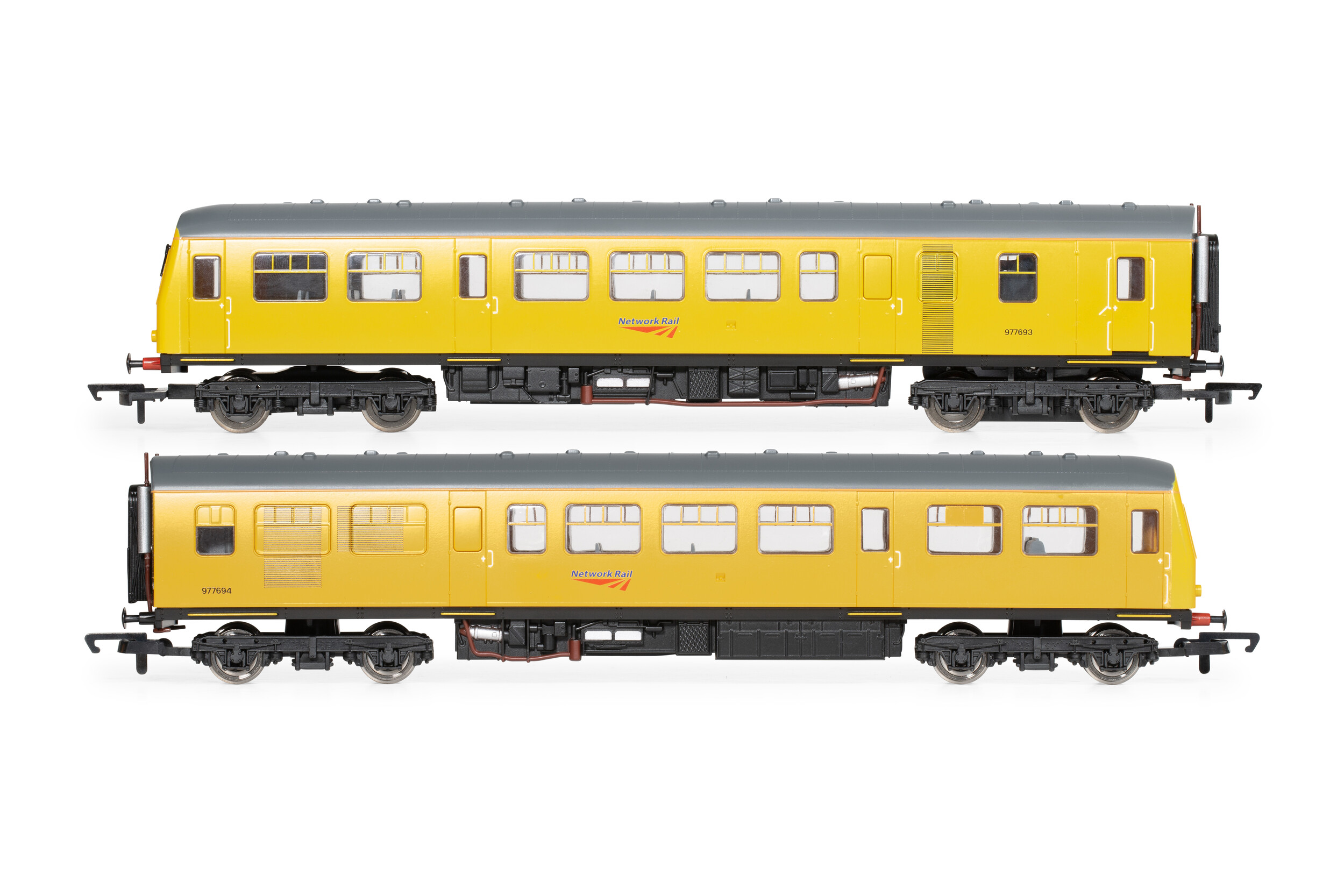
RailRoad Plus Network Rail, Class 960, Bo-Bo, 901002 'Iris 2'
'OO' GaugeReleased: 18/03/24DCC Ready (8 Pin)Era 8Constructed in Birmingham, the Class 101 DMU was one of the longest lasting DMUs to ever see service in the UK. 527 of the class would be built across many orders from BR between 1956 and 1960. The first units would enter BR service in 1956 in the BR green livery.
Class 101 units at the height of their use could be seen in all corners of the UK, at the onset of privatisation in the 1990s the units would appear in all manner of colourful liveries such as the Network South East colours and First North Western. Throughout their life, Class 101 units would occasionally appear as a three car sets where demand dictated.
Beginning life as the BR Class 101 unit 50338 On its entry into departmental service the unit would be reclassified as a class 960 and renumbered 901002, it would also gain the name Iris 2 which would be displayed in place of a destination on its destination boards.
Iris 2 functioned as a lab for Network Rail undertaking tests around the UK. As Iris 2, the DMU appeared in a Serco Railtrack livery, Network Rail livery and a unique grey Lab 19 livery. Iris 2 is currently preserved on the Barry Tourist Railway in a BR Green livery.
Our Price:
£121.49
£121.49
R30348L&MR, No. 58 'Tiger'
'OO' GaugeReleased: 18/03/24DCC Ready (Next18)Era 1Number 58 'Tiger' was the sister engine to 'Lion', one of a plethora of locomotives named after animals as became the norm for the fledgling L&MR. Like its sister engine, 'Tiger' was designed as a luggage engine and was delivered from Todd, Kitson, and Laird alongside 'Lion', having been constructed at the same time as part of the same order. These were the first two locomotives to be built at the Railway Foundry in Leeds.
Information regarding 'Tiger' is scant, but as it was built to the same specifications, it is a reasonable assumption that the engine would have served the same duties as its more notable sister. It is also likely that the engine was also rebuilt at Edge Hill in 1841.
Likely still in service when the L&MR was absorbed into Grand Junction Railway and then the London and North Western Railway, 'Tiger' would have also been renumbered under its new operator. As it is not in preservation, it is assumed that at the time 'Lion' was withdrawn and converted into a stationary pump, 'Tiger' was also withdrawn and scrapped.

Our Price:
£125.99
£125.99
R30273SR, N15 'King Arthur Class', 4-6-0, 741 'Joyous Gard': Big Four Centenary Collection
'OO' GaugeReleased: 02/04/24DCC Ready (21 Pin)Era 3The N15 Class, introduced in 1918 from a design by Robert Urie, was also known as the King Arthur Class, being named after persons and places associated with the legend of King Arthur and the Round Table. This class of two cylinder 4-6-0 passenger steam locomotives proved to be one of the most successful during the post-grouping era of 1928-1948, with 74 locomotives being built during this time.
The whole class was built in a total of six batches, with the first two batches being built at the London & South Western Railway's Eastleigh Works between 1918-19 and 1922-23. Carrying the characteristics of Urie's stove pipe chimney, Drummond style of cab and inspired by the shape of the H15, the first batches of locomotives became known as 'Urie Arthurs'.
Upon assuming the position of CME of the Southern Railway, Richard Maunsell built a third batch of ten locomotives at the Eastleigh Works and these became known as the 'Eastleigh Arthurs'. Maunsell's batch incorporated a small number of significant modifications including changes in the draft, valve gear, chimney, blastpipe and an overall increase in boiler pressure that significantly improved the performance.
In 1924 two more batches were ordered from the Scottish based North British Locomotive Company. These 30 locomotives, referred to as 'Scottish Arthurs' were built to the Southern Railways new composite loading gauge and were connected to eight wheel bogie tenders, which had a 5,000 imperial gallon capacity.
The last batch of 15 locomotives were built at Eastleigh between 1926-27 and adopted a six wheel 3,500 imperial gallon tender. Despite the order the batch was never completed, with the last locomotive being replaced by the prototype of the Lord Nelson Class of locomotives. Having proved to be one of the greatest designs of its day, the King Arthur Class combined reliability with impressive performance.
The introduction of electrification, plus the Lord Nelson Class and ultimately, the Bulleid Pacific locomotives, all hastened the N15's departure.'Joyous Gard' was the sixth example of the class to be built, numbered 741 it would leave the shed at Eastleigh in April 1919. During its life the locomotive would receive various modifications such as the class wide installation of smoke deflectors as well as being fitted with a Lemaitre exhaust, becoming one of only five of the class to have the upgrade fitted.
The locomotive would become 30741 under British Railways, before being withdrawn and scrapped in February 1956. Only one member of the class would be preserved, a North British Loco built example, 777 Sir Lamiel, part of the National Collection, under the care of the 5305 Locomotive Association, being based at the Great Central Railway in Leicestershire.

Our Price:
£197.09
£197.09
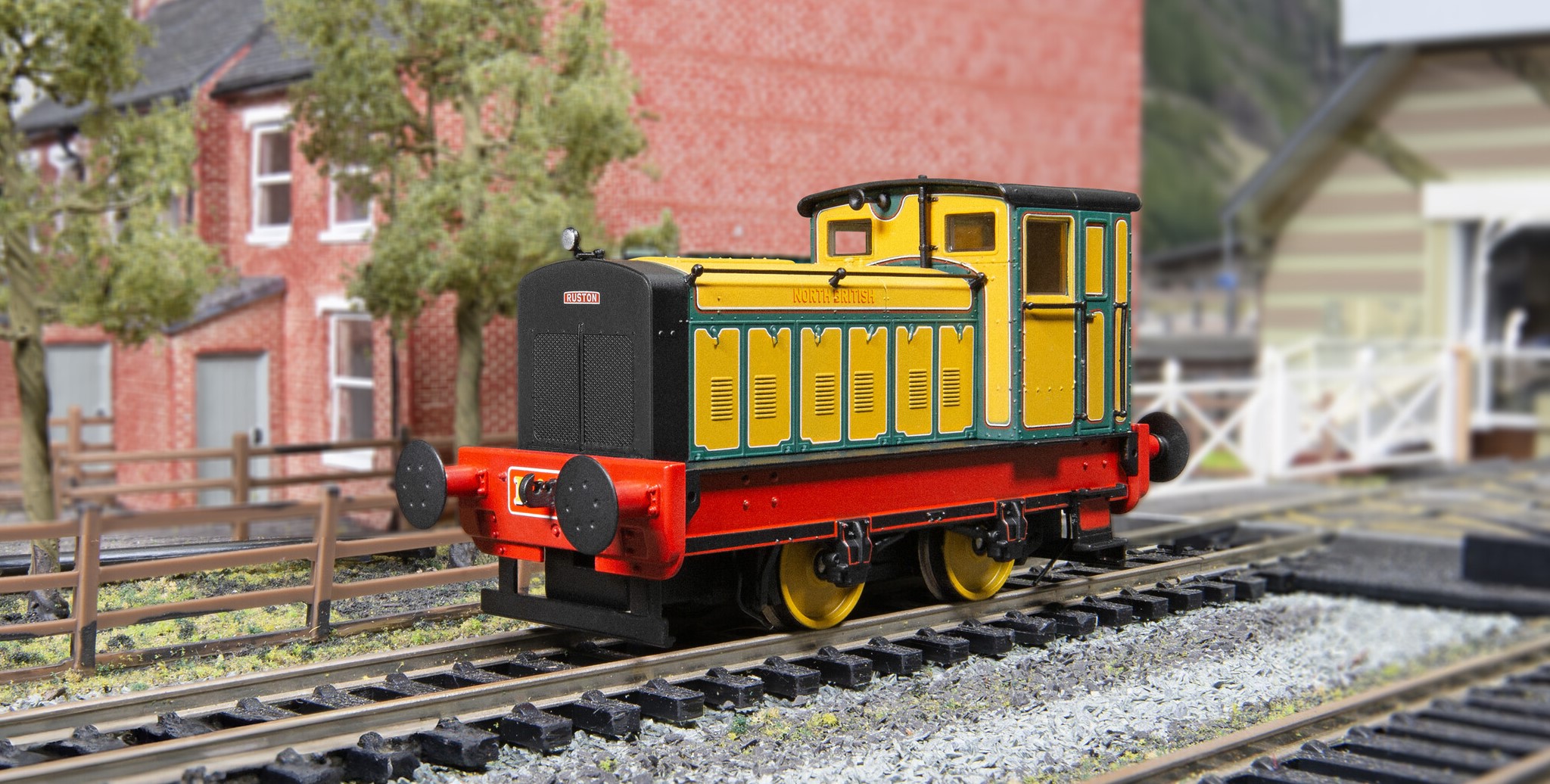
R3894North British Distillery Co. Ltd, Ruston & Hornsby 88DS, 0-4-0, No. 4
'OO' GaugeReleased: 02/04/24DCC Ready (6 Pin)Era 6Ruston & Hornsby Ltd, of Lincoln, was formed as the result of the merger between Ruston, Proctor & Co. Ltd and Richard Hornsby & Sons Ltd on September 11, 1918 and their first narrow gauge diesel locomotive left the works on September 1, 1931. In the summer of 1932, production was moved to the larger Boultham Works, where the firm were eventually to become Britain's largest builder of diesel locomotives, with over 6,500 being built by the time production ceased in 1969. Almost as soon as the firm's 44/48HP 0-4-0 locomotives were making an appearance, an upgraded, more powerful 0-4-0 was on the drawing board.
Although many of the features of the 44/48HP were retained for the new 80/88HP, such as the chain drive and running gear, a new type of transmission was fitted, along with Westinghouse airbrakes. The new power unit, Ruston's own 4VPB, delivered 80BHP at 1000rpm and was later supplanted by Ruston's improved 4VPH that delivered 88BHP, but it required compressed air to be injected into the cylinders to be able to start. While running, an air reservoir was kept charged via the braking system, but after standing idle for a period the reservoir depleted and a secondary source was required to recharge the reservoir. This was achieved by fitting a small, secondary 1½HP 'donkey' engine, giving rise to a distinctive raised cover on the right hand side of the engine compartment that differed in size and placement depending on the make of engine used. Two basic weight options were offered for the 80/88HP, of 17 tons and 20 tons, the difference being achieved by attaching weights to the outside frames, as well as to the front and rear buffer beams.
In 1941, Ruston's locomotive classifications were changed, with the 80/88HP becoming 88DS (with the narrow gauge versions being assigned the DSM and DSN suffix, and the broader gauges assigned DSW). Outward appearance changes to the 'standard' locomotives were mainly confined to the cab area, with examples from mid-1947 replacing the open cab with a fully enclosed cab that featured several ad-hoc styles of front window. The final 88DS, 518494, left Boultham Works on 29 November 1967, bringing to an end a production run of 271 locomotives.
Ruston 421415 was built new for the North British Distillery Co. Ltd, being delivered in March 1958 to their distillery in the Gorgie district of Edinburgh, around the period when the distillery was expanding to include the former Edinburgh Corporation Tramways depot. In 1973, the locomotive was donated to the fledgling Fife Railway Preservation Group, who located it at the Lochty Private Railway until its demise in 1994. 421415, now numbered NBD No. 4, has now been restored and wears the livery of the North British Railway.
Our Price:
£102.59
£102.59
 35-125A
Class 20/3 20310 'Gresty Bridge' DRS Blue
'OO' GaugeReleased: 17/04/24DCC Ready (PluX22)Era 9The British Railways Board's (BRB) 1955 modernisation plan called for a change to alternative forms of traction and manufacturers were asked to produce trial or initial designs for evaluation. English Electric adapted an existing design based on an export model for a 1,000bhp diesel and 20 were built as a pilot scheme for assessment.
The first batch was built in 1957 and the diesels were assigned to work from Devon's Road depot, East London. The design was a success from the start and by 1962 a total of 127 had been built. Following assessment of all the Type 1 diesels, BRB placed a further order increasing the total to 228 by 1968 and the design became the BR standard for 1,000bhp diesel locomotives. With the introduction of TOPS the locomotives were designated Class 20 and renumbered 20001 to 20228. The locomotives were principally designed for freight work but also saw service on summer passenger trains where train heating was not required. The Class 20s worked over the Eastern, London Midland and Scottish regions as well as into Wales and were commonly associated with coal traffic. The only drawback the Class had was its single end cab, unlike modern designs that have a cab at each end. BR resolved this problem by regularly operating the Class 20s as pairs, nose to nose, and with the combined power of 2,000bhp they were able to haul the heavier block freight trains.
BR's decision to switch to Type 5 and in particular Class 60 diesels in the late 1980s started a gradual withdrawal of the fleet, with just 28 left by 1994. A tribute to the design is that after 45 years the Class is still in service with DRS on mainline duties following refurbishment, the resulting locomotives being designated Class 20/3s. At least 28 of the class are now preserved.

Our Price:
£191.20
£191.20
35-125BClass 20/3 20311 'Class 20 'Fifty'' DRS Blue
'OO' GaugeReleased: 17/04/24DCC Ready (PluX22)Era 9CLASS 20/3 HISTORY
The British Railways Board's (BRB) 1955 modernisation plan called for a change to alternative forms of traction and manufacturers were asked to produce trial or initial designs for evaluation. English Electric adapted an existing design based on an export model for a 1,000bhp diesel and 20 were built as a pilot scheme for assessment.
The first batch was built in 1957 and the diesels were assigned to work from Devon's Road depot, East London. The design was a success from the start and by 1962 a total of 127 had been built. Following assessment of all the Type 1 diesels, BRB placed a further order increasing the total to 228 by 1968 and the design became the BR standard for 1,000bhp diesel locomotives. With the introduction of TOPS the locomotives were designated Class 20 and renumbered 20001 to 20228. The locomotives were principally designed for freight work but also saw service on summer passenger trains where train heating was not required. The Class 20s worked over the Eastern, London Midland and Scottish regions as well as into Wales and were commonly associated with coal traffic. The only drawback the Class had was its single end cab, unlike modern designs that have a cab at each end. BR resolved this problem by regularly operating the Class 20s as pairs, nose to nose, and with the combined power of 2,000bhp they were able to haul the heavier block freight trains.
BR's decision to switch to Type 5 and in particular Class 60 diesels in the late 1980s started a gradual withdrawal of the fleet, with just 28 left by 1994. A tribute to the design is that after 45 years the Class is still in service with DRS on mainline duties following refurbishment, the resulting locomotives being designated Class 20/3s. At least 28 of the class are now preserved.

Our Price:
£191.20
£191.20
35-125BSFClass 20/3 20311 'Class 20 'Fifty'' DRS Blue With DCC Sound Fitted
'OO' GaugeReleased: 17/04/24DCC FittedDCC SoundEra 9SOUNDS
F0 - Directional Lights - On / Off (plus Light Switch Sound)
F1 - On - Warm Engine Start / On (with F8 On) - Cold Engine Start
F2 - Brake
F3 - Single Horn (Speed Related)
F4 - Two Tone Horn (Speed Related)
F5 - On - Light Train Mode / Off - Heavy Train Mode
F6 - Engine Idle / Coasting
F7 - Speed Lock
F8 - Cold Start
F9 - Flange Squeal (Speed Related)
F10 - Guard's Whistle
F11 - Buffer Up
F12 - Coupling
F13 - Cab End High Intensity Light (If Fitted)
F14 - On - Night Mode Directional Lights / Off - Day Mode Directional lights (If Fitted)
F15 - Detonators
F16 - Priming Pump
F17 - Wagon Snatching & Buffering
F18 - On - Driver's Door Open / Off - Driver's Door Closed
F19 - Fade All Sounds
F20 - Nose End Directional Lights Off
F21 - Cab End Directional Lights Off
F22 - Cab Light On (Only when Stationary)
F23 - Windscreen Wipers
F24 - Compressor
F25 - Spirax Valves
F26 - Shunt Mode
F27 - Volume Down
F28 - Volume Up
Analogue Users: Please note that normal load running sounds and any other automatic or randomised sounds will also operate when this model is used on analogue control (DC) straight from the box!

Our Price:
£276.20
£276.20
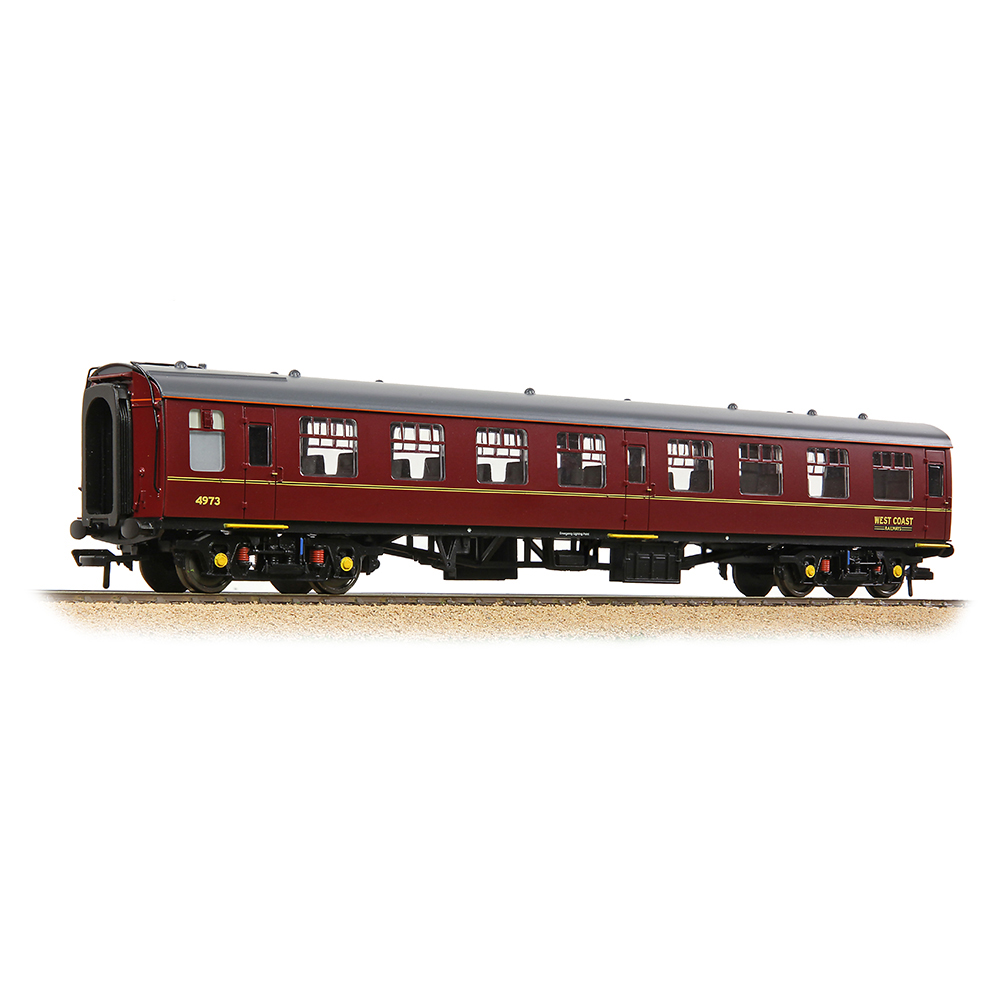
39-059BR Mk1 TSO Tourist Second Open WCRC Maroon
'OO' GaugeReleased: 17/04/24Era 9MODEL FEATURES:
Bachmann Branchline OO Scale
Era 9
Pristine West Coast Railway Company Maroon livery
Running No. 4973
Commonwealth Bogies
Accessory Pack
NEM Coupling Pockets
Close Coupling Mechanism
Length 270mm
Our Price:
£53.95
£53.95
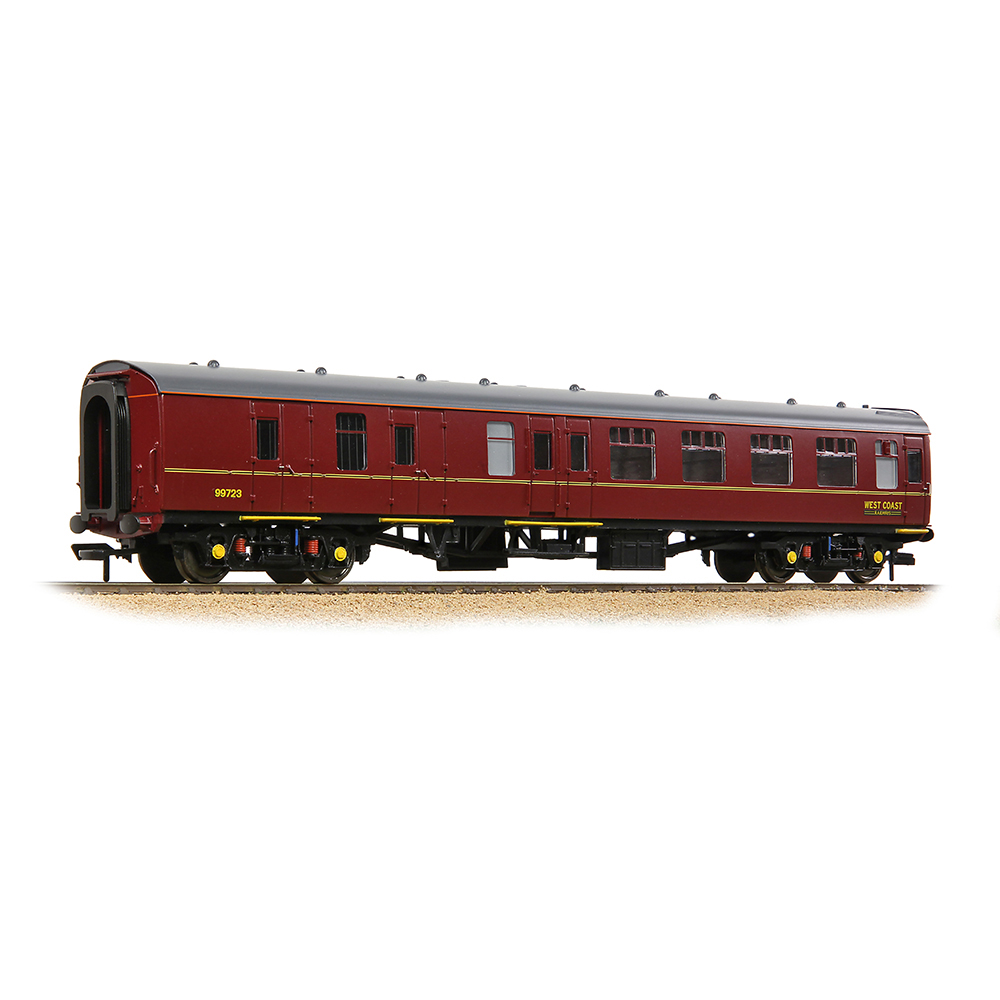
39-083BR Mk1 BSK Brake Second Corridor WCRC Maroon
'OO' GaugeReleased: 17/04/24Era 9MODEL FEATURES:
Bachmann Branchline OO Scale
Era 9
Pristine West Coast Railway Company Maroon livery
Running No. 99723
Commonwealth Bogies
Accessory Pack
NEM Coupling Pockets
Close Coupling Mechanism
Length 270mm
Our Price:
£53.95
£53.95