
Search results
R30273SR, N15 'King Arthur Class', 4-6-0, 741 'Joyous Gard': Big Four Centenary Collection
The N15 Class, introduced in 1918 from a design by Robert Urie, was also known as the King Arthur Class, being named after persons and places associated with the legend of King Arthur and the Round Table. This class of two cylinder 4-6-0 passenger steam locomotives proved to be one of the most successful during the post-grouping era of 1928-1948, with 74 locomotives being built during this time.
The whole class was built in a total of six batches, with the first two batches being built at the London & South Western Railway's Eastleigh Works between 1918-19 and 1922-23. Carrying the characteristics of Urie's stove pipe chimney, Drummond style of cab and inspired by the shape of the H15, the first batches of locomotives became known as 'Urie Arthurs'.
Upon assuming the position of CME of the Southern Railway, Richard Maunsell built a third batch of ten locomotives at the Eastleigh Works and these became known as the 'Eastleigh Arthurs'. Maunsell's batch incorporated a small number of significant modifications including changes in the draft, valve gear, chimney, blastpipe and an overall increase in boiler pressure that significantly improved the performance.
In 1924 two more batches were ordered from the Scottish based North British Locomotive Company. These 30 locomotives, referred to as 'Scottish Arthurs' were built to the Southern Railways new composite loading gauge and were connected to eight wheel bogie tenders, which had a 5,000 imperial gallon capacity.
The last batch of 15 locomotives were built at Eastleigh between 1926-27 and adopted a six wheel 3,500 imperial gallon tender. Despite the order the batch was never completed, with the last locomotive being replaced by the prototype of the Lord Nelson Class of locomotives. Having proved to be one of the greatest designs of its day, the King Arthur Class combined reliability with impressive performance.
The introduction of electrification, plus the Lord Nelson Class and ultimately, the Bulleid Pacific locomotives, all hastened the N15's departure.'Joyous Gard' was the sixth example of the class to be built, numbered 741 it would leave the shed at Eastleigh in April 1919. During its life the locomotive would receive various modifications such as the class wide installation of smoke deflectors as well as being fitted with a Lemaitre exhaust, becoming one of only five of the class to have the upgrade fitted.
The locomotive would become 30741 under British Railways, before being withdrawn and scrapped in February 1956. Only one member of the class would be preserved, a North British Loco built example, 777 Sir Lamiel, part of the National Collection, under the care of the 5305 Locomotive Association, being based at the Great Central Railway in Leicestershire.
R3894North British Distillery Co. Ltd, Ruston & Hornsby 88DS, 0-4-0, No. 4
Ruston & Hornsby Ltd, of Lincoln, was formed as the result of the merger between Ruston, Proctor & Co. Ltd and Richard Hornsby & Sons Ltd on September 11, 1918 and their first narrow gauge diesel locomotive left the works on September 1, 1931. In the summer of 1932, production was moved to the larger Boultham Works, where the firm were eventually to become Britain's largest builder of diesel locomotives, with over 6,500 being built by the time production ceased in 1969. Almost as soon as the firm's 44/48HP 0-4-0 locomotives were making an appearance, an upgraded, more powerful 0-4-0 was on the drawing board.
Although many of the features of the 44/48HP were retained for the new 80/88HP, such as the chain drive and running gear, a new type of transmission was fitted, along with Westinghouse airbrakes. The new power unit, Ruston's own 4VPB, delivered 80BHP at 1000rpm and was later supplanted by Ruston's improved 4VPH that delivered 88BHP, but it required compressed air to be injected into the cylinders to be able to start. While running, an air reservoir was kept charged via the braking system, but after standing idle for a period the reservoir depleted and a secondary source was required to recharge the reservoir. This was achieved by fitting a small, secondary 1½HP 'donkey' engine, giving rise to a distinctive raised cover on the right hand side of the engine compartment that differed in size and placement depending on the make of engine used. Two basic weight options were offered for the 80/88HP, of 17 tons and 20 tons, the difference being achieved by attaching weights to the outside frames, as well as to the front and rear buffer beams.
In 1941, Ruston's locomotive classifications were changed, with the 80/88HP becoming 88DS (with the narrow gauge versions being assigned the DSM and DSN suffix, and the broader gauges assigned DSW). Outward appearance changes to the 'standard' locomotives were mainly confined to the cab area, with examples from mid-1947 replacing the open cab with a fully enclosed cab that featured several ad-hoc styles of front window. The final 88DS, 518494, left Boultham Works on 29 November 1967, bringing to an end a production run of 271 locomotives.
Ruston 421415 was built new for the North British Distillery Co. Ltd, being delivered in March 1958 to their distillery in the Gorgie district of Edinburgh, around the period when the distillery was expanding to include the former Edinburgh Corporation Tramways depot. In 1973, the locomotive was donated to the fledgling Fife Railway Preservation Group, who located it at the Lochty Private Railway until its demise in 1994. 421415, now numbered NBD No. 4, has now been restored and wears the livery of the North British Railway.
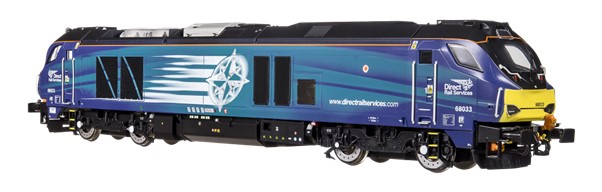
35-125AClass 20/3 20310 'Gresty Bridge' DRS Blue
The British Railways Board's (BRB) 1955 modernisation plan called for a change to alternative forms of traction and manufacturers were asked to produce trial or initial designs for evaluation. English Electric adapted an existing design based on an export model for a 1,000bhp diesel and 20 were built as a pilot scheme for assessment.
The first batch was built in 1957 and the diesels were assigned to work from Devon's Road depot, East London. The design was a success from the start and by 1962 a total of 127 had been built. Following assessment of all the Type 1 diesels, BRB placed a further order increasing the total to 228 by 1968 and the design became the BR standard for 1,000bhp diesel locomotives. With the introduction of TOPS the locomotives were designated Class 20 and renumbered 20001 to 20228. The locomotives were principally designed for freight work but also saw service on summer passenger trains where train heating was not required. The Class 20s worked over the Eastern, London Midland and Scottish regions as well as into Wales and were commonly associated with coal traffic. The only drawback the Class had was its single end cab, unlike modern designs that have a cab at each end. BR resolved this problem by regularly operating the Class 20s as pairs, nose to nose, and with the combined power of 2,000bhp they were able to haul the heavier block freight trains.
BR's decision to switch to Type 5 and in particular Class 60 diesels in the late 1980s started a gradual withdrawal of the fleet, with just 28 left by 1994. A tribute to the design is that after 45 years the Class is still in service with DRS on mainline duties following refurbishment, the resulting locomotives being designated Class 20/3s. At least 28 of the class are now preserved.
35-125BClass 20/3 20311 'Class 20 'Fifty'' DRS Blue
CLASS 20/3 HISTORY
The British Railways Board's (BRB) 1955 modernisation plan called for a change to alternative forms of traction and manufacturers were asked to produce trial or initial designs for evaluation. English Electric adapted an existing design based on an export model for a 1,000bhp diesel and 20 were built as a pilot scheme for assessment.
The first batch was built in 1957 and the diesels were assigned to work from Devon's Road depot, East London. The design was a success from the start and by 1962 a total of 127 had been built. Following assessment of all the Type 1 diesels, BRB placed a further order increasing the total to 228 by 1968 and the design became the BR standard for 1,000bhp diesel locomotives. With the introduction of TOPS the locomotives were designated Class 20 and renumbered 20001 to 20228. The locomotives were principally designed for freight work but also saw service on summer passenger trains where train heating was not required. The Class 20s worked over the Eastern, London Midland and Scottish regions as well as into Wales and were commonly associated with coal traffic. The only drawback the Class had was its single end cab, unlike modern designs that have a cab at each end. BR resolved this problem by regularly operating the Class 20s as pairs, nose to nose, and with the combined power of 2,000bhp they were able to haul the heavier block freight trains.
BR's decision to switch to Type 5 and in particular Class 60 diesels in the late 1980s started a gradual withdrawal of the fleet, with just 28 left by 1994. A tribute to the design is that after 45 years the Class is still in service with DRS on mainline duties following refurbishment, the resulting locomotives being designated Class 20/3s. At least 28 of the class are now preserved.
35-125BSFClass 20/3 20311 'Class 20 'Fifty'' DRS Blue With DCC Sound Fitted
SOUNDS
F0 - Directional Lights - On / Off (plus Light Switch Sound)
F1 - On - Warm Engine Start / On (with F8 On) - Cold Engine Start
F2 - Brake
F3 - Single Horn (Speed Related)
F4 - Two Tone Horn (Speed Related)
F5 - On - Light Train Mode / Off - Heavy Train Mode
F6 - Engine Idle / Coasting
F7 - Speed Lock
F8 - Cold Start
F9 - Flange Squeal (Speed Related)
F10 - Guard's Whistle
F11 - Buffer Up
F12 - Coupling
F13 - Cab End High Intensity Light (If Fitted)
F14 - On - Night Mode Directional Lights / Off - Day Mode Directional lights (If Fitted)
F15 - Detonators
F16 - Priming Pump
F17 - Wagon Snatching & Buffering
F18 - On - Driver's Door Open / Off - Driver's Door Closed
F19 - Fade All Sounds
F20 - Nose End Directional Lights Off
F21 - Cab End Directional Lights Off
F22 - Cab Light On (Only when Stationary)
F23 - Windscreen Wipers
F24 - Compressor
F25 - Spirax Valves
F26 - Shunt Mode
F27 - Volume Down
F28 - Volume Up
Analogue Users: Please note that normal load running sounds and any other automatic or randomised sounds will also operate when this model is used on analogue control (DC) straight from the box!
39-059BR Mk1 TSO Tourist Second Open WCRC Maroon
MODEL FEATURES:
Bachmann Branchline OO Scale
Era 9
Pristine West Coast Railway Company Maroon livery
Running No. 4973
Commonwealth Bogies
Accessory Pack
NEM Coupling Pockets
Close Coupling Mechanism
Length 270mm
39-083BR Mk1 BSK Brake Second Corridor WCRC Maroon
MODEL FEATURES:
Bachmann Branchline OO Scale
Era 9
Pristine West Coast Railway Company Maroon livery
Running No. 99723
Commonwealth Bogies
Accessory Pack
NEM Coupling Pockets
Close Coupling Mechanism
Length 270mm
39-266BR Mk1 RMB Restaurant Miniature Buffet WCRC Maroon
MODEL FEATURES:
Bachmann Branchline OO Scale
Era 9
Pristine West Coast Railway Company Maroon livery
Running No. 1860
Commonwealth Bogies
Accessory Pack
NEM Coupling Pockets
Close Coupling Mechanism
Length 270mm
R30316RailRoad S&DJR, Class 3F 'Jinty', 0-6-0, No. 20
R30325RailRoad S&DJR, Class 3F 'Jinty', 0-6-0, No. 25
R60116Triple Wagon Pack, Houghton Main, Thos. Lebon & Sons & Settle Speakman
392-025Baguley-Drewry 70hp Diesel DH88 RNAD Dean Hill
BAGULEY-DREWRY 70HP DIESEL HISTORY
The seventy horsepower, 4 wheel diesel-hydraulic locomotives were built by Baguley-Drewry in Burton Upon Trent at the start of the 1980s and were some of the final locomotives to be outshopped by the company which closed its doors in 1984. Ordered by the Ministry of Defence for use in the Royal Navy Armaments Depots in Wales at Milford Haven and Trecwn, the fleet was later transferred to Dean Hill in Wiltshire which remained operational until 2004. In 2009, the remaining railway assets were sold off giving the Baguley-Drewrys a second life in preservation or at private railways. Originally built to a gauge of 2ft. 6in., some has since been re-gauged to suit the varying gauges used by the narrow gauge railways that they now call home.
392-026Baguley-Drewry 70hp Diesel Green
BAGULEY-DREWRY 70HP DIESEL HISTORY
The seventy horsepower, 4 wheel diesel-hydraulic locomotives were built by Baguley-Drewry in Burton Upon Trent at the start of the 1980s and were some of the final locomotives to be outshopped by the company which closed its doors in 1984. Ordered by the Ministry of Defence for use in the Royal Navy Armaments Depots in Wales at Milford Haven and Trecwn, the fleet was later transferred to Dean Hill in Wiltshire which remained operational until 2004. In 2009, the remaining railway assets were sold off giving the Baguley-Drewrys a second life in preservation or at private railways. Originally built to a gauge of 2ft. 6in., some has since been re-gauged to suit the varying gauges used by the narrow gauge railways that they now call home.
R30349Hornby Dublo BR, A4 Class, 4-6-2, 60016 'Silver King'
The LNER Gresley A4 is one of the most iconic express locomotives in Great Britain. Its streamlined casing was a classic symbol of the attitude towards speed and design in the 1930s when the railways saw increased competition from road and air travel. The LNER Board knew that they had to make travel between the major cities faster, more comfortable and more reliable.
Nigel Gresley, the LNER's Chief Mechanical Officer, travelled on the Fliegende Hamburger diesel locomotive in Germany and was impressed by its streamlining, although he realized it was only efficient at high speeds. Gresley was certain that a modified A3 Pacific, with streamlining, could haul greater loads than other locomotives at the same speed or faster and a series of trials were conducted to confirm the A3's suitability.
With trials successfully completed, the LNER Board gave Gresley the go-ahead to create the "Silver Jubilee" streamlined trains, the first of the new streamlined A4s. The streamlining of the A4s' steam circuit, higher boiler pressure and extension of the firebox to create a combustion chamber made them more efficient than the A3 as they consumed less coal and water- especially later on when they were also fitted with a Kylchap double chimney. This improved their free steaming capabilities further.
The streamlined design not only improved speeds but it also created an updraught of smoke, obscuring the driver's vision, a major problem on the new Class A4 engines. The story goes that during wind-tunnel testing, after several unsuccessful efforts to get the smoke to lift clear, a thumbprint was inadvertently left on the clay model just behind the chimney. This succeeded in clearing the smoke and was incorporated into the final design.
No. 60016 ‘Silver King’ in its original form as No. 2511 was the third A4 Pacific to be constructed in 1935 and was also designed to haul the new streamlined ‘Silver Jubilee’ coaches. No. 2509 ‘Silver Link’ was named to mark the Silver Jubilee of King George V. Four A4 Pacifics were named with a silver theme in mind. The locomotive entered service in November 1935 in the unique LNER Silver livery designed for the service. The locomotive went on to work under BR as 60016 in a BR green livery before being scrapped in 1965, making it one of the longest-serving A4 locomotives.
Hornby Dublo A4 models feature a die-cast body, just like their original Hornby Dublo counterparts. This is coupled with enchanted decoration which, when paired with the die-cast boiler, provides a realistic finish to the body. The models contain a 5-pole motor with a flywheel and are DCC-ready with an 8-pin socket. The ‘Silver King’ locomotive and tender features a vibrant BR green livery. They also come with crew figures. The accessory bag contains an instruction leaflet, two cylinder draincocks, a wheel/axle assembly, a left-hand driver figure and a fireman figure.
R40238BR InterCity, Mk3 Tourist Standard Open, 42336
R30188RailRoad Plus Loadhaul, Class 37, Co-Co, 37710
The British Rail Class 37 is a diesel-electric locomotive. Also known as the English Electric Type 3, the class was ordered as part of the British Rail modernisation plan.
They were numbered in two series, D6600–D6608 and D6700–D6999.The Class 37 became a familiar sight on many parts of the British Rail network, in particular forming the main motive power for InterCity services in East Anglia and within Scotland. All locomotives would be renumbered from 1973 under the TOPS renumbering system, sometimes multiple times as the exact specification for single locomotives could be changed.
They performed well on secondary and inter-regional services for many years. The Class 37s are known to some railway enthusiasts as 'tractors', a nickname due to the agricultural sound of the diesel engine of the locomotive. A total of 309 of the class would be built with 35 preserved and 66 still in service as of 2023.
Starting out life as D6744, the locomotive would be renumbered twice, both times under the TOPS system. Initially 37044 the locomotive would become 37710. The locomotive would serve with BR Railfreight before being transferred to Loadhaul. Stored for many years in a heavy state of disrepair as a parts donor, the locomotive is currently owned by West Coast Railways although it still wears the Loadhaul livery.