
Search results
 39-430B
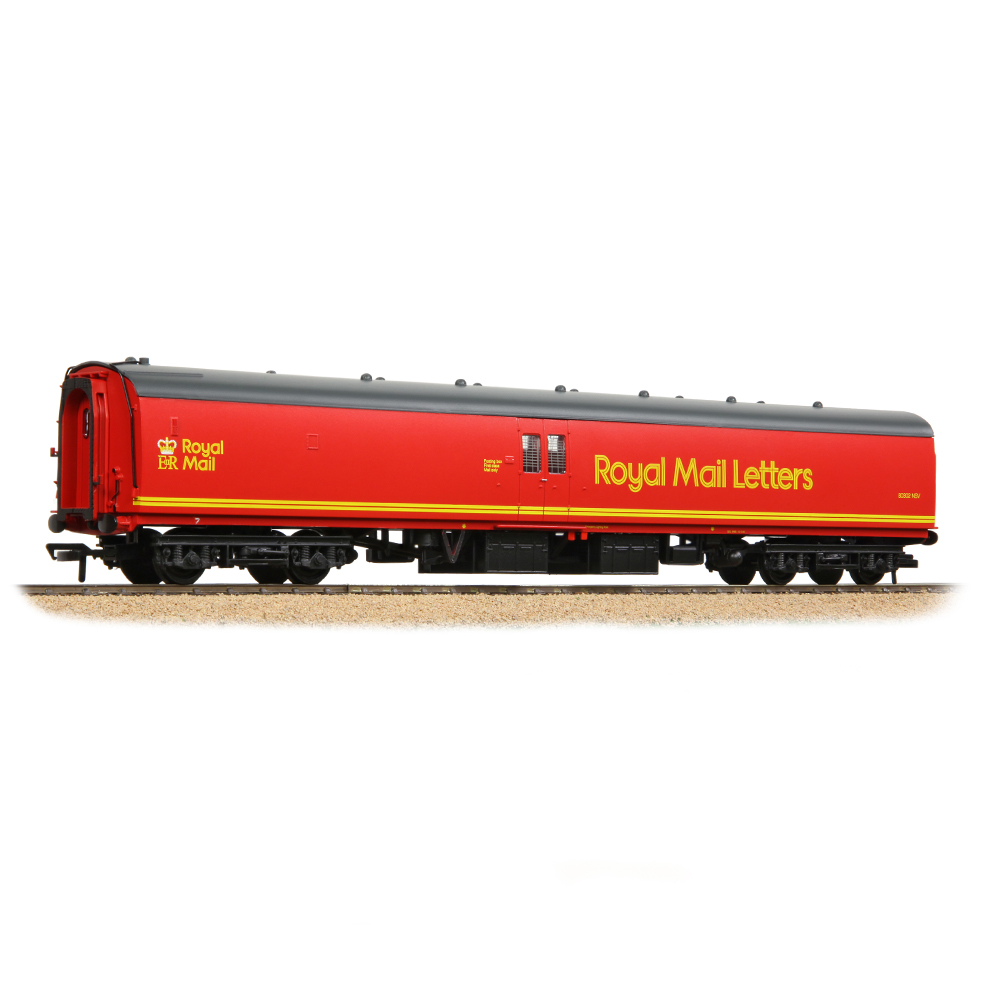
BR Mk1 POS Post Office Sorting Van Royal Mail Letters
 'OO' Gauge
 Released: 18/09/24
 Era 8
Era 8MODEL FEATURES:
Bachmann Branchline OO Scale
Era 8
Pristine Royal Mail Letters livery
Running No. 80302
B4 Bogies
Scallop Roof Ventilators
Accessory Pack
NEM Coupling Pockets
Close Coupling Mechanism
Length 270mm
Our Price:
£62.95
£62.95
 R1287
R1287Tri-ang Railways Remembered: R2X Analogue Train Set
'OO' GaugeReleased: 20/09/24The original Tri-ang Railways R2X Passenger Train Set in ‘00’ gauge was produced by Rovex Scale Models Limited in their Richmond (Surrey) factory in January 1954 and was introduced to the market in a September 1954 trade leaflet. The R2X set can be found listed in the first edition of the Tri-ang Railways 1955 Catalogue.
Sets were contained in the usual Tri-ang Railways packaging of red and yellow. Each set was comprised of a Class 3F ‘Jinty’ No. 47606 locomotive in a BR Black livery, two 7” LMS Crimson passenger coaches, an R42 Speed Control Unit with a forward-off-reverse-switch, an instruction manual sheet and a standard track of 12 curves and 2 straights. The Operating and Maintenance Instructions were pasted to the inside of the box lid as is the case with all vintage Tri-ang sets. Diagrams were also incorporated in the middle of the instruction manual sheet.
Our Tri-ang Railways Remembered Set brings the R2X Set back into your life and those halcyon days can be recreated on a layout. Our train set consists of a Class 3F ‘Jinty’ No. 47606 locomotive, an LMS First Class coach with the running number 7573, an LMS Third Class coach with the running number 27424, 1st radius starter oval, power clip and

Our Price:
£152.99
£152.99
R30286S&DJR, Class 2P, 4-4-0, No. 46
'OO' GaugeReleased: 23/09/24 DCC Ready (8 Pin)Era 2
The LMS 2P class locomotive, designed by Sir Henry Fowler for light passenger work, had its origins in the Midland Railway's 4-4-0 483 Class designed by Samuel Johnson and modified by Richard Deeley. Introduced post-grouping in 1928 the 2Ps dimensions were modified from the 482 class and the boiler mountings reduced.
Between 1928 and 1931, 128 2P locomotives were produced at either Crewe of Derby Locomotive Works. The locomotive layout was a basic and well proven two inside frame cylinder design, characteristic of the Midland Railway's design philosophy.
In addition to being employed by the LMS, three of the locomotives, numbers 44-46 were allocated from new to the Somerset and Dorset Joint Railway (S&DJR) however once the LMS assumed responsibility for the motive power on the line in 1930 they were absorbed into the LMS fleet as numbers 633-635.
Where loads dictated, 2Ps were often run double headed primarily as the LMS had a shortage of larger heavy duty or express locomotives to serve such services.
Typically painted in basic clack livery by the LMS, other colour schemes did prevail. The S&DJR locomotive were painted in Prussian Blue and in later BR days the locomotives were appropriately lined out for mixed traffic working in accordance with British Railway policy.

Our Price:
£139.49
£139.49
 GMI-D01
Infinity Digital SOVEREIGN Model Railway Control Package
Released: 23/09/24DCC ControllerWith Infinity Digital we have ripped up the rule book on what design engineers think a digital system does and built one that does everything modellers think it should do. No more do you need to deliberate between wired and wireless handsets as this digital system comes with a wireless remote out of the box, and that’s just one of its many features.
As standard this system comes with a host of customizable features to run your layout how you want. This controller is designed by modellers for modellers, with operation in mind as well as being elegant to look at. Full control of your digital locomotives and accessories can be achieved with this system which has been built with usability in mind.
The Sovereign base unit can control two handsets connected to it at any one time, but if more operators are needed then you can expand the system by adding a Consort unit. Each Consort allows an additional two handsets to be connected to the system and provides an addition power district. You can connect multiple consorts together, how’s that for easy expansion?

Our Price:
£373.95
£373.95
 371-015F
Class 08 08895 BR Blue
'N' GaugeReleased: 14/10/24DCC Ready (Next18)Era 8The first diesel shunters were pioneered by the LMS which began trialling designs during the 1930s. It soon became apparent that this form of traction offered many advantages over the steam locomotive – the former being ‘ready to use’ as and when required, whereas steam locos had to be kept at the ready even when not required immediately – with the obvious staffing and fuel costs associated with doing so. By the time of Nationalisation in 1948, the LMS had built various shunters and the 12033 series was adopted by BR as the basis for a new standard design of diesel-electric shunting locomotive. As a stop gap whilst the Class 08 was being developed, BR constructed further 12033 series locomotives and these would later be designated as Class 11s.
Production of the 08s began in 1952 with the first example, No. 13000, entering traffic in 1953. Construction continued until 1962 and during the ten year period, 996 locomotives were built making the Class 08 the most numerous of all British locomotive classes. In addition, construction of the near-identical Class 09s (26 examples) and Class 10s (171) took the total well above a thousand – the former differed in having higher gearing whilst the latter had different engines and transmission.

Our Price:
£127.45
£127.45
371-015FSFClass 08 08895 BR Blue With DCC Sound
'N' GaugeReleased: 14/10/24DCC FittedDCC SoundEra 8The Class 08 is a legend of the British Rail Locomotive fleet, and we are delighted to offer this Graham Farish model of the 08 with a new, DCC-compatible chassis, and this example is finished as No. 08895 in BR Blue livery.
N scale modellers running DCC can now quickly and easily add the iconic Class 08 diesel shunter to their fleet with this new Graham Farish model. The highly detailed body is constructed from numerous separate components, including handrails, lamps, lamp brackets and whistle, whilst the chassis features the distinctive outside frames that are synonymous with the 08s along with metal sand pipes and separate brake rigging. As you would expect, the livery application is second to none and is achieved using authentic colours, logos and fonts. Provision for DCC via a Next18 DCC and what’s more, with a pre-fitted speaker adding sound to your model is possible too – or why not opt for a SOUND FITTED model and really bring your layout to life!

Our Price:
£212.45
£212.45
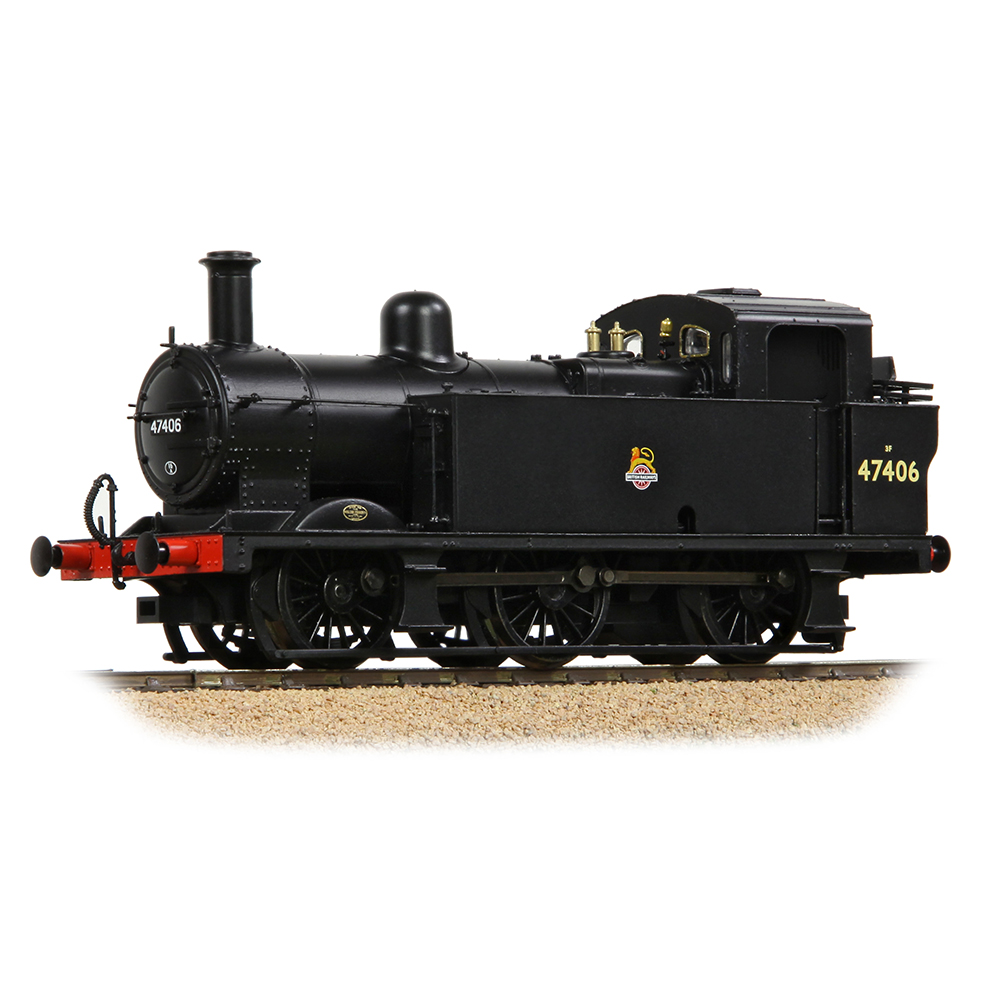
32-231BFowler 3F (Jinty) 47406 BR Black (Early Emblem)
'OO' GaugeReleased: 16/10/24DCC Ready (Next18)Era 4The origins of the ‘Jinty’ can be traced back to the Midland Railway’s Chief Mechanical Engineer (CME) S.W. Johnson and his 2441 Class locomotive. After the formation of the London Midland & Scottish Railway (LMS), Sir Henry Fowler, deputy CME of the LMS at the time, took the 2441 Class design and added a Belpaire firebox and improved cab, creating the ultimate development of the Midland Railway’s six-coupled tank engines. A total of 422 ‘Jinties’ were built from 1924 until 1931 with production spread between the LMS and various sub-contractors. The locomotives were versatile, at home shunting in stations, yards, and exchange sidings as well as on trip workings. They could also be found on passenger services and seven saw service on the Somerset & Dorset Railway until 1930 when they were absorbed back into LMS stock. The entire Class survived to Nationalisation, with the first withdrawals in 1959 brought about by the introduction of new diesel shunters. Soon, more and more locomotives were withdrawn and by 1964 less than half remained in traffic. The final examples were withdrawn in 1967, however nine have been preserved.
Our Price:
£114.70
£114.70
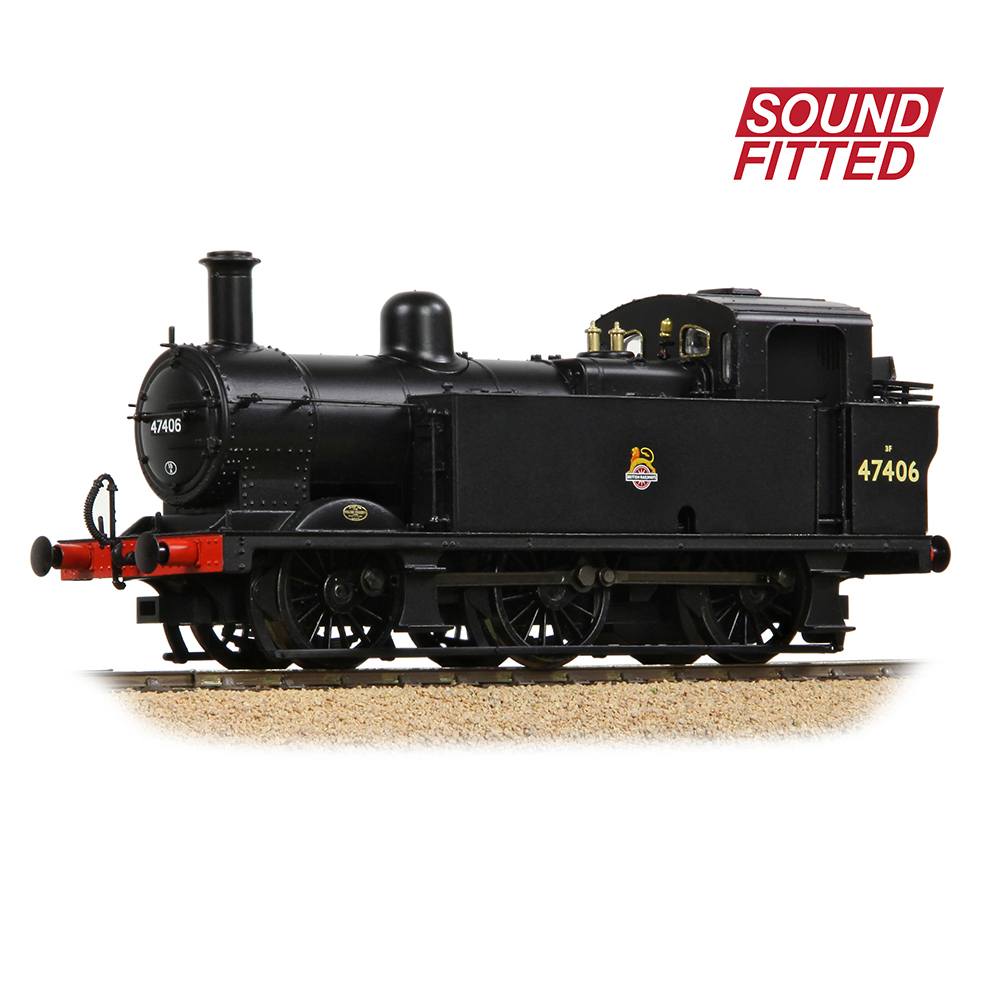
32-234BSFFowler 3F (Jinty) 47406 BR Black (Early Emblem) With DCC Sound
'OO' GaugeReleased: 16/10/24DCC FittedDCC SoundEra 4The ‘Jinty’ is a timeless classic and we are delighted to welcome this LMS workhorse back to the Bachmann Branchline OO scale range with this model of preserved locomotive No. 47406 in BR Black with Early Emblem. Taking advantage of the technical upgrades undertaken to the popular Branchline model a few years ago, the ‘Jinty’ combines a powerful 3 pole motor with a Next18 DCC decoder socket and has space for a speaker for those wishing to add sound – or why not opt for our SOUND FITTED model which has a Speaker and DCC Sound Decoder pre-fitted.
The Bachmann Branchline model combines a chassis that is sure to provide smooth and powerful running and which is detailed with brake blocks, brake rigging, sandboxes and sandpipes, with a high fidelity bodyshell that is mounted to a diecast running plate. The model is adorned with numerous separately-fitted detail parts including the handrails, lamp irons and vacuum pipes, whilst the safety valves are also separate additions and are of metal construction. Inside the cab a detailed boiler back-head can be found, decorated to the same high standard as the exterior of the model with its exquisite livery application using authentic colours, logos and fonts.
Our Price:
£208.20
£208.20
32-232AFowler 3F (Jinty) 47298 BR Black (Late Crest)
'OO' GaugeReleased: 16/10/24DCC Ready (Next18)Era 5The origins of the ‘Jinty’ can be traced back to the Midland Railway’s Chief Mechanical Engineer (CME) S.W. Johnson and his 2441 Class locomotive. After the formation of the London Midland & Scottish Railway (LMS), Sir Henry Fowler, deputy CME of the LMS at the time, took the 2441 Class design and added a Belpaire firebox and improved cab, creating the ultimate development of the Midland Railway’s six-coupled tank engines. A total of 422 ‘Jinties’ were built from 1924 until 1931 with production spread between the LMS and various sub-contractors. The locomotives were versatile, at home shunting in stations, yards, and exchange sidings as well as on trip workings. They could also be found on passenger services and seven saw service on the Somerset & Dorset Railway until 1930 when they were absorbed back into LMS stock. The entire Class survived to Nationalisation, with the first withdrawals in 1959 brought about by the introduction of new diesel shunters. Soon, more and more locomotives were withdrawn and by 1964 less than half remained in traffic. The final examples were withdrawn in 1967, however nine have been preserved.

Our Price:
£114.70
£114.70
37-528EBR 20T Brake Van BR Grey (Early)
'OO' GaugeReleased: 16/10/24Era 4
Our Price:
£34.15
£34.15
37-528FBR 20T Brake Van BR Grey (Early) Weathered
'OO' GaugeReleased: 16/10/24Era 4
Our Price:
£35.95
£35.95
37-532ABR 20T Brake Van BR Bauxite (TOPS)
'OO' GaugeReleased: 16/10/24Era 7
Our Price:
£34.15
£34.15
37-532BBR 20T Brake Van BR Bauxite (TOPS) Weathered
'OO' GaugeReleased: 16/10/24Era 7
Our Price:
£35.95
£35.95
 ACC2753
BR BLUE CLASS 31 - 31402
'OO' GaugeReleased: 01/10/24DCC Ready (21 Pin)Era 7
Our Price:
£169.95
£169.95
39-102CBR Mk1 RU Restaurant Unclassified BR (WR) Chocolate & Cream
'OO' GaugeReleased: 24/10/24Era 5
Our Price:
£53.95
£53.95
39-126HBR Mk1 CK Composite Corridor BR Maroon
'OO' GaugeReleased: 24/10/24Era 5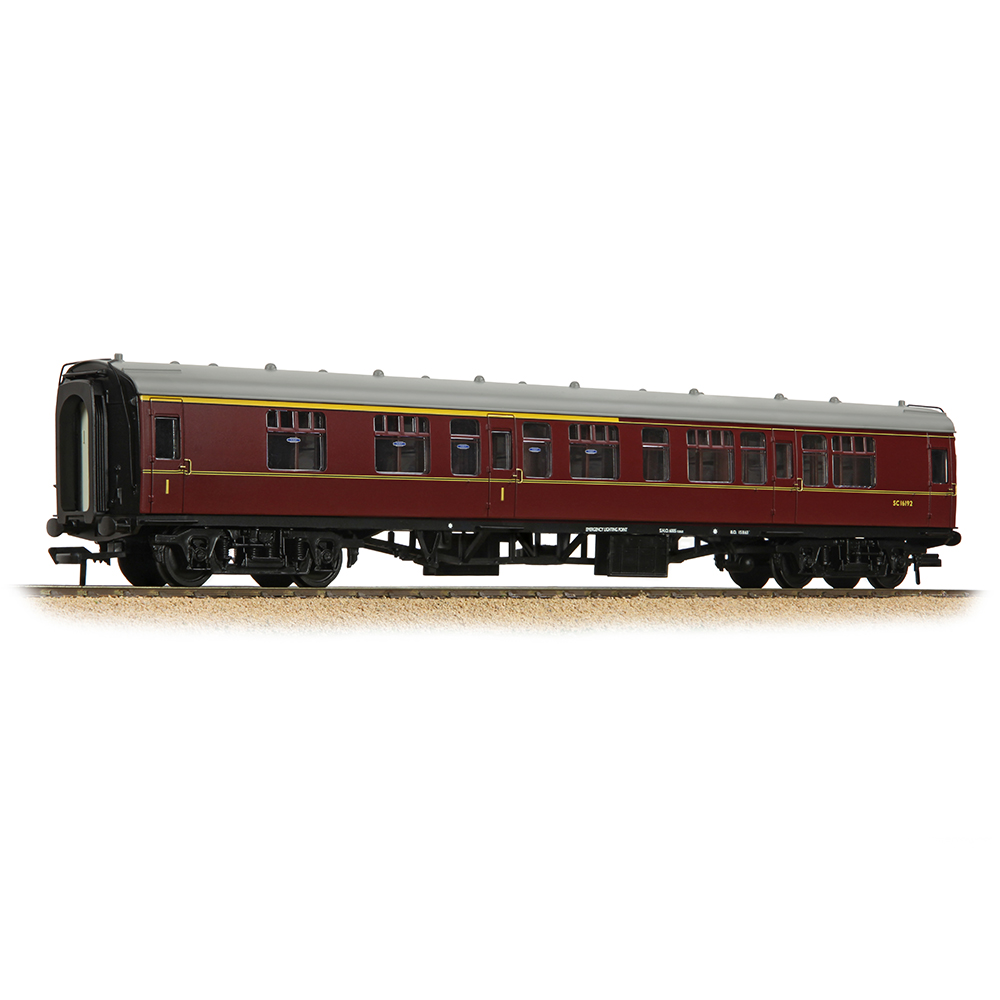
Our Price:
£53.95
£53.95
39-129DBR Mk1 CK Composite Corridor BR (WR) Chocolate & Cream
'OO' GaugeReleased: 24/10/24Era 5
Our Price:
£53.95
£53.95
39-151GBR Mk1 FK First Corridor BR Maroon
'OO' GaugeReleased: 24/10/24Era 5
Our Price:
£53.95
£53.95
39-154DBR Mk1 FK First Corridor BR (WR) Chocolate & Cream
'OO' GaugeReleased: 24/10/24Era 5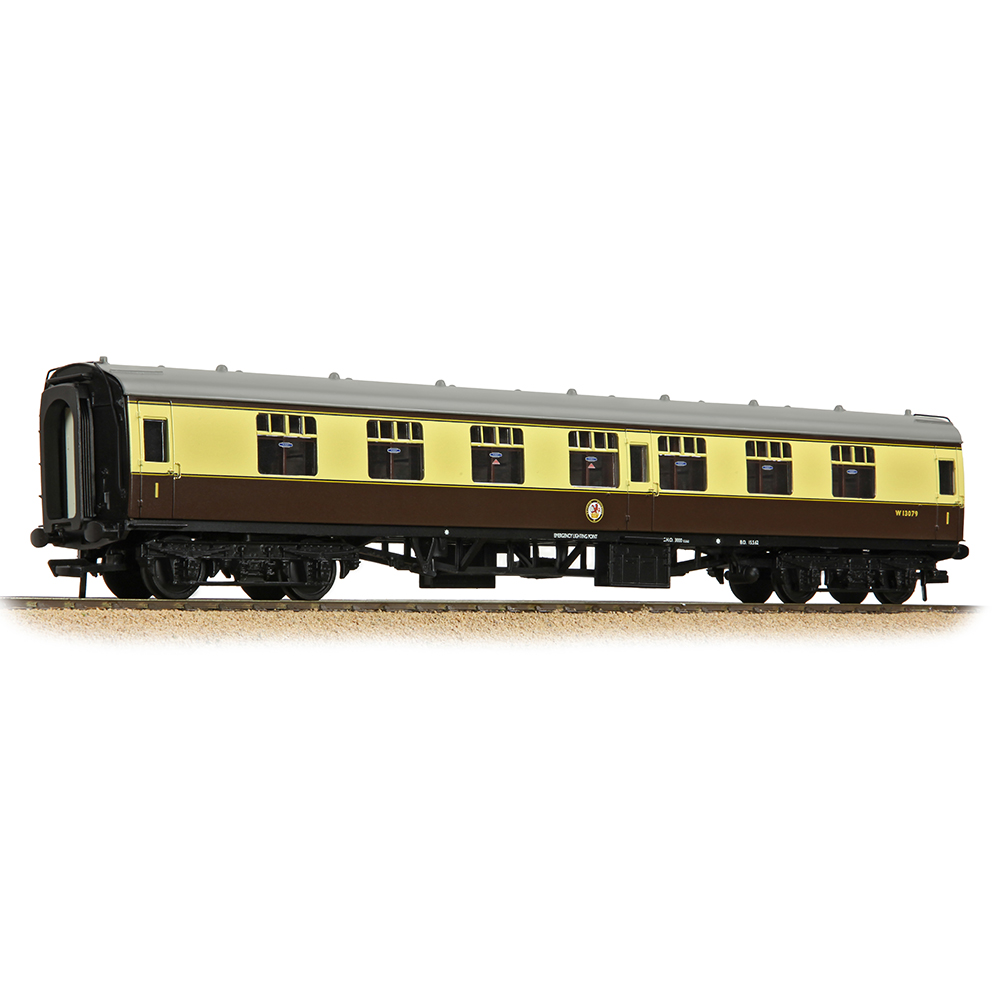
Our Price:
£53.95
£53.95
39-175GBR Mk1 NDV (Ex-BG) Brake Gangwayed BR Blue & Grey
'OO' GaugeReleased: 24/10/24Era 7
Our Price:
£53.95
£53.95