
Search results
 35-411
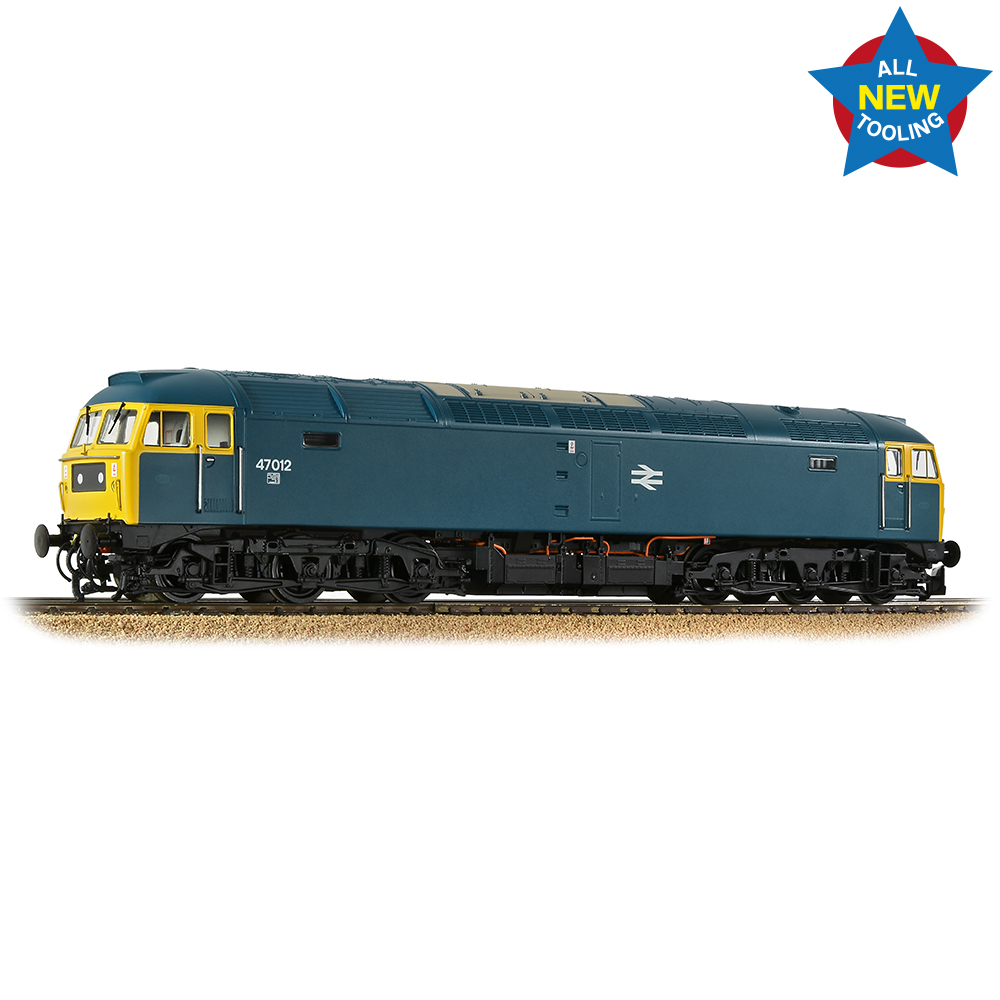
Class 47/0 47012 BR Blue
 'OO' Gauge
 Released: 13/12/21
 DCC Ready (PluX22)
 Era 7
Era 7CLASS 47 HISTORY
Towards the end of the 1950s, British Railways began planning a new fleet of diesel locomotives and after investigating several prototypes, BR decided to place an order with Brush Engineering for 20 locomotives during February 1961. The resulting design became the iconic Brush Type 4 Diesel locomotive, a practical, versatile design with a very distinctive cab. Powered with a Sulzer engine and initially rated at 2,750hp, the locomotive could achieve a top speed of 75mph with a tractive effort of 55,000lb. Building commenced in January 1962 and the first locomotive No. D1500 appeared in late September of the same year with test runs on the London Midland Region and Western Region. The design was a success and BR went on to order a total of 512 with continuous production through to early 1967, forming the largest single class of main-line diesel locomotives in the UK.
During this time and subsequent years, several variations appeared with an increase in speed and tractive effort to 95mph and 62,000lb respectively. Originally fitted with four character train reporting head-codes, these changed to marker lights, with the addition of high intensity lights and roof aerials in the late 1980s. Other variations involved the fitting of different types of steam heating boiler for early BR coaching stock, later replaced with electric train heating for use with modern rolling stock. The numbering system started with four figures but changed to five with the introduction of the TOPS coding system which saw the locomotives classified as Class 47 Diesels with variations such as 47/0, 47/2, 47/3, 47/4 and 47/7. By the end of the 1990s, half of the Class 47 fleet had been withdrawn or scrapped, 33 have been converted into Class 57 locomotives and several have been preserved, including the original No. D1500, now numbered 47401.
Our Price: £203.95
Bargain Price:
£179.95
£179.95
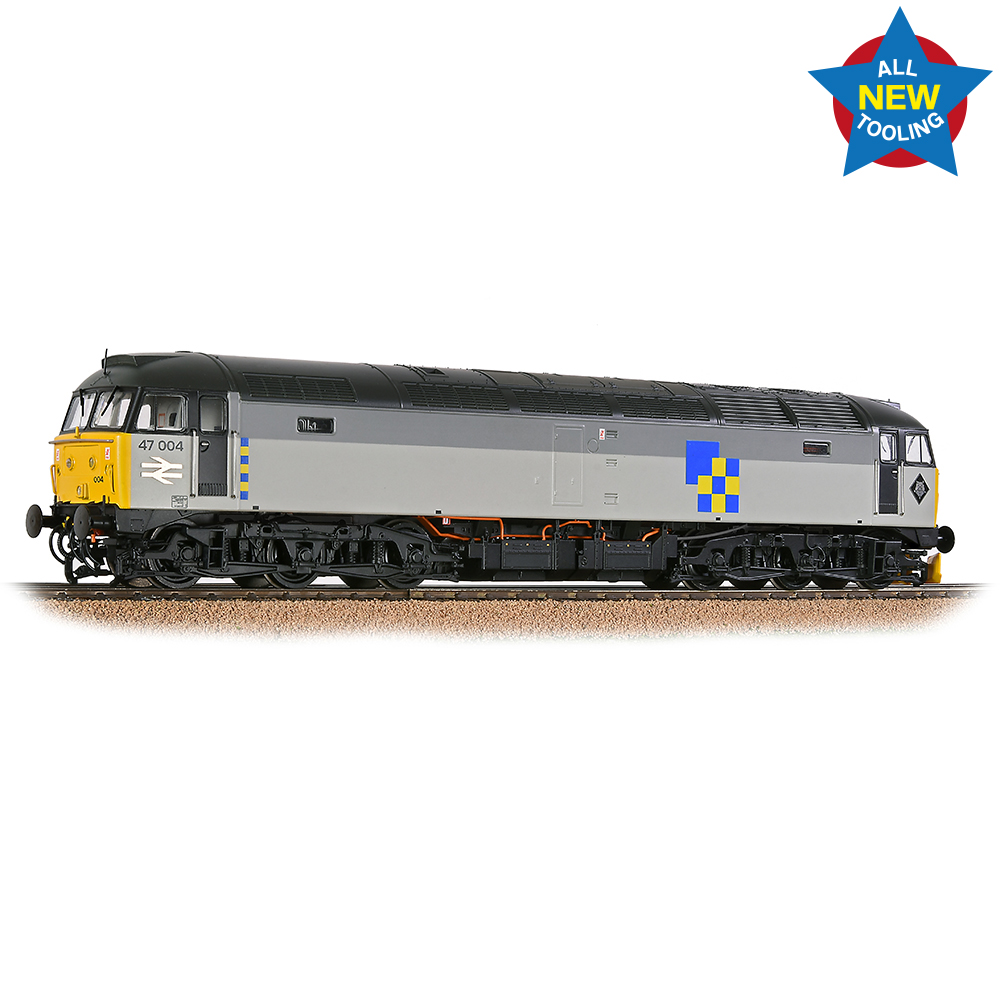
35-418Class 47/0 47004 BR Railfreight Construction Sector
'OO' GaugeReleased: 13/12/21DCC Ready (PluX22)Era 8CLASS 47 HISTORY
Towards the end of the 1950s, British Railways began planning a new fleet of diesel locomotives and after investigating several prototypes, BR decided to place an order with Brush Engineering for 20 locomotives during February 1961. The resulting design became the iconic Brush Type 4 Diesel locomotive, a practical, versatile design with a very distinctive cab. Powered with a Sulzer engine and initially rated at 2,750hp, the locomotive could achieve a top speed of 75mph with a tractive effort of 55,000lb. Building commenced in January 1962 and the first locomotive No. D1500 appeared in late September of the same year with test runs on the London Midland Region and Western Region. The design was a success and BR went on to order a total of 512 with continuous production through to early 1967, forming the largest single class of main-line diesel locomotives in the UK.
During this time and subsequent years, several variations appeared with an increase in speed and tractive effort to 95mph and 62,000lb respectively. Originally fitted with four character train reporting head-codes, these changed to marker lights, with the addition of high intensity lights and roof aerials in the late 1980s. Other variations involved the fitting of different types of steam heating boiler for early BR coaching stock, later replaced with electric train heating for use with modern rolling stock. The numbering system started with four figures but changed to five with the introduction of the TOPS coding system which saw the locomotives classified as Class 47 Diesels with variations such as 47/0, 47/2, 47/3, 47/4 and 47/7. By the end of the 1990s, half of the Class 47 fleet had been withdrawn or scrapped, 33 have been converted into Class 57 locomotives and several have been preserved, including the original No. D1500, now numbered 47401.
Our Price:
£203.95
£203.95
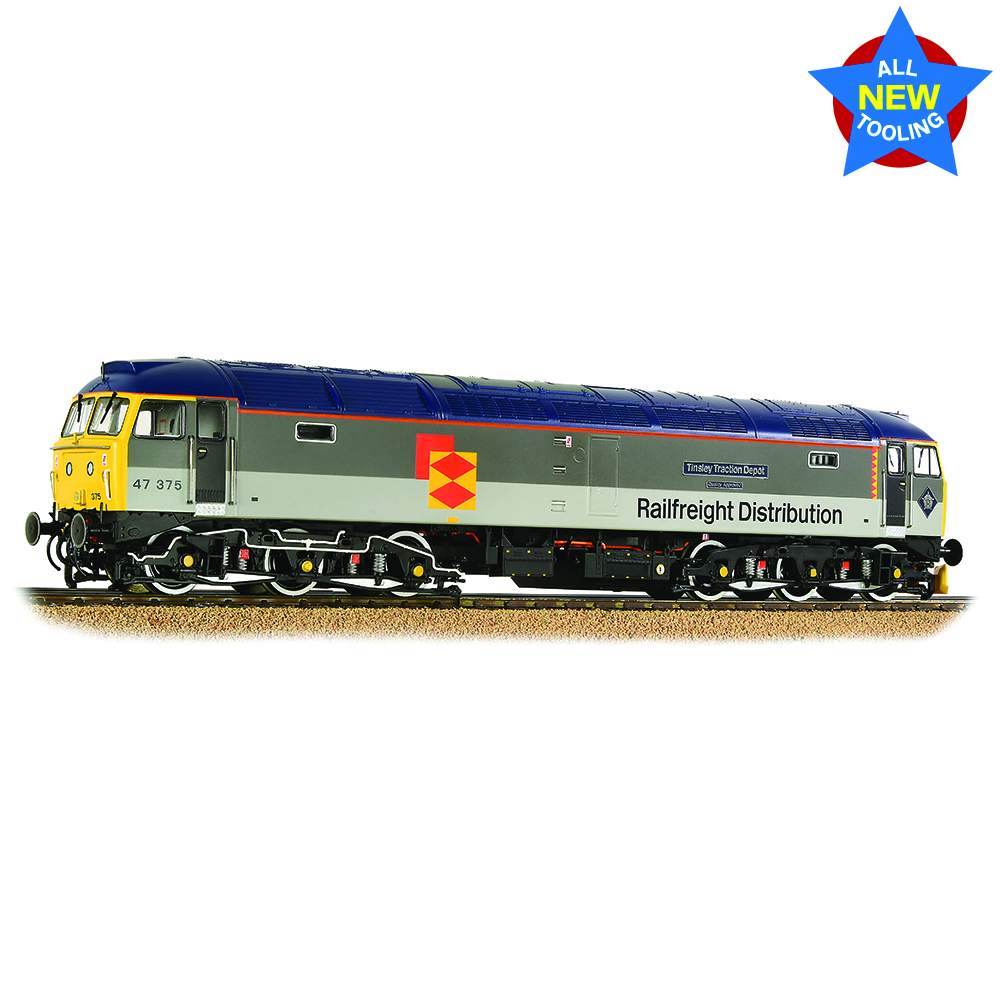
35-419Class 47/3 47375 'Tinsley Traction Depot' BR RF Distribution European
'OO' GaugeReleased: 13/12/21DCC Ready (PluX22)Era 8CLASS 47 HISTORY
Towards the end of the 1950s, British Railways began planning a new fleet of diesel locomotives and after investigating several prototypes, BR decided to place an order with Brush Engineering for 20 locomotives during February 1961. The resulting design became the iconic Brush Type 4 Diesel locomotive, a practical, versatile design with a very distinctive cab. Powered with a Sulzer engine and initially rated at 2,750hp, the locomotive could achieve a top speed of 75mph with a tractive effort of 55,000lb. Building commenced in January 1962 and the first locomotive No. D1500 appeared in late September of the same year with test runs on the London Midland Region and Western Region. The design was a success and BR went on to order a total of 512 with continuous production through to early 1967, forming the largest single class of main-line diesel locomotives in the UK.
During this time and subsequent years, several variations appeared with an increase in speed and tractive effort to 95mph and 62,000lb respectively. Originally fitted with four character train reporting head-codes, these changed to marker lights, with the addition of high intensity lights and roof aerials in the late 1980s. Other variations involved the fitting of different types of steam heating boiler for early BR coaching stock, later replaced with electric train heating for use with modern rolling stock. The numbering system started with four figures but changed to five with the introduction of the TOPS coding system which saw the locomotives classified as Class 47 Diesels with variations such as 47/0, 47/2, 47/3, 47/4 and 47/7. By the end of the 1990s, half of the Class 47 fleet had been withdrawn or scrapped, 33 have been converted into Class 57 locomotives and several have been preserved, including the original No. D1500, now numbered 47401.
Our Price: £203.95
Bargain Price:
£179.95
£179.95
 R30026
 GBRF, Class 60, Co-Co, 60026
'OO' GaugeReleased: 10/01/22DCC Ready (8 Pin)Era 11The last mainline diesel locomotive type built for British Rail, the Class 60 arose from the arrival, and subsequent success, of the Class 59 locomotive. With a haulage capacity and reliability superior to the Class 31, 37 and 47 locomotives in sector service at the time, Trainload Petroleum, Metals, Construction and Coal were prompted to lobby for a new UK designed locomotive to match it. British Rail Board eventually secured the necessary treasury funding and following a difficult procurement process, the contract was finally awarded to Brush Electrical Machines of Loughborough on May 17, 1988 for 100 locomotives. Brush's design incorporated many features from the Class 59's specification, as well as their own Sepex traction control system, tested on the Class 58, to improve adhesion.
The Class 60s were geared for a maximum speed of 62 mph, the power units being eight cylinder, 145 litre Blackstone 8MB275T diesel traction engines built by Mirrlees at their Stockport works, delivering a maximum power output of 3,100hp at 1000rpm. The bodyshell, shared with the Class 92 locomotives, was of a monocoque, stressed skin construction with diagonal trusses, the external bodywork providing support for the internal components and all were built by Procor (UK) of Wakefield. The first locomotive was handed over to Railfreight on time, in June 1989, but extensive teething problems (many involving computer software), meant that it took sixteen months before the first of the Class were accepted and nearly four years to introduce all 100 of the Class 60 locomotives to service. By the time the Class 60 fleet entered service, Trainload's Sector businesses had given way to 'shadow' privatisation and the formation, in 1994, of Loadhaul, Transrail and Mainline Freight with the Class 60 fleet split equally between them. English, Welsh and Scottish Railway bought the whole Class 60 fleet as part of British Railway's privatisation, reallocating the entire Class 60 fleet to Toton as a cost cutting measure and to pool common parts.
By 2003/4, a number of locomotives were stored as surplus to operational requirements. In 2007 EWS became part of DB Schenker and at the end of October 2010, the entire Class 60 fleet was mothballed, with the exception of 60040 The Territorial Army Centenary and 60074 Teenage Cancer Trust. By the end of 2011, two more locomotives were returned to service, followed by an announcement that 21 further Class 60s were to be overhauled in 2012, this being completed by the end of 2013. Since then, the fortunes of the Class 60 Fleet have ebbed and flowed, with locomotives being sold, re-sold and leased, but in 2019 the majority of locomotives are owned by DB Cargo (UK), with Beacon Rail and GBRf also owning vehicles. Of the 100 locomotives in operation, 71 are in storage; DB Cargo (UK) preferring to rotate its operational Class 60s, with around fourteen being in service at any one time.
Following their acquisition of ten Class 66 locomotives from DB Cargo and a further sixteen Class 56 locomotives, in June 2018 GBRf continued the expansion of their heavy rail fleet by reaching an agreement with Colas Rail to take over the operation of that company's fleet of ten Class 60 units. On 2 October 2019, in partnership with Beacon Rail Leasing, GBRf released the newly named 60026 Helvellyn into traffic wearing Beacon Rail's Royal Blue livery, with GBRf branding. 60026 was named Helvellyn after one of the original Class 44 Peak locomotives and the style of the locomotive's new nameplate reflected that heritage.

Our Price:
£206.09
£206.09
R4970InterCity APT-U Ex-TS Development Vehicle, Sc48204/977527
'OO' GaugeReleased: 13/01/22Era 7In mid-1984, TS Sc48204 was withdrawn from Set 370 004 and was sent to the Engineering Development Unit (EDU) at Derby RTC for conversion to an APT-U test vehicle, with extensive rebuilding of the underframe being undertaken in order to incorporate tilting double bogies based on the BT12 units.Following the completion of the vehicle some static testing was undertaken at Derby, as well as dynamic testing on the West Coast Mainline in an APT formation, where the coach was inserted between the TBF and NDM vehicles. The APT-U project evolved into the IC140 project which, once tilt was dropped from the specifications, became the IC225 Class 91/Mk IV rollout on the East Coast Mainline.Renumbered as 977527 in Departmental use, the coach seems to have retained 48204 while testing, the number being painted out once it had been withdrawn from the APT dynamic testing some time during mid-1989. Stored at the RTC yard in Derby, the vehicle was finally scrapped in October 1989.

Our Price:
£49.49
£49.49
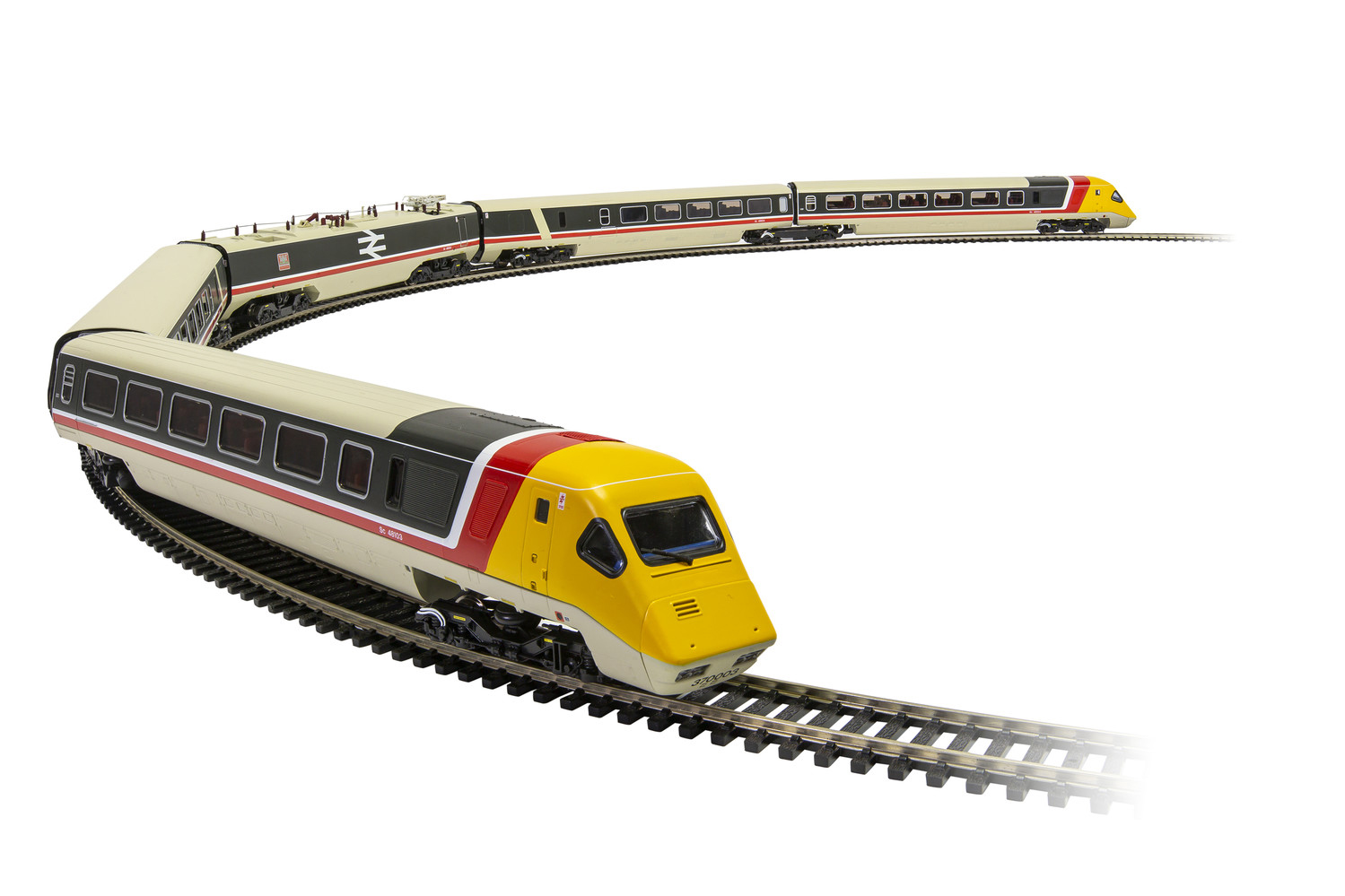
R3873BR, Class 370 Advanced Passenger Train, Sets 370 003 and 370 004, 5-car pack
'OO' GaugeReleased: 21/01/22DCC Ready (8 Pin)Era 7British Rail Class 370 Advanced Passenger Train 5-car Pack Set 370 003 comprising DTS Sc48103, TBF Sc48603 and NDM Sc49003 City of Derby, along with Set 370 004 comprising TBF Sc48604 and DTS Sc48104. By the end of 1970 the British Rail Board began considering the third design phase of the Advanced Passenger Train; the prototype for the full production trains that would incorporate the technology of the APT-E in a practical application.
From the outset the pre-production APT project, or APT-P, was considered to be nothing more than a proving prototype for evaluation, prior to the finalized Advance Passenger Train design being authorized for squadron service; the APT-S. Having settled on electric traction for the production APT, the West Coast main line between Euston and Glasgow was the obvious route for conducting testing, being electrified along its length and with some severe curves that curtailed high speed travel. The date for commencement of services was set for 1977 and the Chief Mechanical and Electrical Engineers' Department (CM&EE) design engineers began work in October 1973. In a move similar to the current situation of the DfT defining design specifications, it was the passenger business of British Rail that decided upon the original configuration for the APT-P. Each set was to comprise fourteen cars, with the two power cars marshalled at the outer ends of the sets.
It soon became clear that the use of two pantographs, one on each power car, was unsuitable for the OHP wires in place at that time and the use of two power cars in the middle of the train became the only option, effectively cutting the train in half. This created two 1+6 formations of DTS, TS, TRBS, TU, TF, TBF and NDM (Non-Driving Motor), through which passengers could not pass due to the high magnetic fields generated by the electrical equipment contained in the NDM. The NDM was the first vehicle completed for testing in June 1977 and it spent a year on static tests at RTC Derby, as well as dynamic tests on the WCML with a spare HST Power Car from September 1977.
In mid-1978 the power car was joined by the rest of the first half set for testing on the WCML and was unveiled to the press on June 7th but, hampered by industrial action, it was to be February 1979 before various formations of the full train were marshalled to test different aspects of the train. At the end of the year on December 20, 1979, a new rail speed record of 162.2mph was achieved and by March 1980 all three APT-P trains were delivered and ready for mileage accumulation on the WCML.
Having finally achieved full route clearance and with testing indicating that all was progressing to plan, shadow passenger service was set to commence on June 9, 1980 with a daily Glasgow/London return service. A demonstration run on April 18th with a 1+9 set was meant to usher in a new era of high speed rail travel, but a derailment caused by a faulty articulated bogie signaled the beginning of the APT 'jinx' and the postponement of passenger introduction. Wheelsets had to be rebuilt across the fleet and reliability problems with the tilt, transmission and braking systems were also exacerbated by the mediocre ride quality. It was also found that failure of the tilting mechanism could result in the APT exceeding its kinematic envelope and potentially coming into contact with an APT travelling in the opposite direction.
It was to be Spring 1981 before main line testing could resume and by now media and public opinion was turning against the project, with some individuals in Government and within the British Railways Board expressing their discontent as well. Entering public service on December 7, 1981 at first all went well, but very cold weather in Scotland on December 9th and again on December 11th resulted in the brakes freezing and the APT being taken out of traffic until the summer of 1982. A year of technical R&D project running followed, before limited passenger running took place across 1983/84 to assess passenger comfort using the full 2+12 sets between London Euston and Glasgow, culminating in a new time and speed record for the 401 mile trip of three hours and fifty-two minutes; an average speed of 103mph.
Far exceeding its budget, APT-P had now effectively reached the end of its development program. Although a number of plans had been suggested for the implementation of APT in service, in a number of formations and with varying traction options, the APT-S, APT-R, APT-T, APT-U and APT-V projects never materialized. The fleet of six sets had been reduced since March 1983, parts being canonicalized to keep the remaining vehicles running and at the end of May 1985 the APT-P was withdrawn from service, with the Intercity Development Train (APT-D) continuing until December 1986.
Our Price:
£430.19
£430.19
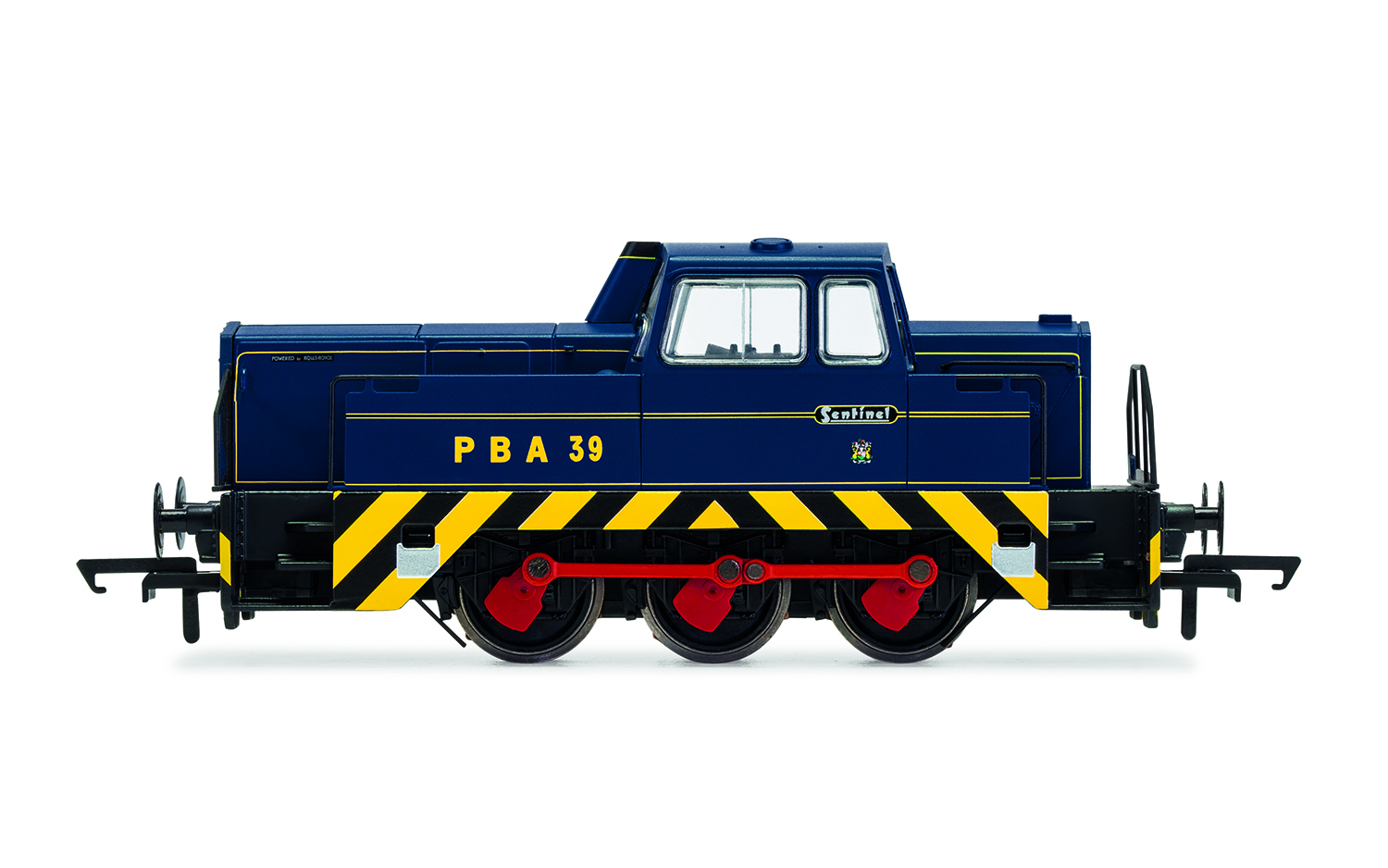
R30083Port of Bristol Authority, Sentinel, 0-6-0, 39
'OO' GaugeReleased: 09/02/22DCC Ready (6 Pin)Era 5Sentinel 10218 was built for the Port of Bristol Authority, becoming PBA locomotive No. 39 and remaining at Avonmouth Docks until 1984. Moving to the Dean Forest Railway for preservation, and then the East Somerset Railway in 1999, 10218 received a large overhaul in 2011, restored to full working condition and painted in its original Oxford Blue PBA livery.
Our Price:
£98.10
£98.10
32-613SFClass 90 90026 BR InterCity (Mainline) DCC Sound Fitted
'OO' GaugeReleased: 10/02/22DCC FittedDCC SoundEra 8F0 - Directional Lights - On/Off (plus Light Switch Sound)
F1 - Sound - On/Off (plus Battery Switch and Compressor Sounds)
F2 - Brake
F3 - Low Horn (Playable)
F4 - Two-Tone Horn
F5 - Parking Brake On/Off (Loco won’t move with Parking Brake On)
F6 - On - Pantograph Up / Off - Pantograph Down (with Sounds)
F7 - Flange Squeal (Speed Related)
F8 - Windscreen Wipers
F9 - Air Dump
F10 - On - Guard’s Whistle / Off - Driver’s Response
F11 - Spirax Valve
F12 - On - Pantograph Up (Sounds Only) / Off - Pantograph Down (Sounds Only)
F13 - AWS
F14 - Directional Lights - On - Day Mode / Off - Night Mode
F15 - Cab Lights - On/Off (Direction Dependent)
F16 - Coupling Up
F17 - Uncoupling
F18 - On - Cab Door Open / Off - Cab Door Shut
F19 - Uncoupling Movement Cycle
F20 - Directional Lights Off (Non-Pantograph End)
F21 - Directional Lights Off (Pantograph End)
F22 - Fire Alarm Test
F23 - Volume Control (6 levels)
Analogue Users: Please note that any automated drive sounds will be played when this model is used on analogue control (DC) straight from the box!
CLASS 90 HISTORY
Fifty Class 90 locomotives were ordered by British Rail in 1986 to replace the ageing Class 85 fleet on West Coast Main Line duties, whilst also allowing BR to cascade a number of Class 86s to East Anglia. Constructed at British Rail Engineering Limited, Crewe, the new locomotives were initially classified as 87/2s however this was soon changed to Class 90 as the design featured a completely new body-shell – although much of the technology within was shared with the Class 87s.
Construction of the 110mph rated locomotives was completed in 1990 and the fleet was split between different sectors of British Rail – 15 were allocated to InterCity services, five for Rail Express Systems (mail and parcels traffic) and the remaining 30 for Railfreight Distribution. Most of those allocated to Railfreight Distribution would later be downgraded to 75mph and reclassified as 90/1s numbered in the 901xx series following work to isolate the Electric Train Heating and push-pull equipment making them dedicated freight locos.
Upon privatisation the Class 90 fleet was split between Virgin Trains, EWS and Freightliner. By 1999 all of the Class 90/1s acquired by EWS had been converted back to 90/0s due to an increased requirement for passenger locomotives to work contracted ScotRail sleeper trains and for hire to GNER for East Coast Main Line services. Further renumbering by EWS occurred when nine locos were fitted with different brake blocks and these became Class 90/2s numbered in the 902xx series. The Freightliner locos were also converted back to their original specification in the early 2000s.
The Class 90s have carried numerous liveries including three decorated in European liveries for the Freightconnection event in 1992 which coincided with the opening of the Channel Tunnel to freight services. No. 90128 was decorated in SNCB turquoise (Belgium), No. 90129 in DB red (Germany) and No. 90130 in SNCF orange and grey (France) and each carried the name Freightconnection in their respective languages, alongside No. 90022 which was named ‘Freightconnection’ and carried Railfreight Distribution livery.
The majority of the Class have carried names whilst in service and the 90s have appeared a variety of other post-Privatisation liveries such as GNER, DB Schenker, First ScotRail, One (Anglia), Greater Anglia, National Express, DRS and Malcolm Logistics. Today, Class 90s remain in operation with Freightliner, DB Cargo UK (ex-EWS/DB Schenker) and most recently Locomotive Services which has acquired Nos. 90001 and 90002 and repainted them into InterCity Swallow livery for use on charters and excursions.

Our Price:
£280.45
£280.45
32-620SFClass 90 90048 Freightliner Grey [W] DCC Sound Fitted
'OO' GaugeReleased: 10/02/22DCC FittedDCC SoundEra 9F0 - Directional Lights - On/Off (plus Light Switch Sound)
F1 - Sound - On/Off (plus Battery Switch and Compressor Sounds)
F2 - Brake
F3 - Low Horn (Playable)
F4 - Two-Tone Horn
F5 - Parking Brake On/Off (Loco won’t move with Parking Brake On)
F6 - On - Pantograph Up / Off - Pantograph Down (with Sounds)
F7 - Flange Squeal (Speed Related)
F8 - Windscreen Wipers
F9 - Air Dump
F10 - On - Guard’s Whistle / Off - Driver’s Response
F11 - Spirax Valve
F12 - On - Pantograph Up (Sounds Only) / Off - Pantograph Down (Sounds Only)
F13 - AWS
F14 - Directional Lights - On - Day Mode / Off - Night Mode
F15 - Cab Lights - On/Off (Direction Dependent)
F16 - Coupling Up
F17 - Uncoupling
F18 - On - Cab Door Open / Off - Cab Door Shut
F19 - Uncoupling Movement Cycle
F20 - Directional Lights Off (Non-Pantograph End)
F21 - Directional Lights Off (Pantograph End)
F22 - Fire Alarm Test
F23 - Volume Control (6 levels)
Analogue Users: Please note that any automated drive sounds will be played when this model is used on analogue control (DC) straight from the box!
CLASS 90 HISTORY
Fifty Class 90 locomotives were ordered by British Rail in 1986 to replace the ageing Class 85 fleet on West Coast Main Line duties, whilst also allowing BR to cascade a number of Class 86s to East Anglia. Constructed at British Rail Engineering Limited, Crewe, the new locomotives were initially classified as 87/2s however this was soon changed to Class 90 as the design featured a completely new body-shell – although much of the technology within was shared with the Class 87s.
Construction of the 110mph rated locomotives was completed in 1990 and the fleet was split between different sectors of British Rail – 15 were allocated to InterCity services, five for Rail Express Systems (mail and parcels traffic) and the remaining 30 for Railfreight Distribution. Most of those allocated to Railfreight Distribution would later be downgraded to 75mph and reclassified as 90/1s numbered in the 901xx series following work to isolate the Electric Train Heating and push-pull equipment making them dedicated freight locos.
Upon privatisation the Class 90 fleet was split between Virgin Trains, EWS and Freightliner. By 1999 all of the Class 90/1s acquired by EWS had been converted back to 90/0s due to an increased requirement for passenger locomotives to work contracted ScotRail sleeper trains and for hire to GNER for East Coast Main Line services. Further renumbering by EWS occurred when nine locos were fitted with different brake blocks and these became Class 90/2s numbered in the 902xx series. The Freightliner locos were also converted back to their original specification in the early 2000s.
The Class 90s have carried numerous liveries including three decorated in European liveries for the Freightconnection event in 1992 which coincided with the opening of the Channel Tunnel to freight services. No. 90128 was decorated in SNCB turquoise (Belgium), No. 90129 in DB red (Germany) and No. 90130 in SNCF orange and grey (France) and each carried the name Freightconnection in their respective languages, alongside No. 90022 which was named ‘Freightconnection’ and carried Railfreight Distribution livery.
The majority of the Class have carried names whilst in service and the 90s have appeared a variety of other post-Privatisation liveries such as GNER, DB Schenker, First ScotRail, One (Anglia), Greater Anglia, National Express, DRS and Malcolm Logistics. Today, Class 90s remain in operation with Freightliner, DB Cargo UK (ex-EWS/DB Schenker) and most recently Locomotive Services which has acquired Nos. 90001 and 90002 and repainted them into InterCity Swallow livery for use on charters and excursions.

Our Price:
£280.45
£280.45
33-856E30T Bogie Bolster BR Grey (Early) [W]
'OO' GaugeReleased: 10/02/22Era 4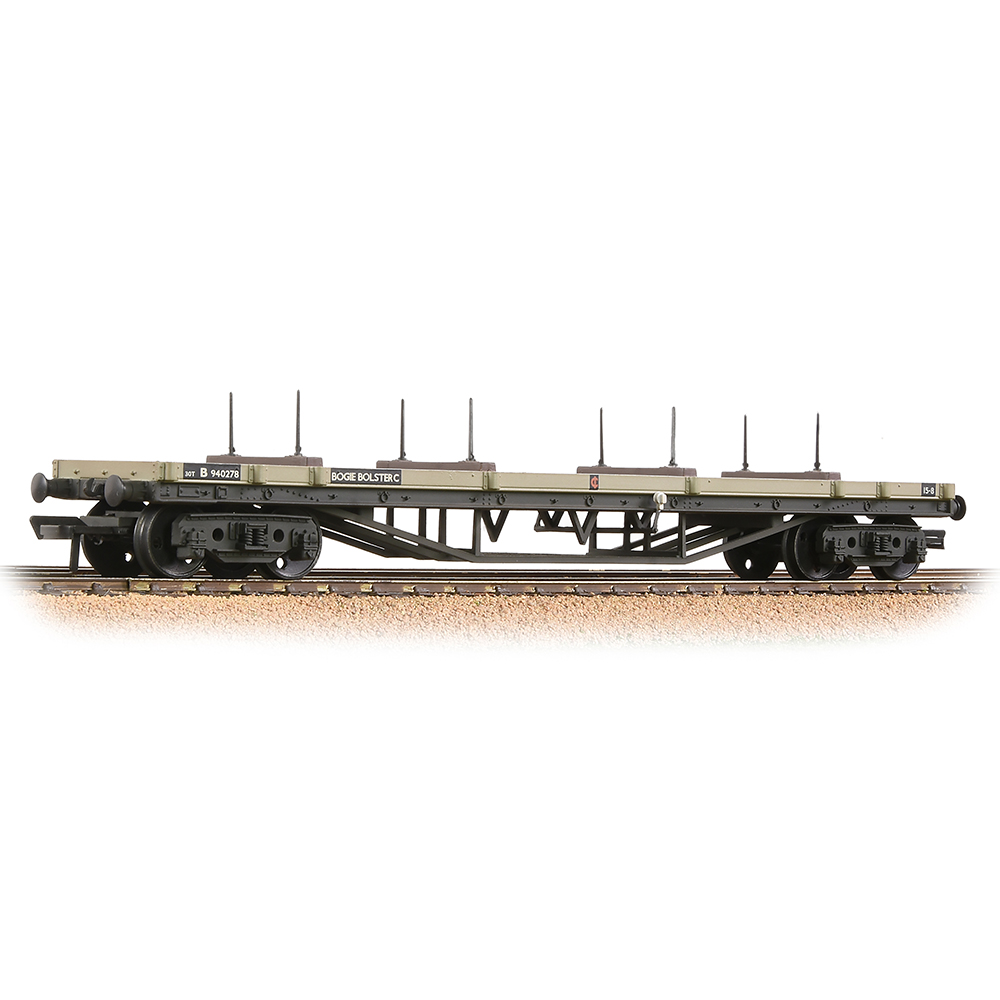
Our Price:
£30.55
£30.55
33-927A30T Bogie Bolster GWR Grey [WL]
'OO' GaugeReleased: 10/02/22Era 3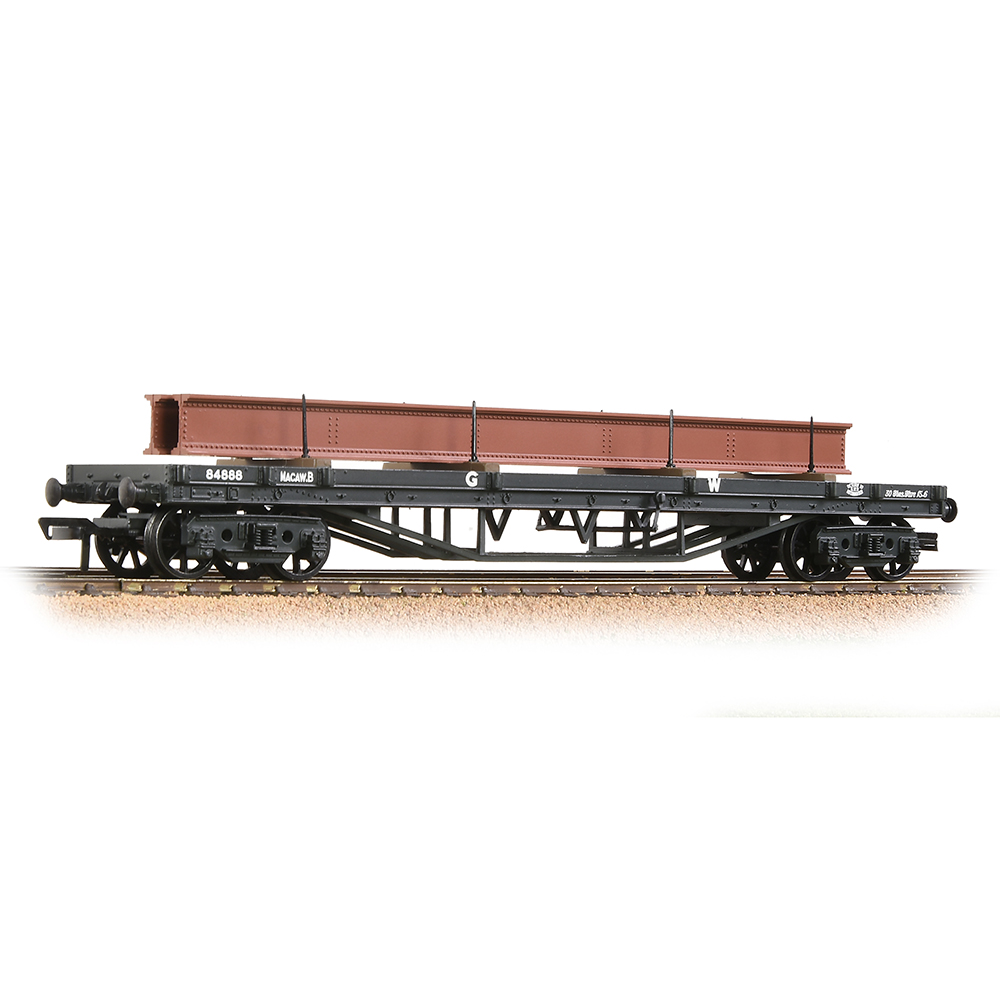
Our Price:
£28.75
£28.75
33-929C30T Bogie Bolster BR Grey (Early) [WL]
'OO' GaugeReleased: 10/02/22Era 4
Our Price:
£28.75
£28.75
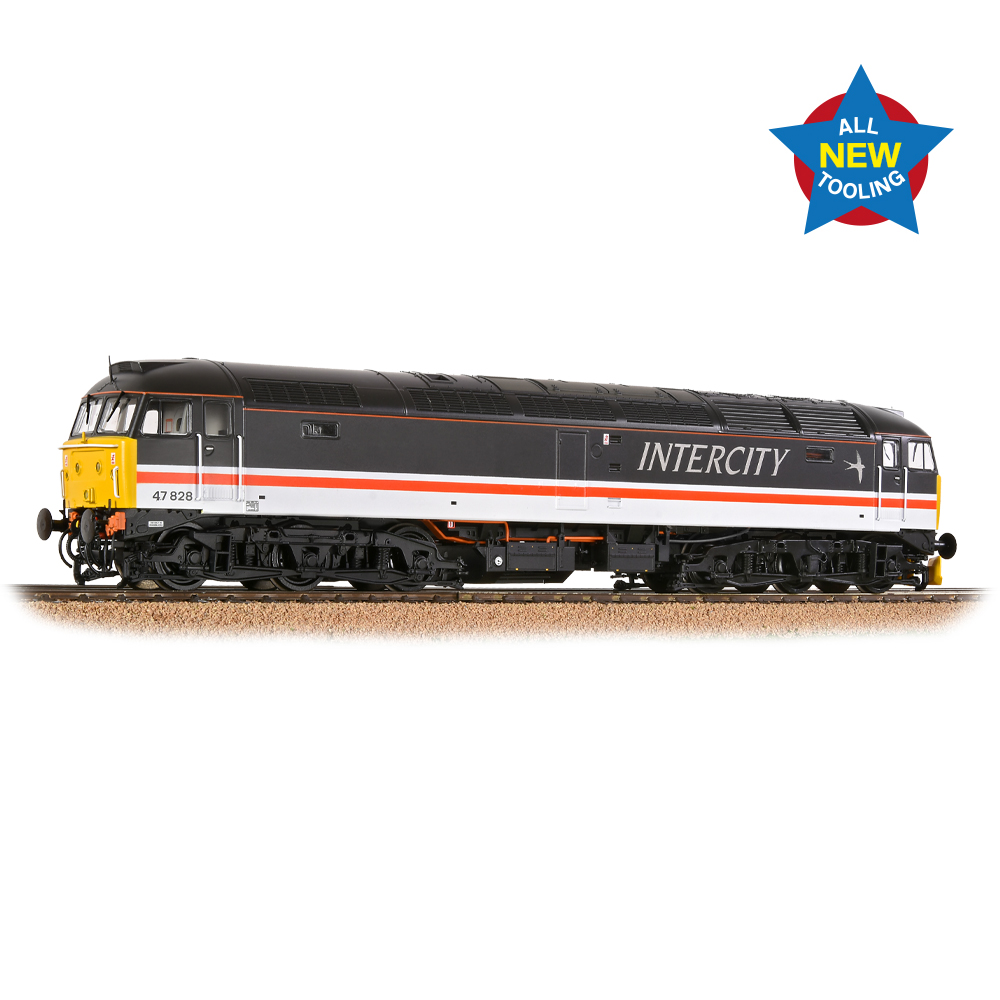
35-413Class 47/4 47828 BR InterCity (Swallow)
'OO' GaugeReleased: 10/02/22DCC Ready (PluX22)Era 7Towards the end of the 1950s, British Railways began planning a new fleet of diesel locomotives and after investigating several prototypes, BR decided to place an order with Brush Engineering for 20 locomotives during February 1961. The resulting design became the iconic Brush Type 4 Diesel locomotive, a practical, versatile design with a very distinctive cab. Powered with a Sulzer engine and initially rated at 2,750hp, the locomotive could achieve a top speed of 75mph with a tractive effort of 55,000lb. Building commenced in January 1962 and the first locomotive No. D1500 appeared in late September of the same year with test runs on the London Midland Region and Western Region. The design was a success and BR went on to order a total of 512 with continuous production through to early 1967, forming the largest single class of main-line diesel locomotives in the UK.
During this time and subsequent years, several variations appeared with an increase in speed and tractive effort to 95mph and 62,000lb respectively. Originally fitted with four character train reporting head-codes, these changed to marker lights, with the addition of high intensity lights and roof aerials in the late 1980s. Other variations involved the fitting of different types of steam heating boiler for early BR coaching stock, later replaced with electric train heating for use with modern rolling stock. The numbering system started with four figures but changed to five with the introduction of the TOPS coding system which saw the locomotives classified as Class 47 Diesels with variations such as 47/0, 47/2, 47/3, 47/4 and 47/7. By the end of the 1990s, half of the Class 47 fleet had been withdrawn or scrapped, 33 have been converted into Class 57 locomotives and several have been preserved, including the original No. D1500, now numbered 47401.
Our Price: £203.95
Bargain Price:
£179.95
£179.95
37-205A8 Plank Wagon Coke Rails 'Bedwas' Grey
'OO' GaugeReleased: 10/02/22Era 3
Our Price:
£26.05
£26.05
37-206B8 Plank Wagon Coke Rails 'Stanton' Red
'OO' GaugeReleased: 10/02/22Era 3
Our Price:
£26.05
£26.05
37-4801 Plank Wagon GWR Grey With 'GWR' AF Container [WL]
'OO' GaugeReleased: 10/02/22Era 3
Our Price:
£22.45
£22.45
37-4811 Plank Wagon LNER Bauxite With 'LNER' Blue BD Container [WL]
'OO' GaugeReleased: 10/02/22Era 3
Our Price:
£22.45
£22.45
37-902B12T Shock Van Planked Ends BR Bauxite (Early) [W]
'OO' GaugeReleased: 10/02/22Era 4
Our Price:
£26.05
£26.05
37-903B12T Shock Van Corrugated Ends BR Bauxite (Early)
'OO' GaugeReleased: 10/02/22Era 4
Our Price:
£23.35
£23.35
37-904AGWR 12T Shock Van Planked Ends GWR Grey
'OO' GaugeReleased: 10/02/22Era 3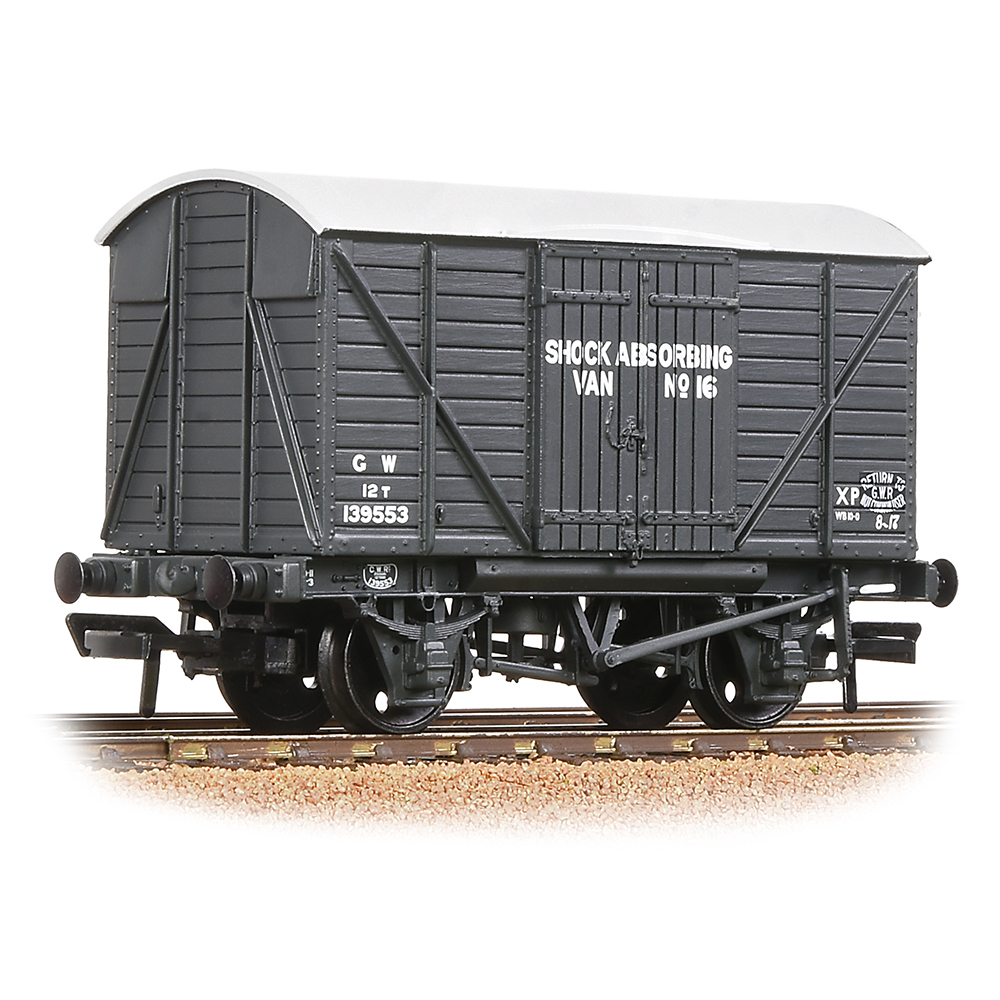
Our Price:
£23.35
£23.35