Search results

Your search found 1479 results.

Filter your search results using the options below:

Manufacturer
Gauge
Category
Digital features
 
Era
 
Number of items to display per page: 5 | 10 | 20 | Show All
32-613
Class 90 90026 BR InterCity (Mainline)
'OO' Gauge
Released: 15/06/22
DCC Ready (21 Pin)
Era 8
Fifty Class 90 locomotives were ordered by British Rail in 1986 to replace the ageing Class 85 fleet on West Coast Main Line duties, whilst also allowing BR to cascade a number of Class 86s to East Anglia. Constructed at British Rail Engineering Limited, Crewe, the new locomotives were initially classified as 87/2s however this was soon changed to Class 90 as the design featured a completely new body-shell – although much of the technology within was shared with the Class 87s. Construction of the 110mph rated locomotives was completed in 1990 and the fleet was split between different sectors of British Rail – 15 were allocated to InterCity services, five for Rail Express Systems (mail and parcels traffic) and the remaining 30 for Railfreight Distribution. Most of those allocated to Railfreight Distribution would later be downgraded to 75mph and reclassified as 90/1s numbered in the 901xx series following work to isolate the Electric Train Heating and push-pull equipment making them dedicated freight locos. Upon privatisation the Class 90 fleet was split between Virgin Trains, EWS and Freightliner. By 1999 all of the Class 90/1s acquired by EWS had been converted back to 90/0s due to an increased requirement for passenger locomotives to work contracted ScotRail sleeper trains and for hire to GNER for East Coast Main Line services. Further renumbering by EWS occurred when nine locos were fitted with different brake blocks and these became Class 90/2s numbered in the 902xx series. The Freightliner locos were also converted back to their original specification in the early 2000s. The Class 90s have carried numerous liveries including three decorated in European liveries for the Freightconnection event in 1992 which coincided with the opening of the Channel Tunnel to freight services. No. 90128 was decorated in SNCB turquoise (Belgium), No. 90129 in DB red (Germany) and No. 90130 in SNCF orange and grey (France) and each carried the name Freightconnection in their respective languages, alongside No. 90022 which was named ‘Freightconnection’ and carried Railfreight Distribution livery. The majority of the Class have carried names whilst in service and the 90s have appeared a variety of other post-Privatisation liveries such as GNER, DB Schenker, First ScotRail, One (Anglia), Greater Anglia, National Express, DRS and Malcolm Logistics. Today, Class 90s remain in operation with Freightliner, DB Cargo UK (ex-EWS/DB Schenker) and most recently Locomotive Services which has acquired Nos. 90001 and 90002 and repainted them into InterCity Swallow livery for use on charters and excursions.
Our Price:
£195.45
32-619
Class 90 90030 'Crewe Locomotive Works' EWS
'OO' Gauge
Released: 15/06/22
DCC Ready (21 Pin)
Era 9
Fifty Class 90 locomotives were ordered by British Rail in 1986 to replace the ageing Class 85 fleet on West Coast Main Line duties, whilst also allowing BR to cascade a number of Class 86s to East Anglia. Constructed at British Rail Engineering Limited, Crewe, the new locomotives were initially classified as 87/2s however this was soon changed to Class 90 as the design featured a completely new body-shell – although much of the technology within was shared with the Class 87s. Construction of the 110mph rated locomotives was completed in 1990 and the fleet was split between different sectors of British Rail – 15 were allocated to InterCity services, five for Rail Express Systems (mail and parcels traffic) and the remaining 30 for Railfreight Distribution. Most of those allocated to Railfreight Distribution would later be downgraded to 75mph and reclassified as 90/1s numbered in the 901xx series following work to isolate the Electric Train Heating and push-pull equipment making them dedicated freight locos. Upon privatisation the Class 90 fleet was split between Virgin Trains, EWS and Freightliner. By 1999 all of the Class 90/1s acquired by EWS had been converted back to 90/0s due to an increased requirement for passenger locomotives to work contracted ScotRail sleeper trains and for hire to GNER for East Coast Main Line services. Further renumbering by EWS occurred when nine locos were fitted with different brake blocks and these became Class 90/2s numbered in the 902xx series. The Freightliner locos were also converted back to their original specification in the early 2000s. The Class 90s have carried numerous liveries including three decorated in European liveries for the Freightconnection event in 1992 which coincided with the opening of the Channel Tunnel to freight services. No. 90128 was decorated in SNCB turquoise (Belgium), No. 90129 in DB red (Germany) and No. 90130 in SNCF orange and grey (France) and each carried the name Freightconnection in their respective languages, alongside No. 90022 which was named ‘Freightconnection’ and carried Railfreight Distribution livery. The majority of the Class have carried names whilst in service and the 90s have appeared a variety of other post-Privatisation liveries such as GNER, DB Schenker, First ScotRail, One (Anglia), Greater Anglia, National Express, DRS and Malcolm Logistics. Today, Class 90s remain in operation with Freightliner, DB Cargo UK (ex-EWS/DB Schenker) and most recently Locomotive Services which has acquired Nos. 90001 and 90002 and repainted them into InterCity Swallow livery for use on charters and excursions.
Our Price:
£195.45
37-951E
Conflat Wagon BR Bauxite (Early) With BR Crimson BD Container [WL]
'OO' Gauge
Released: 22/06/22
Era 4
Our Price:
£25.15
37-954A
Conflat Wagon BR Bauxite (Early) With 'Pickfords' BD Container [WL]
'OO' Gauge
Released: 22/06/22
Era 4
Our Price:
£25.15
37-975B
Conflat Wagon GWR Grey With 'GWR' AF Container [W, WL]
'OO' Gauge
Released: 22/06/22
Era 3
Our Price:
£26.95
37-978A
Conflat Wagon BR Bauxite (Early) With BR Ice Blue AF Container [WL]
'OO' Gauge
Released: 22/06/22
Era 5
Our Price:
£25.95
371-004B
Class 08 08721 'Starlet' BR Red Star Express Parcels
'N' Gauge
Released: 22/06/22
DCC Ready (Next18)
Era 8
The first diesel shunters were pioneered by the LMS which began trialling designs during the 1930s. It soon became apparent that this form of traction offered many advantages over the steam locomotive – the former being ‘ready to use’ as and when required, whereas steam locos had to be kept at the ready even when not required immediately – with the obvious staffing and fuel costs associated with doing so. By the time of Nationalisation in 1948, the LMS had built various shunters and the 12033 series was adopted by BR as the basis for a new standard design of diesel-electric shunting locomotive. As a stop gap whilst the Class 08 was being developed, BR constructed further 12033 series locomotives and these would later be designated as Class 11s. Production of the 08s began in 1952 with the first example, No. 13000, entering traffic in 1953. Construction continued until 1962 and during the ten year period, 996 locomotives were built making the Class 08 the most numerous of all British locomotive classes. In addition, construction of the near-identical Class 09s (26 examples) and Class 10s (171) took the total well above a thousand – the former differed in having higher gearing whilst the latter had different engines and transmission. Built ‘in-house’ at BR’s Crewe, Darlington, Derby, Doncaster and Horwich Works, the 08s were allocated across the BR regions, with many being based at major stations and terminals where stock was marshalled and positioned ready for service, where trains were divided or merged, and of course at many freight facilities. Although they had a top speed of just 15 mph, what the 08s lacked in speed they more than made up for with tractive effort which was more than double that of the 03s and 04s. Although the first example was withdrawn in 1967, just four had gone prior to the introduction of TOPS and despite an ever-decreasing need for shunting locomotives, around a quarter of the Class remained in traffic at the start of the 21st century. Upon Privatisation of British Rail in 1994, EWS inherited many of the survivors, with others going to passenger operators for use as depot shunters. More than a decade later EWS was still operating over 40 of the shunters, with many more in store. Even today, Class 08s can still be found earning their keep at numerous depots, freight facilities and railway workshops. Meanwhile, ever since the first withdrawals Class 08s have been popular machines with heritage railways and today, more than 70 have found a new lease of life in preservation – often carrying out similar tasks to those for which they were designed some seven decades ago.
Our Price:
£123.20
371-004BSF
Class 08 08721 'Starlet' BR Red Star Express Parcels With DCC Sound
'N' Gauge
Released: 22/06/22
DCC Fitted
DCC Sound
Era 8
SOUNDS F1 - Engine Start-up / Shut-down F2 - Brake F3 - Single Horn (Speed Related) F4 - Double Horn F5 - Cold Start / Light Load F6 - Engine Idle / Coasting F7 - Speed Lock F8 - Exhauster (Vacuum Train Brakes) F9 - Flange Squeal (Speed Related) F10 - Guard’s Whistle F11 - Buffer Clash F12 - Coupling F13 - Compressor F14 - Sanders F15 - Handbrake F16 – Fuel Transfer Pump F17 - Wagon Snatching & Buffering F18 - On - Cab Door Open / Off - Cab Door Closed F19 - Fade All Sounds F20 - 'Draw Up’ F21 - ‘Squeeze Up’ F22 - 'I’m Going Under’ F23 - Window Wipers F24 - Station Ambience F25 - Spirax Valves F26 - Shunting Mode F27 - Volume Down F28 - Volume Up Analogue Users: Directional lights and basic Prime Mover (engine) sounds, which vary with speed, plus any other automated sounds, can be enjoyed when using this model on analogue control (DC) straight from the box!
Our Price:
£208.20
371-005A
Class 08 08950 'Neville Hill 1st' BR InterCity (Swallow)
'N' Gauge
Released: 22/06/22
DCC Ready (Next18)
Era 8
CLASS 08 HISTORY The first diesel shunters were pioneered by the LMS which began trialling designs during the 1930s. It soon became apparent that this form of traction offered many advantages over the steam locomotive – the former being ‘ready to use’ as and when required, whereas steam locos had to be kept at the ready even when not required immediately – with the obvious staffing and fuel costs associated with doing so. By the time of Nationalisation in 1948, the LMS had built various shunters and the 12033 series was adopted by BR as the basis for a new standard design of diesel-electric shunting locomotive. As a stop gap whilst the Class 08 was being developed, BR constructed further 12033 series locomotives and these would later be designated as Class 11s. Production of the 08s began in 1952 with the first example, No. 13000, entering traffic in 1953. Construction continued until 1962 and during the ten year period, 996 locomotives were built making the Class 08 the most numerous of all British locomotive classes. In addition, construction of the near-identical Class 09s (26 examples) and Class 10s (171) took the total well above a thousand – the former differed in having higher gearing whilst the latter had different engines and transmission. Built ‘in-house’ at BR’s Crewe, Darlington, Derby, Doncaster and Horwich Works, the 08s were allocated across the BR regions, with many being based at major stations and terminals where stock was marshalled and positioned ready for service, where trains were divided or merged, and of course at many freight facilities. Although they had a top speed of just 15 mph, what the 08s lacked in speed they more than made up for with tractive effort which was more than double that of the 03s and 04s. Although the first example was withdrawn in 1967, just four had gone prior to the introduction of TOPS and despite an ever-decreasing need for shunting locomotives, around a quarter of the Class remained in traffic at the start of the 21st century. Upon Privatisation of British Rail in 1994, EWS inherited many of the survivors, with others going to passenger operators for use as depot shunters. More than a decade later EWS was still operating over 40 of the shunters, with many more in store. Even today, Class 08s can still be found earning their keep at numerous depots, freight facilities and railway workshops. Meanwhile, ever since the first withdrawals Class 08s have been popular machines with heritage railways and today, more than 70 have found a new lease of life in preservation – often carrying out similar tasks to those for which they were designed some seven decades ago.
Our Price:
£123.20
371-010
Class 08 08441 RSS Railway Support Services
'N' Gauge
Released: 22/06/22
DCC Ready (Next18)
Era 9
CLASS 08 HISTORY The first diesel shunters were pioneered by the LMS which began trialling designs during the 1930s. It soon became apparent that this form of traction offered many advantages over the steam locomotive – the former being ‘ready to use’ as and when required, whereas steam locos had to be kept at the ready even when not required immediately – with the obvious staffing and fuel costs associated with doing so. By the time of Nationalisation in 1948, the LMS had built various shunters and the 12033 series was adopted by BR as the basis for a new standard design of diesel-electric shunting locomotive. As a stop gap whilst the Class 08 was being developed, BR constructed further 12033 series locomotives and these would later be designated as Class 11s. Production of the 08s began in 1952 with the first example, No. 13000, entering traffic in 1953. Construction continued until 1962 and during the ten year period, 996 locomotives were built making the Class 08 the most numerous of all British locomotive classes. In addition, construction of the near-identical Class 09s (26 examples) and Class 10s (171) took the total well above a thousand – the former differed in having higher gearing whilst the latter had different engines and transmission. Built ‘in-house’ at BR’s Crewe, Darlington, Derby, Doncaster and Horwich Works, the 08s were allocated across the BR regions, with many being based at major stations and terminals where stock was marshalled and positioned ready for service, where trains were divided or merged, and of course at many freight facilities. Although they had a top speed of just 15 mph, what the 08s lacked in speed they more than made up for with tractive effort which was more than double that of the 03s and 04s. Although the first example was withdrawn in 1967, just four had gone prior to the introduction of TOPS and despite an ever-decreasing need for shunting locomotives, around a quarter of the Class remained in traffic at the start of the 21st century. Upon Privatisation of British Rail in 1994, EWS inherited many of the survivors, with others going to passenger operators for use as depot shunters. More than a decade later EWS was still operating over 40 of the shunters, with many more in store. Even today, Class 08s can still be found earning their keep at numerous depots, freight facilities and railway workshops. Meanwhile, ever since the first withdrawals Class 08s have been popular machines with heritage railways and today, more than 70 have found a new lease of life in preservation – often carrying out similar tasks to those for which they were designed some seven decades ago.
Our Price:
£123.20
371-011
Class 08 08417 Network Rail Yellow
'N' Gauge
Released: 22/06/22
DCC Ready (Next18)
Era 9
CLASS 08 HISTORY The first diesel shunters were pioneered by the LMS which began trialling designs during the 1930s. It soon became apparent that this form of traction offered many advantages over the steam locomotive – the former being ‘ready to use’ as and when required, whereas steam locos had to be kept at the ready even when not required immediately – with the obvious staffing and fuel costs associated with doing so. By the time of Nationalisation in 1948, the LMS had built various shunters and the 12033 series was adopted by BR as the basis for a new standard design of diesel-electric shunting locomotive. As a stop gap whilst the Class 08 was being developed, BR constructed further 12033 series locomotives and these would later be designated as Class 11s. Production of the 08s began in 1952 with the first example, No. 13000, entering traffic in 1953. Construction continued until 1962 and during the ten year period, 996 locomotives were built making the Class 08 the most numerous of all British locomotive classes. In addition, construction of the near-identical Class 09s (26 examples) and Class 10s (171) took the total well above a thousand – the former differed in having higher gearing whilst the latter had different engines and transmission. Built ‘in-house’ at BR’s Crewe, Darlington, Derby, Doncaster and Horwich Works, the 08s were allocated across the BR regions, with many being based at major stations and terminals where stock was marshalled and positioned ready for service, where trains were divided or merged, and of course at many freight facilities. Although they had a top speed of just 15 mph, what the 08s lacked in speed they more than made up for with tractive effort which was more than double that of the 03s and 04s. Although the first example was withdrawn in 1967, just four had gone prior to the introduction of TOPS and despite an ever-decreasing need for shunting locomotives, around a quarter of the Class remained in traffic at the start of the 21st century. Upon Privatisation of British Rail in 1994, EWS inherited many of the survivors, with others going to passenger operators for use as depot shunters. More than a decade later EWS was still operating over 40 of the shunters, with many more in store. Even today, Class 08s can still be found earning their keep at numerous depots, freight facilities and railway workshops. Meanwhile, ever since the first withdrawals Class 08s have been popular machines with heritage railways and today, more than 70 have found a new lease of life in preservation – often carrying out similar tasks to those for which they were designed some seven decades ago.
Our Price:
£123.20
371-011SF
Class 08 08417 Network Rail Yellow With DCC Sound
'N' Gauge
Released: 22/06/22
DCC Fitted
DCC Sound
Era 9
SOUNDS F1 - Engine Start-up / Shut-down F2 - Brake F3 - Single Horn (Speed Related) F4 - Double Horn F5 - Cold Start / Light Load F6 - Engine Idle / Coasting F7 - Speed Lock F8 - Exhauster (Vacuum Train Brakes) F9 - Flange Squeal (Speed Related) F10 - Guard’s Whistle F11 - Buffer Clash F12 - Coupling F13 - Compressor F14 - Sanders F15 - Handbrake F16 – Fuel Transfer Pump F17 - Wagon Snatching & Buffering F18 - On - Cab Door Open / Off - Cab Door Closed F19 - Fade All Sounds F20 - 'Draw Up’ F21 - ‘Squeeze Up’ F22 - 'I’m Going Under’ F23 - Window Wipers F24 - Station Ambience F25 - Spirax Valves F26 - Shunting Mode F27 - Volume Down F28 - Volume Up Analogue Users: Directional lights and basic Prime Mover (engine) sounds, which vary with speed, plus any other automated sounds, can be enjoyed when using this model on analogue control (DC) straight from the box!
Our Price:
£208.20
371-012
Class 08 08919 Rail Express Systems
'N' Gauge
Released: 22/06/22
DCC Ready (Next18)
Era 9
CLASS 08 HISTORY The first diesel shunters were pioneered by the LMS which began trialling designs during the 1930s. It soon became apparent that this form of traction offered many advantages over the steam locomotive – the former being ‘ready to use’ as and when required, whereas steam locos had to be kept at the ready even when not required immediately – with the obvious staffing and fuel costs associated with doing so. By the time of Nationalisation in 1948, the LMS had built various shunters and the 12033 series was adopted by BR as the basis for a new standard design of diesel-electric shunting locomotive. As a stop gap whilst the Class 08 was being developed, BR constructed further 12033 series locomotives and these would later be designated as Class 11s. Production of the 08s began in 1952 with the first example, No. 13000, entering traffic in 1953. Construction continued until 1962 and during the ten year period, 996 locomotives were built making the Class 08 the most numerous of all British locomotive classes. In addition, construction of the near-identical Class 09s (26 examples) and Class 10s (171) took the total well above a thousand – the former differed in having higher gearing whilst the latter had different engines and transmission. Built ‘in-house’ at BR’s Crewe, Darlington, Derby, Doncaster and Horwich Works, the 08s were allocated across the BR regions, with many being based at major stations and terminals where stock was marshalled and positioned ready for service, where trains were divided or merged, and of course at many freight facilities. Although they had a top speed of just 15 mph, what the 08s lacked in speed they more than made up for with tractive effort which was more than double that of the 03s and 04s. Although the first example was withdrawn in 1967, just four had gone prior to the introduction of TOPS and despite an ever-decreasing need for shunting locomotives, around a quarter of the Class remained in traffic at the start of the 21st century. Upon Privatisation of British Rail in 1994, EWS inherited many of the survivors, with others going to passenger operators for use as depot shunters. More than a decade later EWS was still operating over 40 of the shunters, with many more in store. Even today, Class 08s can still be found earning their keep at numerous depots, freight facilities and railway workshops. Meanwhile, ever since the first withdrawals Class 08s have been popular machines with heritage railways and today, more than 70 have found a new lease of life in preservation – often carrying out similar tasks to those for which they were designed some seven decades ago.
Our Price:
£123.20
371-012SF
Class 08 08919 Rail Express Systems With DCC Sound
'N' Gauge
Released: 22/06/22
DCC Fitted
DCC Sound
Era 9
SOUNDS F1 - Engine Start-up / Shut-down F2 - Brake F3 - Single Horn (Speed Related) F4 - Double Horn F5 - Cold Start / Light Load F6 - Engine Idle / Coasting F7 - Speed Lock F8 - Exhauster (Vacuum Train Brakes) F9 - Flange Squeal (Speed Related) F10 - Guard’s Whistle F11 - Buffer Clash F12 - Coupling F13 - Compressor F14 - Sanders F15 - Handbrake F16 – Fuel Transfer Pump F17 - Wagon Snatching & Buffering F18 - On - Cab Door Open / Off - Cab Door Closed F19 - Fade All Sounds F20 - 'Draw Up’ F21 - ‘Squeeze Up’ F22 - 'I’m Going Under’ F23 - Window Wipers F24 - Station Ambience F25 - Spirax Valves F26 - Shunting Mode F27 - Volume Down F28 - Volume Up Analogue Users: Directional lights and basic Prime Mover (engine) sounds, which vary with speed, plus any other automated sounds, can be enjoyed when using this model on analogue control (DC) straight from the box!
Our Price:
£208.95
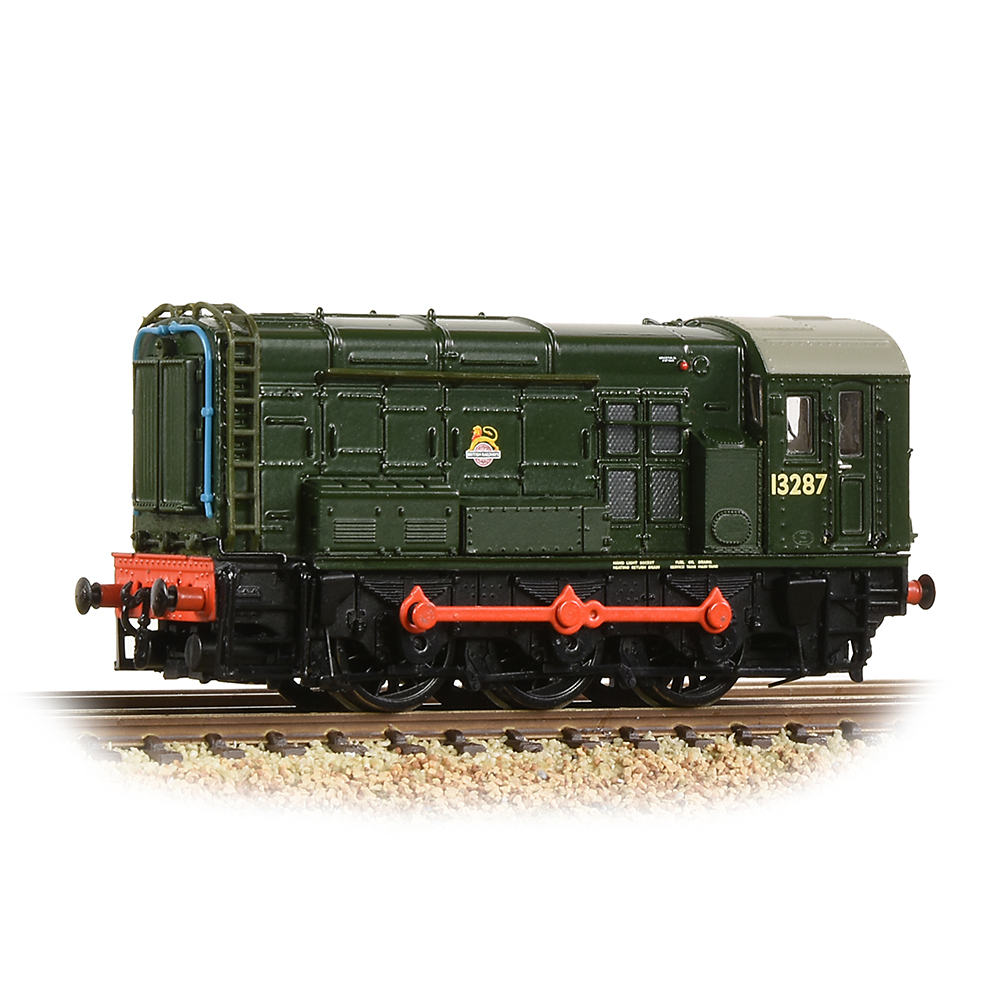
371-013
Class 08 13287 BR Green (Early Emblem)
'N' Gauge
Released: 22/06/22
DCC Ready (Next18)
Era 4
CLASS 08 HISTORY The first diesel shunters were pioneered by the LMS which began trialling designs during the 1930s. It soon became apparent that this form of traction offered many advantages over the steam locomotive – the former being ‘ready to use’ as and when required, whereas steam locos had to be kept at the ready even when not required immediately – with the obvious staffing and fuel costs associated with doing so. By the time of Nationalisation in 1948, the LMS had built various shunters and the 12033 series was adopted by BR as the basis for a new standard design of diesel-electric shunting locomotive. As a stop gap whilst the Class 08 was being developed, BR constructed further 12033 series locomotives and these would later be designated as Class 11s. Production of the 08s began in 1952 with the first example, No. 13000, entering traffic in 1953. Construction continued until 1962 and during the ten year period, 996 locomotives were built making the Class 08 the most numerous of all British locomotive classes. In addition, construction of the near-identical Class 09s (26 examples) and Class 10s (171) took the total well above a thousand – the former differed in having higher gearing whilst the latter had different engines and transmission. Built ‘in-house’ at BR’s Crewe, Darlington, Derby, Doncaster and Horwich Works, the 08s were allocated across the BR regions, with many being based at major stations and terminals where stock was marshalled and positioned ready for service, where trains were divided or merged, and of course at many freight facilities. Although they had a top speed of just 15 mph, what the 08s lacked in speed they more than made up for with tractive effort which was more than double that of the 03s and 04s. Although the first example was withdrawn in 1967, just four had gone prior to the introduction of TOPS and despite an ever-decreasing need for shunting locomotives, around a quarter of the Class remained in traffic at the start of the 21st century. Upon Privatisation of British Rail in 1994, EWS inherited many of the survivors, with others going to passenger operators for use as depot shunters. More than a decade later EWS was still operating over 40 of the shunters, with many more in store. Even today, Class 08s can still be found earning their keep at numerous depots, freight facilities and railway workshops. Meanwhile, ever since the first withdrawals Class 08s have been popular machines with heritage railways and today, more than 70 have found a new lease of life in preservation – often carrying out similar tasks to those for which they were designed some seven decades ago.
Our Price:
£123.20
371-015D
Class 08 08818 BR Blue [W]
'N' Gauge
Released: 22/06/22
DCC Ready (Next18)
Era 7/8
CLASS 08 HISTORY The first diesel shunters were pioneered by the LMS which began trialling designs during the 1930s. It soon became apparent that this form of traction offered many advantages over the steam locomotive – the former being ‘ready to use’ as and when required, whereas steam locos had to be kept at the ready even when not required immediately – with the obvious staffing and fuel costs associated with doing so. By the time of Nationalisation in 1948, the LMS had built various shunters and the 12033 series was adopted by BR as the basis for a new standard design of diesel-electric shunting locomotive. As a stop gap whilst the Class 08 was being developed, BR constructed further 12033 series locomotives and these would later be designated as Class 11s. Production of the 08s began in 1952 with the first example, No. 13000, entering traffic in 1953. Construction continued until 1962 and during the ten year period, 996 locomotives were built making the Class 08 the most numerous of all British locomotive classes. In addition, construction of the near-identical Class 09s (26 examples) and Class 10s (171) took the total well above a thousand – the former differed in having higher gearing whilst the latter had different engines and transmission. Built ‘in-house’ at BR’s Crewe, Darlington, Derby, Doncaster and Horwich Works, the 08s were allocated across the BR regions, with many being based at major stations and terminals where stock was marshalled and positioned ready for service, where trains were divided or merged, and of course at many freight facilities. Although they had a top speed of just 15 mph, what the 08s lacked in speed they more than made up for with tractive effort which was more than double that of the 03s and 04s. Although the first example was withdrawn in 1967, just four had gone prior to the introduction of TOPS and despite an ever-decreasing need for shunting locomotives, around a quarter of the Class remained in traffic at the start of the 21st century. Upon Privatisation of British Rail in 1994, EWS inherited many of the survivors, with others going to passenger operators for use as depot shunters. More than a decade later EWS was still operating over 40 of the shunters, with many more in store. Even today, Class 08s can still be found earning their keep at numerous depots, freight facilities and railway workshops. Meanwhile, ever since the first withdrawals Class 08s have been popular machines with heritage railways and today, more than 70 have found a new lease of life in preservation – often carrying out similar tasks to those for which they were designed some seven decades ago.
Our Price:
£131.70
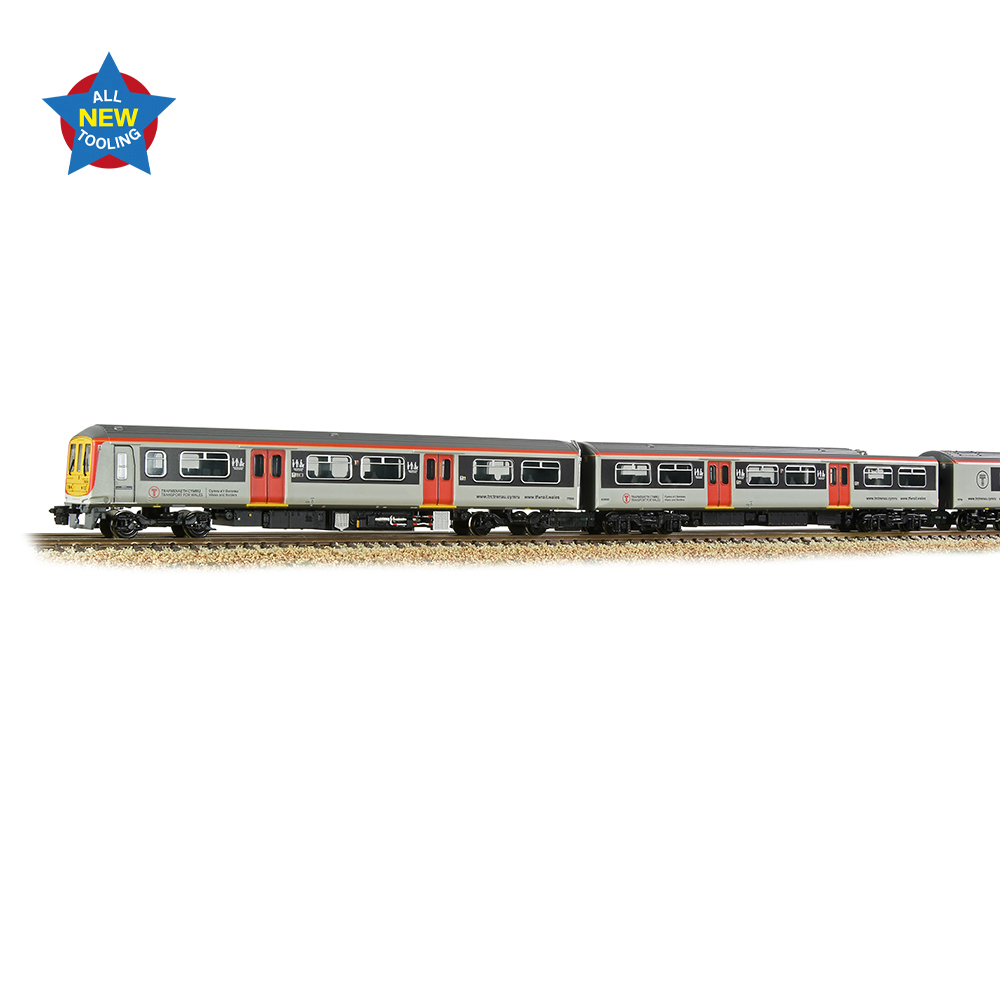
372-850
Class 769 4-Car BiMU 769008 Transport for Wales
'N' Gauge
Released: 22/06/22
DCC Ready (Next18)
Era 9
CLASS 769 HISTORY The Class 769 is a type of bi-mode or tri-mode multiple unit train capable of operating on electrified lines via 25kV overhead wires and/or 750V DC third rail, or on non-electrified lines via a diesel engine. They have been converted from surplus dual-voltage Class 319 units by Brush Traction and are to be used by Transport for Wales, Northern and Great Western Railway. The Class 769 units have primarily been designed to run on routes with multiple power supplies, such as the Rhymney Valley line in Wales which has overhead wires and non-electrified stretches and the units can change between EMU and DMU model whilst the train is in motion. Rolling stock company Porterbrook first conceptualised the Class 769 in 2016 when, in partnership with Northern, they began work on converting Class 319/4 units to provide a solution to a shortage of diesel units and deferrals of electrification projects on the network. These units were chosen for the conversion as they had recently undergone upgrades to install new passenger information systems and accessible toilets, as well as having suitable space for a new diesel power pack and alternator to power the existing electric traction systems. The first conversions were completed in 2018 and testing was undertaken at the Great Central Railway in Leicestershire, with the first unit delivered to Northern in 2018, although the first to enter service was a Transport for Wales unit in November 2020.
Our Price:
£297.45
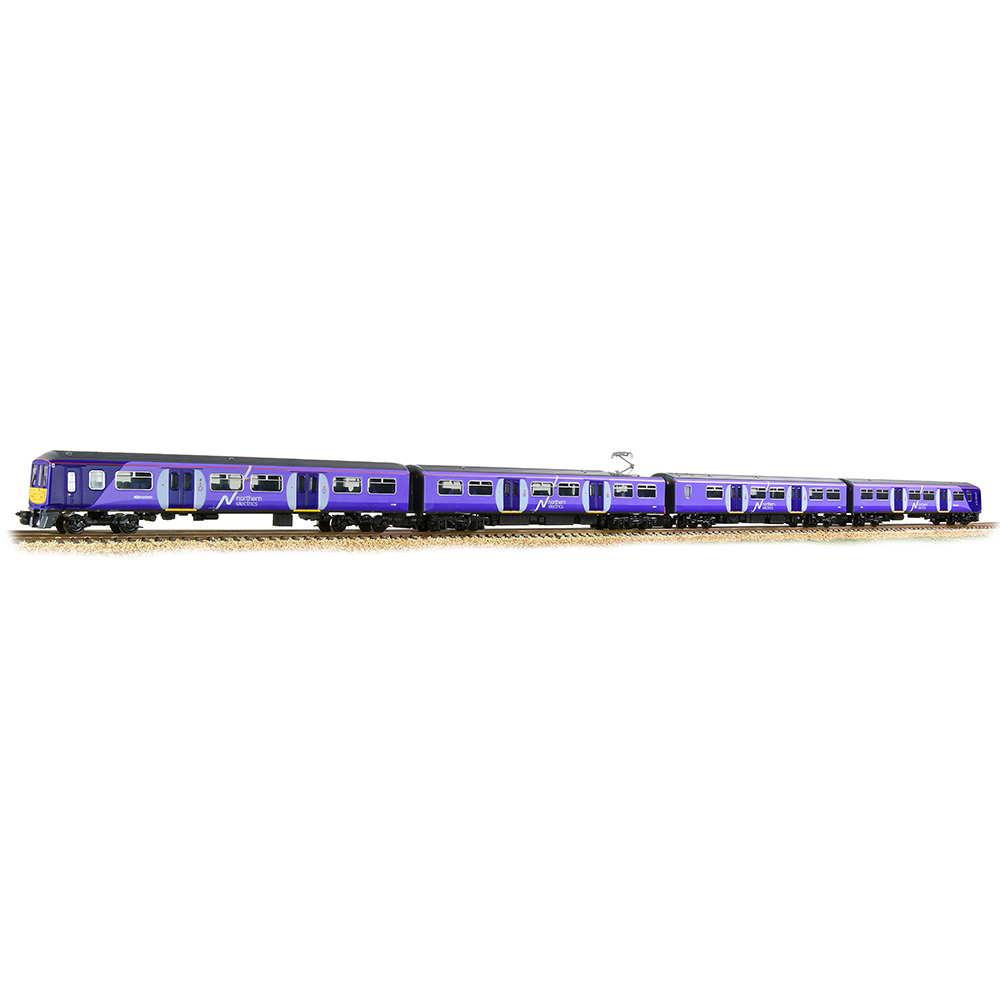
372-877
Class 319 4-Car EMU 319362 Northern Rail
'N' Gauge
Released: 22/06/22
DCC Ready (Next18)
Era 9
CLASS 319 HISTORY The British Rail Class 319 is a dual-voltage electric multiple unit train capable of operating on 25kV 50Hz AC from overhead wires or 750V DC from a third rail. They were built by British Rail Engineering Limited's York carriage works for use on north-south cross-London services. Built in two batches in 1987–88 and 1990 for BR's Network SouthEast sector, the units were primarily used on the then-new Thameslink service operating from Bedford to Brighton and various other destinations south of London. The majority of the fleet remained in use on the Thameslink network after its reshaping and privatisation in 1997, with a few units moving to Southern. Some of the fleet was also used on various other services operating out of London Victoria, including flagship expresses to Brighton. Since delivery of new Class 700 rolling stock for Thameslink services commenced in 2015, Class 319 units have been redeployed for use in the Northwest of England on newly electrified lines as well as being converted to self-powered trains for use away from the electricity supply.
Our Price:
£297.45
377-526D
BR 20T Brake Van BR Grey (Early)
'N' Gauge
Released: 22/06/22
Era 4
Our Price:
£26.95
377-529A
BR 20T Brake Van BR Engineers Grey & Yellow [W]
'N' Gauge
Released: 22/06/22
Era 8
Our Price:
£28.75