Search results

Your search found 1479 results.

Filter your search results using the options below:

Manufacturer
Gauge
Category
Digital features
 
Era
 
Number of items to display per page: 5 | 10 | 20 | Show All
371-361
Class 60 60040 'The Territorial Army Centenary' DB Schenker/Army Red
'N' Gauge
Released: 22/09/22
DCC Ready (Next18)
Era 9
CLASS 60 HISTORY The British Rail Class 60 is a Class of Diesel-Electric Locomotive built by Brush Traction in Loughborough, Leicestershire between 1989 and 1993. Affectionately known as ‘Tugs’ by enthusiasts due to their Mirrlees marine-derived powerplant, 100 locomotives were built and the first entered service in late-1990 – more than a year after the first example had been ceremoniously handed over to BR – after various technical issues were uncovered during testing of the first locos. Designed for heavy freight trains, the Class 60s entered service at a time when BR’s Railfreight operations had been split into various sub-sectors and locomotives were assigned to the Coal, Metals, Construction and Petroleum divisions of BR Railfreight, with each carrying the triple-grey base livery with the addition of the relevant graphics for the sub-sector and depot plaques. In 1994 and in the runup to the Privatisation of British Rail, the Class 60 fleet was split between three of the shadow freight operators – Loadhaul, Mainline and Transrail – that had been created to handle BR’s freight business. All three operators were purchased by EWS in 1996, resulting in the entire class falling under EWS ownership. With the introduction of the Class 66s at the end of the century and coupled with a decline in EWS heavy freight traffic, several Class 60s were put into store and the future of the fleet was uncertain at times. However, a number of locomotives were retained as the heaviest trains could not be hauled by a single Class 66 and instead required the superior power of a Class 60. EWS was acquired by DB Schenker in 2007 (later renamed DB Cargo) and the new owners put several Class 60s up for sale, however they also announced overhauls for some 60s, giving the class glimmers of hopes for the future. In 2014 Colas Rail purchased ten Class 60s and these remained with the company until 2018 when they were replaced by Class 70s. These ten Class 60s were subsequently sold to GB Railfreight who still operate the fleet which includes No. 60002 that was named ‘Graham Farish – 50th Anniversary 1970 – 2020’ to mark 50th anniversary of production of British N scale models by the brand which is now owned by Bachmann Europe. Despite their ups and downs, the Class 60s continue to serve DB Cargo, GB Railfreight and other private operators including DC Rail and the class remains a popular sight across the UK where they can be found hauling the heavy freight trains for which they were originally designed.
Our Price:
£143.95
R40154
BR, Mk4 Open First, Coach H, 11212
'OO' Gauge
Released: 26/09/22
Era 8
Built at Metro-Cammell's Washwood Heath factory, 314 Mk4 coaches were produced between 1989 and 1992. They were built specifically for use on the newly electrified East Coast Main Line, along with hopes that a second order for the West Coast Main Line would be placed at a later date, although this second order never transpired. Mk4 coaches featured many improvements over the Mk3s such as push-button operated plug-type doors, fully sealed gangways and a designed top speed of 140mph. Much of the Mk4 design was based upon the Advanced Passenger Train. In particular, Mk4 coaches feature sides profiled to allow a tilt of up to 6° with newly fitted tilting bogies.
Our Price:
£40.49
R40152
BR, Mk4 Open First, Coach G, 11213
'OO' Gauge
Released: 26/09/22
Era 8
Built at Metro-Cammell's Washwood Heath factory, 314 Mk4 coaches were produced between 1989 and 1992. They were built specifically for use on the newly electrified East Coast Main Line, along with hopes that a second order for the West Coast Main Line would be placed at a later date, although this second order never transpired. Mk4 coaches featured many improvements over the Mk3s such as push-button operated plug-type doors, fully sealed gangways and a designed top speed of 140mph. Much of the Mk4 design was based upon the Advanced Passenger Train. In particular, Mk4 coaches feature sides profiled to allow a tilt of up to 6° with newly fitted tilting bogies.
Our Price:
£40.49
R30073
BR, Class 56, Co-Co, 56047
'OO' Gauge
Released: 26/09/22
DCC Ready (21 Pin)
Era 7
The British Rail Class 56 Type 5 Co-Co diesel locomotive was first introduced in 1976 to cope with the increased requirement for heavy freight. British Rail awarded the contract to design and build these new engines to Brush Traction in Loughborough, who subsequently sub-contracted the construction to Electroputere in Romania, due to the lack of capacity in their own works. The initial 30 locomotives to be delivered from Romania suffered from transit damage and construction deficiencies and had to be extensively rebuilt before entering service. With this in mind the decision was made to build the remaining 105 locomotives in England, British Rail Engineering Ltd manufacturing them at their Doncaster Works (nos. 56031 to 56115). The design specification was based upon the Class 47 bodyshell, with the omission of redundant features such as the headcode panel. Power came from a Ruston-Paxman unit that was similar to that fitted in the Class 50 locomotives, which provided the capability for heavy haul freight. Air brakes were fitted for the first time in a British Rail engine and the electrics were improved in a number of areas, resulting in a more robust power unit. Nicknamed as Gridirons or 'Grids', the Class 56 displaced the Class 20 and Class 47 locomotives and commonly undertook the transportation of iron ore, coal, aggregate and steel across the Eastern and London Midland Regions and on the Western Region for aggregate duties. Strong and reliable performers, the locomotives were popular but needed heavy maintenance, particularly when compared against the Class 66 locomotives that came to displace them in service. The introduction of the Class 60 locomotives saw a gradual reduction in the use of the Class 56 locomotives and with the arrival of the Class 66 locomotives, with their greater availability and lower maintenance, the Class 56 fleet were placed into storage between 1998 and 2004. Most of the locomotives remain in depots around the UK, despite being variously sold for scrap and then re-acquired and reinstated in service. Colas Railfreight operate a small fleet on a rotating basis and British American Railway Services and UK Rail Leasing have a number available for working. Five locomotives, 56006, 56097, 56098, 56301 and 56302 have been preserved. No. 56060 was built in June 1979 by BREL in Doncaster. The locomotive received the name 'The Cardiff Rod Mill' in December 1992 and ran under this name until March 1997.
Our Price:
£196.19
R30040TTS
RailRoad Plus BR, Class 47, Co-Co, 47583 ‘County of Hertfordshire’
'OO' Gauge
Released: 28/09/22
DCC Fitted
DCC Sound
Era 7
Built between 1962 and 1968, the British Rail (BR) Class 47 Co-Co Diesel-Electric locomotive was once the most numerous class of mainline diesel in Britain with 512 examples. 310 locomotives were constructed by Brush in Loughborough, and the remaining 202 at Crewe. The locomotives were used for passenger and freight operations. In 2020, 24 of the class remain operational on the national network with more in storage and an additional 31 preserved. Built in October 1964 as D1767 the locomotive was initially assigned to the Tinsley depot. Under TOPS the locomotive was initially numbered 47172. The locomotive received the name 'County of Hertfordshire' in 1979 before being reclassified a class 47/4 and renumbered 47583 in November 1980. In 1981 the livery of the locomotive was updated to mark the wedding of HRH Prince Charles and Lady Diana Spencer featuring a large BR arrow uniquely lined in Red and Blue.
Our Price:
£108.89
R30042TTS
RailRoad Plus ROG, Class 47, Co-Co, 47813 ‘Jack Frost’
'HO' Gauge
Released: 28/09/22
DCC Fitted
DCC Sound
Era 11
Built between 1962 and 1968, the British Rail (BR) Class 47 Co-Co Diesel-Electric locomotive was once the most numerous class of mainline diesel in Britain with 512 examples. 310 locomotives were constructed by Brush in Loughborough, and the remaining 202 at Crewe. The locomotives were used for passenger and freight operations. In 2020, 24 of the class remain operational on the national network with more in storage and an additional 31 preserved. Built in October 1964 as D1767 the locomotive was initially assigned to the Tinsley depot. Under TOPS the locomotive was initially numbered 47172. The locomotive received the name 'County of Hertfordshire' in 1979 before being reclassified a class 47/4 and renumbered 47583 in November 1980. In 1981 the livery of the locomotive was updated to mark the wedding of HRH Prince Charles and Lady Diana Spencer featuring a large BR arrow uniquely lined in Red and Blue.
Our Price:
£108.89
31-265A
Class 419 MLV S68002 BR (SR) Green
'OO' Gauge
Released: 30/09/22
DCC Ready (21 Pin)
Era 4
CLASS 419 MLV HISTORY Ten single car Motor Luggage Vans (MLV) were built between 1959 and 1961 to provide additional luggage carrying capacity for boat trains operating on the newly electrified Kent Coast line from London to ports on the South Coast which connected with cross-channel ferries. They were designed to be fully compatible with units that operated services on the stretch of the South Eastern network between London and the Kent ports, principally 4CEP and 4BEP units (later Class 411 and 410 respectively). Each MLV was also fitted with two sets of batteries which were charged by a motor generator during operation on the third rail electrified lines - this enabled the vehicles to work independently and away from electrified routes which was particularly useful upon reaching the ferry ports in the south. The MLV would be detached from the train and could then traverse the dockyard to enable direct loading of luggage onto the ship, with the vehicle added back onto the London end of the train for the return journey. Originally numbered S68001-S68010, with the implementation of TOPS (Total Operating Processing System) the MLVs were designated Class 419 with numbers in the series 419001 – 419010. When renumbered, the units retained their original numbers on the bodysides (albeit without the ‘S’ prefix) and the last four digits of the new TOPS number were applied to the unit ends. As boat traffic reduced, the vehicles saw increased use on other services, particularly carrying parcels and mail, or in departmental use where they served as tractors units on electrified lines. Their use on mail traffic saw two examples (Nos. 419001 and 419004) receive Royal Mail livery, however this livery made the units obvious targets for thieves and No. 419004 was the subject of a robbery in March 1989 whilst working a Brighton to London Bridge service. Withdrawals commenced in 1994 and all had been retired by 2004, although remarkably only two examples were lost – the other eight having been preserved.
Our Price:
£135.95
31-267A
Class 419 MLV S68008 BR Blue & Grey
'OO' Gauge
Released: 30/09/22
DCC Ready (21 Pin)
Era 7
CLASS 419 MLV HISTORY Ten single car Motor Luggage Vans (MLV) were built between 1959 and 1961 to provide additional luggage carrying capacity for boat trains operating on the newly electrified Kent Coast line from London to ports on the South Coast which connected with cross-channel ferries. They were designed to be fully compatible with units that operated services on the stretch of the South Eastern network between London and the Kent ports, principally 4CEP and 4BEP units (later Class 411 and 410 respectively). Each MLV was also fitted with two sets of batteries which were charged by a motor generator during operation on the third rail electrified lines - this enabled the vehicles to work independently and away from electrified routes which was particularly useful upon reaching the ferry ports in the south. The MLV would be detached from the train and could then traverse the dockyard to enable direct loading of luggage onto the ship, with the vehicle added back onto the London end of the train for the return journey. Originally numbered S68001-S68010, with the implementation of TOPS (Total Operating Processing System) the MLVs were designated Class 419 with numbers in the series 419001 – 419010. When renumbered, the units retained their original numbers on the bodysides (albeit without the ‘S’ prefix) and the last four digits of the new TOPS number were applied to the unit ends. As boat traffic reduced, the vehicles saw increased use on other services, particularly carrying parcels and mail, or in departmental use where they served as tractors units on electrified lines. Their use on mail traffic saw two examples (Nos. 419001 and 419004) receive Royal Mail livery, however this livery made the units obvious targets for thieves and No. 419004 was the subject of a robbery in March 1989 whilst working a Brighton to London Bridge service. Withdrawals commenced in 1994 and all had been retired by 2004, although remarkably only two examples were lost – the other eight having been preserved.
Our Price:
£135.95
31-267ASF
Class 419 MLV S68008 BR Blue & Grey With DCC Sound
'OO' Gauge
Released: 30/09/22
DCC Fitted
DCC Sound
Era 7
SOUNDS F0 - Directional Lights - On/Off F1 - Sound - On/Off F2* - Brake F3** - Air Horn (High) F4*** - Air Horn (Various) F5 - Heavy Engine F6 - Southern Region Whistle F7 - 3rd Rail Arcing F8**** - Coupling F9 - Flange Squeal F10 - On - Guard's Whistle / Off - Driver's Response F11 - Buffering Up F12 - On - Driver's Single Buzzer / Off - Guard’s Response F13 - On - Driver's Double Buzzer / Off - Guard’s Response F14 - On - Cab Door Opening / Off - Cab Door Closing F15 - Luggage Loading/Unloading F16 - AWS Horn F17 - Air Tank Drain Down F18 - Fade All Sounds F19 - Mute (Latch) / Volume Cycles 6 Levels (Trigger) F20 - Compressor F21***** - Rail Clank F22 - Spirax Valve F23 - Windscreen Wipers F24 - Handbrake F25 - Station Announcement F26 - Brake Set/Release * Alterative Brake sounds can be selected via CV changes **/***Alternative Horn characteristics can be selected via CV changes **** Alternative Coupling sounds can be selected via CV changes ***** Alternative Rail Clank sound can be selected via CV change Analogue Users: Please note that normal load running sounds and any other automatic or randomised sounds will also operate when this model is used on analogue control (DC) straight from the box! CLASS 419 MLV HISTORY Ten single car Motor Luggage Vans (MLV) were built between 1959 and 1961 to provide additional luggage carrying capacity for boat trains operating on the newly electrified Kent Coast line from London to ports on the South Coast which connected with cross-channel ferries. They were designed to be fully compatible with units that operated services on the stretch of the South Eastern network between London and the Kent ports, principally 4CEP and 4BEP units (later Class 411 and 410 respectively). Each MLV was also fitted with two sets of batteries which were charged by a motor generator during operation on the third rail electrified lines - this enabled the vehicles to work independently and away from electrified routes which was particularly useful upon reaching the ferry ports in the south. The MLV would be detached from the train and could then traverse the dockyard to enable direct loading of luggage onto the ship, with the vehicle added back onto the London end of the train for the return journey. Originally numbered S68001-S68010, with the implementation of TOPS (Total Operating Processing System) the MLVs were designated Class 419 with numbers in the series 419001 – 419010. When renumbered, the units retained their original numbers on the bodysides (albeit without the ‘S’ prefix) and the last four digits of the new TOPS number were applied to the unit ends. As boat traffic reduced, the vehicles saw increased use on other services, particularly carrying parcels and mail, or in departmental use where they served as tractors units on electrified lines. Their use on mail traffic saw two examples (Nos. 419001 and 419004) receive Royal Mail livery, however this livery made the units obvious targets for thieves and No. 419004 was the subject of a robbery in March 1989 whilst working a Brighton to London Bridge service. Withdrawals commenced in 1994 and all had been retired by 2004, although remarkably only two examples were lost – the other eight having been preserved.
Our Price:
£220.95
35-421
Class 47/4 47526 BR Blue (Large Logo) [W]
'OO' Gauge
Released: 30/09/22
DCC Ready (PluX22)
Era 8
CLASS 47 HISTORY Towards the end of the 1950s, British Railways began planning a new fleet of diesel locomotives and after investigating several prototypes, BR decided to place an order with Brush Engineering for 20 locomotives during February 1961. The resulting design became the iconic Brush Type 4 Diesel locomotive, a practical, versatile design with a very distinctive cab. Powered with a Sulzer engine and initially rated at 2,750hp, the locomotive could achieve a top speed of 75mph with a tractive effort of 55,000lb. Building commenced in January 1962 and the first locomotive No. D1500 appeared in late September of the same year with test runs on the London Midland Region and Western Region. The design was a success and BR went on to order a total of 512 with continuous production through to early 1967, forming the largest single class of main-line diesel locomotives in the UK. During this time and subsequent years, several variations appeared with an increase in speed and tractive effort to 95mph and 62,000lb respectively. Originally fitted with four character train reporting head-codes, these changed to marker lights, with the addition of high intensity lights and roof aerials in the late 1980s. Other variations involved the fitting of different types of steam heating boiler for early BR coaching stock, later replaced with electric train heating for use with modern rolling stock. The numbering system started with four figures but changed to five with the introduction of the TOPS coding system which saw the locomotives classified as Class 47 Diesels with variations such as 47/0, 47/2, 47/3, 47/4 and 47/7. By the end of the 1990s, half of the Class 47 fleet had been withdrawn or scrapped, 33 have been converted into Class 57 locomotives and several have been preserved, including the original No. D1500, now numbered 47401.
Our Price:
£216.70
35-421SF
Class 47/4 47526 BR Blue (Large Logo) [W]
'OO' Gauge
Released: 30/09/22
DCC Fitted
DCC Sound
Era 8
SOUNDS F0 - Directional Lights - On/Off (plus Light Switch Sound) F1 - On - Warm Engine Start / On, Off - Failed Engine Start / On, Off, On - Cold Engine Start F2 - Brake F3* - Horn (Playable) F4* - Two-Tone Horn F5 - Heavy Load F6 - Coasting (Manual notch Down if F22 On) F7 - Maximum Revs (Manual notch Up if F22 On) F8** - On - Coupling Up / Off - Uncoupling F9 - Flange Squeal (Speed Related) F10 - Fan Noise F11 - Engine Room Lights On/Off (plus Light Switch Sound) F12 - On - Guard’s Whistle / Off - Driver’s Response Horn F13 - Cab Lights On/Off No. 1 (plus Light Switch Sound) F14 - Cab Lights On/Off No. 2 (plus Light Switch Sound) F15 - Auto Uncouple Cycle F16 - AWS Horn F17 - AWS Bell F18 - On - Sound Fades Out / Off - Sound Fades In F19 - Mute (Latch) / Volume Cycles 6 Levels (Trigger) F20 - No. 1 End (Fan) Directional Lights Off F21 - No. 2 End (non-Fan) Directional Lights Off F22 - Manual Notching Logic On/Off (control with F6 & F7) F23 - Spirax Valve F24 - Station Announcement F25 - On - Driver’s Door Open / Off - Driver’ Door Shut F26 - Air Dump *Alternative Horn sounds and behaviour can be selected via CV changes ** Alternative coupling sounds can be selected via CV changes Analogue Users: Please note that normal load running sounds and any other automatic or randomised sounds will also operate when this model is used on analogue control (DC) straight from the box! CLASS 47 HISTORY Towards the end of the 1950s, British Railways began planning a new fleet of diesel locomotives and after investigating several prototypes, BR decided to place an order with Brush Engineering for 20 locomotives during February 1961. The resulting design became the iconic Brush Type 4 Diesel locomotive, a practical, versatile design with a very distinctive cab. Powered with a Sulzer engine and initially rated at 2,750hp, the locomotive could achieve a top speed of 75mph with a tractive effort of 55,000lb. Building commenced in January 1962 and the first locomotive No. D1500 appeared in late September of the same year with test runs on the London Midland Region and Western Region. The design was a success and BR went on to order a total of 512 with continuous production through to early 1967, forming the largest single class of main-line diesel locomotives in the UK. During this time and subsequent years, several variations appeared with an increase in speed and tractive effort to 95mph and 62,000lb respectively. Originally fitted with four character train reporting head-codes, these changed to marker lights, with the addition of high intensity lights and roof aerials in the late 1980s. Other variations involved the fitting of different types of steam heating boiler for early BR coaching stock, later replaced with electric train heating for use with modern rolling stock. The numbering system started with four figures but changed to five with the introduction of the TOPS coding system which saw the locomotives classified as Class 47 Diesels with variations such as 47/0, 47/2, 47/3, 47/4 and 47/7. By the end of the 1990s, half of the Class 47 fleet had been withdrawn or scrapped, 33 have been converted into Class 57 locomotives and several have been preserved, including the original No. D1500, now numbered 47401.
Our Price:
£301.70
35-430
Class 47/3 47376 'Freightliner 1995' Freightliner Grey [W]
'OO' Gauge
Released: 30/09/22
DCC Ready (PluX22)
Era 9
CLASS 47 HISTORY Towards the end of the 1950s, British Railways began planning a new fleet of diesel locomotives and after investigating several prototypes, BR decided to place an order with Brush Engineering for 20 locomotives during February 1961. The resulting design became the iconic Brush Type 4 Diesel locomotive, a practical, versatile design with a very distinctive cab. Powered with a Sulzer engine and initially rated at 2,750hp, the locomotive could achieve a top speed of 75mph with a tractive effort of 55,000lb. Building commenced in January 1962 and the first locomotive No. D1500 appeared in late September of the same year with test runs on the London Midland Region and Western Region. The design was a success and BR went on to order a total of 512 with continuous production through to early 1967, forming the largest single class of main-line diesel locomotives in the UK. During this time and subsequent years, several variations appeared with an increase in speed and tractive effort to 95mph and 62,000lb respectively. Originally fitted with four character train reporting head-codes, these changed to marker lights, with the addition of high intensity lights and roof aerials in the late 1980s. Other variations involved the fitting of different types of steam heating boiler for early BR coaching stock, later replaced with electric train heating for use with modern rolling stock. The numbering system started with four figures but changed to five with the introduction of the TOPS coding system which saw the locomotives classified as Class 47 Diesels with variations such as 47/0, 47/2, 47/3, 47/4 and 47/7. By the end of the 1990s, half of the Class 47 fleet had been withdrawn or scrapped, 33 have been converted into Class 57 locomotives and several have been preserved, including the original No. D1500, now numbered 47401.
Our Price:
£216.70
35-430SF
Class 47/3 47376 'Freightliner 1995' Freightliner Grey [W] With DCC Sound
'OO' Gauge
Released: 30/09/22
DCC Fitted
DCC Sound
Era 9
SOUNDS F0 - Directional Lights - On/Off (plus Light Switch Sound) F1 - On - Warm Engine Start / On, Off - Failed Engine Start / On, Off, On - Cold Engine Start F2 - Brake F3* - Horn (Playable) F4* - Two-Tone Horn F5 - Heavy Load F6 - Coasting (Manual notch Down if F22 On) F7 - Maximum Revs (Manual notch Up if F22 On) F8** - On - Coupling Up / Off - Uncoupling F9 - Flange Squeal (Speed Related) F10 - Fan Noise F11 - Engine Room Lights On/Off (plus Light Switch Sound) F12 - On - Guard’s Whistle / Off - Driver’s Response Horn F13 - Cab Lights On/Off No. 1 (plus Light Switch Sound) F14 - Cab Lights On/Off No. 2 (plus Light Switch Sound) F15 - Auto Uncouple Cycle F16 - AWS Horn F17 - AWS Bell F18 - On - Sound Fades Out / Off - Sound Fades In F19 - Mute (Latch) / Volume Cycles 6 Levels (Trigger) F20 - No. 1 End (Fan) Directional Lights Off F21 - No. 2 End (non-Fan) Directional Lights Off F22 - Manual Notching Logic On/Off (control with F6 & F7) F23 - Spirax Valve F24 - Station Announcement F25 - On - Driver’s Door Open / Off - Driver’ Door Shut F26 - Air Dump *Alternative Horn sounds and behaviour can be selected via CV changes ** Alternative coupling sounds can be selected via CV changes Analogue Users: Please note that normal load running sounds and any other automatic or randomised sounds will also operate when this model is used on analogue control (DC) straight from the box! CLASS 47 HISTORY Towards the end of the 1950s, British Railways began planning a new fleet of diesel locomotives and after investigating several prototypes, BR decided to place an order with Brush Engineering for 20 locomotives during February 1961. The resulting design became the iconic Brush Type 4 Diesel locomotive, a practical, versatile design with a very distinctive cab. Powered with a Sulzer engine and initially rated at 2,750hp, the locomotive could achieve a top speed of 75mph with a tractive effort of 55,000lb. Building commenced in January 1962 and the first locomotive No. D1500 appeared in late September of the same year with test runs on the London Midland Region and Western Region. The design was a success and BR went on to order a total of 512 with continuous production through to early 1967, forming the largest single class of main-line diesel locomotives in the UK. During this time and subsequent years, several variations appeared with an increase in speed and tractive effort to 95mph and 62,000lb respectively. Originally fitted with four character train reporting head-codes, these changed to marker lights, with the addition of high intensity lights and roof aerials in the late 1980s. Other variations involved the fitting of different types of steam heating boiler for early BR coaching stock, later replaced with electric train heating for use with modern rolling stock. The numbering system started with four figures but changed to five with the introduction of the TOPS coding system which saw the locomotives classified as Class 47 Diesels with variations such as 47/0, 47/2, 47/3, 47/4 and 47/7. By the end of the 1990s, half of the Class 47 fleet had been withdrawn or scrapped, 33 have been converted into Class 57 locomotives and several have been preserved, including the original No. D1500, now numbered 47401.
Our Price:
£301.70
35-430SFX
Class 47/3 47376 'Freightliner 1995' Freightliner Grey [W] With DCC Sound & Working Fans
'OO' Gauge
Released: 30/09/22
DCC Fitted
DCC Sound
Era 9
SOUNDS F0 - Directional Lights - On/Off (plus Light Switch Sound) F1 - On - Warm Engine Start / On, Off - Failed Engine Start / On, Off, On - Cold Engine Start F2 - Brake F3* - Horn (Playable) F4* - Two-Tone Horn F5 - Heavy Load F6 - Coasting (Manual notch Down if F22 On) F7 - Maximum Revs (Manual notch Up if F22 On) F8** - On - Coupling Up / Off - Uncoupling F9 - Flange Squeal (Speed Related) F10 - Fan Noise F11 - Engine Room Lights On/Off (plus Light Switch Sound) F12 - On - Guard’s Whistle / Off - Driver’s Response Horn F13 - Cab Lights On/Off No. 1 (plus Light Switch Sound) F14 - Cab Lights On/Off No. 2 (plus Light Switch Sound) F15 - Auto Uncouple Cycle F16 - AWS Horn F17 - AWS Bell F18 - On - Sound Fades Out / Off - Sound Fades In F19 - Mute (Latch) / Volume Cycles 6 Levels (Trigger) F20 - No. 1 End (Fan) Directional Lights Off F21 - No. 2 End (non-Fan) Directional Lights Off F22 - Manual Notching Logic On/Off (control with F6 & F7) F23 - Spirax Valve F24 - Station Announcement F25 - On - Driver’s Door Open / Off - Driver’ Door Shut F26 - Air Dump *Alternative Horn sounds and behaviour can be selected via CV changes ** Alternative coupling sounds can be selected via CV changes Analogue Users: Please note that normal load running sounds and any other automatic or randomised sounds will also operate when this model is used on analogue control (DC) straight from the box! CLASS 47 HISTORY Towards the end of the 1950s, British Railways began planning a new fleet of diesel locomotives and after investigating several prototypes, BR decided to place an order with Brush Engineering for 20 locomotives during February 1961. The resulting design became the iconic Brush Type 4 Diesel locomotive, a practical, versatile design with a very distinctive cab. Powered with a Sulzer engine and initially rated at 2,750hp, the locomotive could achieve a top speed of 75mph with a tractive effort of 55,000lb. Building commenced in January 1962 and the first locomotive No. D1500 appeared in late September of the same year with test runs on the London Midland Region and Western Region. The design was a success and BR went on to order a total of 512 with continuous production through to early 1967, forming the largest single class of main-line diesel locomotives in the UK. During this time and subsequent years, several variations appeared with an increase in speed and tractive effort to 95mph and 62,000lb respectively. Originally fitted with four character train reporting head-codes, these changed to marker lights, with the addition of high intensity lights and roof aerials in the late 1980s. Other variations involved the fitting of different types of steam heating boiler for early BR coaching stock, later replaced with electric train heating for use with modern rolling stock. The numbering system started with four figures but changed to five with the introduction of the TOPS coding system which saw the locomotives classified as Class 47 Diesels with variations such as 47/0, 47/2, 47/3, 47/4 and 47/7. By the end of the 1990s, half of the Class 47 fleet had been withdrawn or scrapped, 33 have been converted into Class 57 locomotives and several have been preserved, including the original No. D1500, now numbered 47401.
Our Price:
£327.20
35-432
Class 47/7 47790 'Galloway Princess' DRS Compass (Original)
'OO' Gauge
Released: 30/09/22
DCC Ready (PluX22)
Era 9
CLASS 47 HISTORY Towards the end of the 1950s, British Railways began planning a new fleet of diesel locomotives and after investigating several prototypes, BR decided to place an order with Brush Engineering for 20 locomotives during February 1961. The resulting design became the iconic Brush Type 4 Diesel locomotive, a practical, versatile design with a very distinctive cab. Powered with a Sulzer engine and initially rated at 2,750hp, the locomotive could achieve a top speed of 75mph with a tractive effort of 55,000lb. Building commenced in January 1962 and the first locomotive No. D1500 appeared in late September of the same year with test runs on the London Midland Region and Western Region. The design was a success and BR went on to order a total of 512 with continuous production through to early 1967, forming the largest single class of main-line diesel locomotives in the UK. During this time and subsequent years, several variations appeared with an increase in speed and tractive effort to 95mph and 62,000lb respectively. Originally fitted with four character train reporting head-codes, these changed to marker lights, with the addition of high intensity lights and roof aerials in the late 1980s. Other variations involved the fitting of different types of steam heating boiler for early BR coaching stock, later replaced with electric train heating for use with modern rolling stock. The numbering system started with four figures but changed to five with the introduction of the TOPS coding system which saw the locomotives classified as Class 47 Diesels with variations such as 47/0, 47/2, 47/3, 47/4 and 47/7. By the end of the 1990s, half of the Class 47 fleet had been withdrawn or scrapped, 33 have been converted into Class 57 locomotives and several have been preserved, including the original No. D1500, now numbered 47401.
Our Price:
£203.95
35-432SF
Class 47/7 47790 'Galloway Princess' DRS Compass (Original) With DCC Sound
'OO' Gauge
Released: 30/09/22
DCC Fitted
DCC Sound
Era 9
SOUNDS F0 - Directional Lights - On/Off (plus Light Switch Sound) F1 - On - Warm Engine Start / On, Off - Failed Engine Start / On, Off, On - Cold Engine Start F2 - Brake F3* - Horn (Playable) F4* - Two-Tone Horn F5 - Heavy Load F6 - Coasting (Manual notch Down if F22 On) F7 - Maximum Revs (Manual notch Up if F22 On) F8** - On - Coupling Up / Off - Uncoupling F9 - Flange Squeal (Speed Related) F10 - Fan Noise F11 - Engine Room Lights On/Off (plus Light Switch Sound) F12 - On - Guard’s Whistle / Off - Driver’s Response Horn F13 - Cab Lights On/Off No. 1 (plus Light Switch Sound) F14 - Cab Lights On/Off No. 2 (plus Light Switch Sound) F15 - Auto Uncouple Cycle F16 - AWS Horn F17 - AWS Bell F18 - On - Sound Fades Out / Off - Sound Fades In F19 - Mute (Latch) / Volume Cycles 6 Levels (Trigger) F20 - No. 1 End (Fan) Directional Lights Off F21 - No. 2 End (non-Fan) Directional Lights Off F22 - Manual Notching Logic On/Off (control with F6 & F7) F23 - Spirax Valve F24 - Station Announcement F25 - On - Driver’s Door Open / Off - Driver’ Door Shut F26 - Air Dump *Alternative Horn sounds and behaviour can be selected via CV changes ** Alternative coupling sounds can be selected via CV changes Analogue Users: Please note that normal load running sounds and any other automatic or randomised sounds will also operate when this model is used on analogue control (DC) straight from the box! CLASS 47 HISTORY Towards the end of the 1950s, British Railways began planning a new fleet of diesel locomotives and after investigating several prototypes, BR decided to place an order with Brush Engineering for 20 locomotives during February 1961. The resulting design became the iconic Brush Type 4 Diesel locomotive, a practical, versatile design with a very distinctive cab. Powered with a Sulzer engine and initially rated at 2,750hp, the locomotive could achieve a top speed of 75mph with a tractive effort of 55,000lb. Building commenced in January 1962 and the first locomotive No. D1500 appeared in late September of the same year with test runs on the London Midland Region and Western Region. The design was a success and BR went on to order a total of 512 with continuous production through to early 1967, forming the largest single class of main-line diesel locomotives in the UK. During this time and subsequent years, several variations appeared with an increase in speed and tractive effort to 95mph and 62,000lb respectively. Originally fitted with four character train reporting head-codes, these changed to marker lights, with the addition of high intensity lights and roof aerials in the late 1980s. Other variations involved the fitting of different types of steam heating boiler for early BR coaching stock, later replaced with electric train heating for use with modern rolling stock. The numbering system started with four figures but changed to five with the introduction of the TOPS coding system which saw the locomotives classified as Class 47 Diesels with variations such as 47/0, 47/2, 47/3, 47/4 and 47/7. By the end of the 1990s, half of the Class 47 fleet had been withdrawn or scrapped, 33 have been converted into Class 57 locomotives and several have been preserved, including the original No. D1500, now numbered 47401.
Our Price:
£288.95
371-358A
Class 60 60096 Colas Rail Freight
'N' Gauge
Released: 30/09/22
DCC Ready (Next18)
Era 9
CLASS 60 HISTORY The British Rail Class 60 is a Class of Diesel-Electric Locomotive built by Brush Traction in Loughborough, Leicestershire between 1989 and 1993. Affectionately known as ‘Tugs’ by enthusiasts due to their Mirrlees marine-derived powerplant, 100 locomotives were built and the first entered service in late-1990 – more than a year after the first example had been ceremoniously handed over to BR – after various technical issues were uncovered during testing of the first locos. Designed for heavy freight trains, the Class 60s entered service at a time when BR’s Railfreight operations had been split into various sub-sectors and locomotives were assigned to the Coal, Metals, Construction and Petroleum divisions of BR Railfreight, with each carrying the triple-grey base livery with the addition of the relevant graphics for the sub-sector and depot plaques. In 1994 and in the runup to the Privatisation of British Rail, the Class 60 fleet was split between three of the shadow freight operators – Loadhaul, Mainline and Transrail – that had been created to handle BR’s freight business. All three operators were purchased by EWS in 1996, resulting in the entire class falling under EWS ownership. With the introduction of the Class 66s at the end of the century and coupled with a decline in EWS heavy freight traffic, several Class 60s were put into store and the future of the fleet was uncertain at times. However, a number of locomotives were retained as the heaviest trains could not be hauled by a single Class 66 and instead required the superior power of a Class 60. EWS was acquired by DB Schenker in 2007 (later renamed DB Cargo) and the new owners put several Class 60s up for sale, however they also announced overhauls for some 60s, giving the class glimmers of hopes for the future. In 2014 Colas Rail purchased ten Class 60s and these remained with the company until 2018 when they were replaced by Class 70s. These ten Class 60s were subsequently sold to GB Railfreight who still operate the fleet which includes No. 60002 that was named ‘Graham Farish – 50th Anniversary 1970 – 2020’ to mark 50th anniversary of production of British N scale models by the brand which is now owned by Bachmann Europe. Despite their ups and downs, the Class 60s continue to serve DB Cargo, GB Railfreight and other private operators including DC Rail and the class remains a popular sight across the UK where they can be found hauling the heavy freight trains for which they were originally designed.
Our Price:
£135.95
371-359
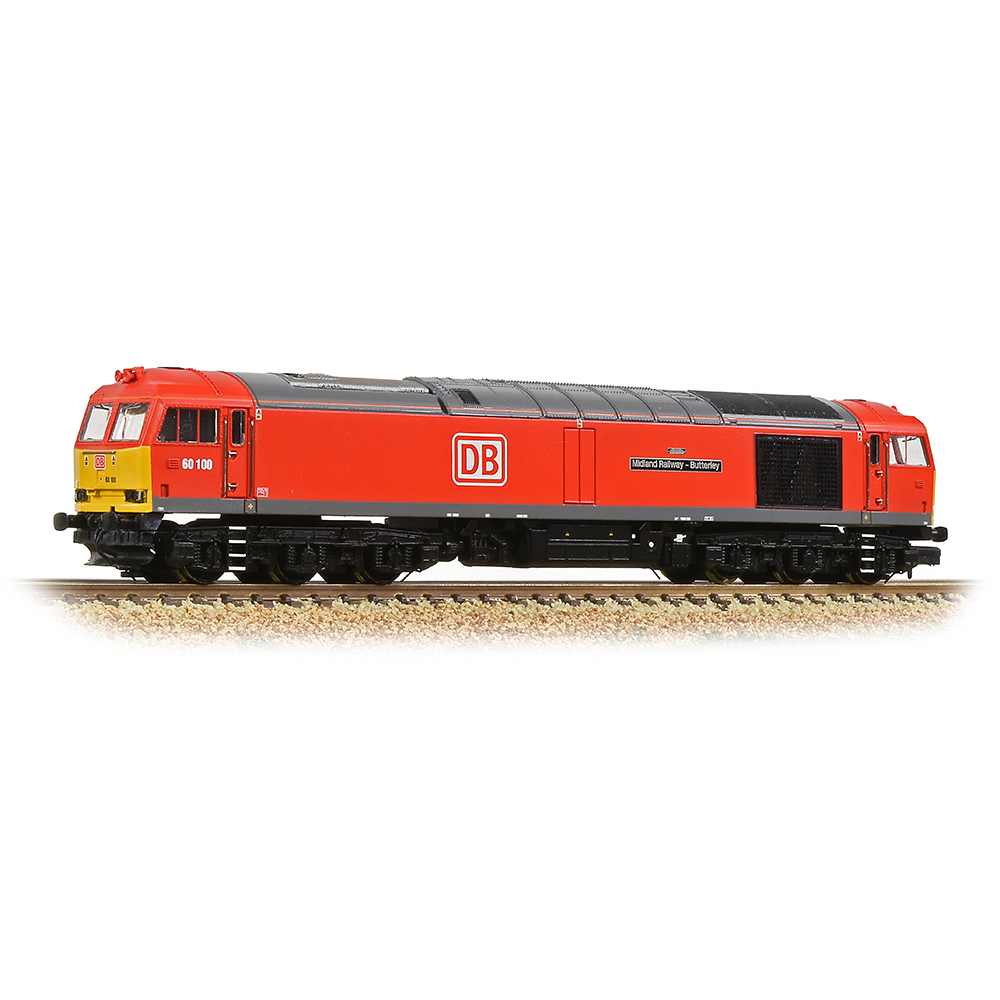
Class 60 60100 'Midland Railway - Butterley' DB Cargo
'N' Gauge
Released: 30/09/22
DCC Ready (Next18)
Era 9
CLASS 60 HISTORY The British Rail Class 60 is a Class of Diesel-Electric Locomotive built by Brush Traction in Loughborough, Leicestershire between 1989 and 1993. Affectionately known as ‘Tugs’ by enthusiasts due to their Mirrlees marine-derived powerplant, 100 locomotives were built and the first entered service in late-1990 – more than a year after the first example had been ceremoniously handed over to BR – after various technical issues were uncovered during testing of the first locos. Designed for heavy freight trains, the Class 60s entered service at a time when BR’s Railfreight operations had been split into various sub-sectors and locomotives were assigned to the Coal, Metals, Construction and Petroleum divisions of BR Railfreight, with each carrying the triple-grey base livery with the addition of the relevant graphics for the sub-sector and depot plaques. In 1994 and in the runup to the Privatisation of British Rail, the Class 60 fleet was split between three of the shadow freight operators – Loadhaul, Mainline and Transrail – that had been created to handle BR’s freight business. All three operators were purchased by EWS in 1996, resulting in the entire class falling under EWS ownership. With the introduction of the Class 66s at the end of the century and coupled with a decline in EWS heavy freight traffic, several Class 60s were put into store and the future of the fleet was uncertain at times. However, a number of locomotives were retained as the heaviest trains could not be hauled by a single Class 66 and instead required the superior power of a Class 60. EWS was acquired by DB Schenker in 2007 (later renamed DB Cargo) and the new owners put several Class 60s up for sale, however they also announced overhauls for some 60s, giving the class glimmers of hopes for the future. In 2014 Colas Rail purchased ten Class 60s and these remained with the company until 2018 when they were replaced by Class 70s. These ten Class 60s were subsequently sold to GB Railfreight who still operate the fleet which includes No. 60002 that was named ‘Graham Farish – 50th Anniversary 1970 – 2020’ to mark 50th anniversary of production of British N scale models by the brand which is now owned by Bachmann Europe. Despite their ups and downs, the Class 60s continue to serve DB Cargo, GB Railfreight and other private operators including DC Rail and the class remains a popular sight across the UK where they can be found hauling the heavy freight trains for which they were originally designed.
Our Price:
£135.95
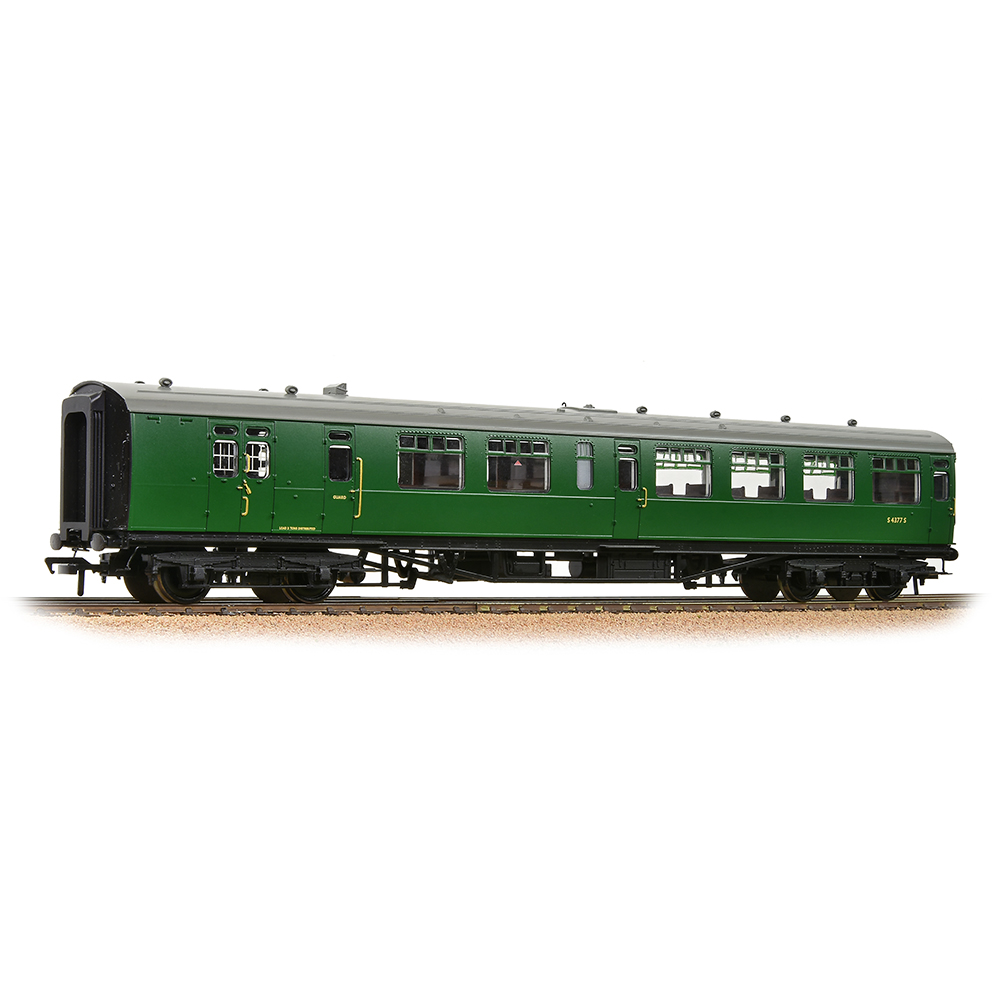
34-726
SR Bulleid Brake Third Semi-Open 10'' Vents BR (SR) Green
'OO' Gauge
Released: 17/10/22
Era 5
Our Price:
£67.45
34-775
SR Bulleid Third Corridor 10'' Vents BR (Ex-SR) Malachite Green
'OO' Gauge
Released: 17/10/22
Era 4
Our Price:
£67.45