
Search results
 372-981
Class 24/1 D5100 BR Green (Small Yellow Panels)
 'N' Gauge
 Released: 08/12/22
 DCC Ready (6 Pin)
 Era 5
Era 5History
The widely travelled British Railways Class 24 diesel locomotives, also known as the Sulzer Type 2, were built from 1958 to 1961. One hundred and fifty-one were built at Derby, Crewe and Darlington, the first twenty of them as part of the British Railways 1955 Modernisation Plan. This class was used as the basis for the development of the class 25 locomotives. The final survivor, no. 24081, was withdrawn from Crewe depot in 1980. Four class members are preserved.
Initial deliveries were for operation in the Crewe and Derby areas, but fifteen of the initial twenty were diverted for use on the Southern Region to cover for delays in the Kent Coast Electrification scheme.
As deliveries continued allocations were made to both the London Midland Region and Eastern Region, and with the class becoming familiar to crews and staff around London they were used on freight trains over the Metropolitan Widened Lines. Locos allocated to East Anglia for use on freight soon became redundant due to the rundown of freight in that region, and these were, in turn, moved to Wales and Lancashire.
Class 24s took over the 'Condor' fast freight service between London (Hendon) and Glasgow (Gushetfaulds) in 1961. Thus the class was also used when a second "Condor" fast overnight freight service was introduced, running from Aston to Glasgow. These were the usual motive power from its introduction on 17 January 1963 when D5082 hauled the Down train and D5083 the up train until replaced by the first Freightliner service in 1965.
The batch D5096–D5113 were all allocated to Gateshead depot in 1966 to replace 9F steam locos on the Tyne Dock to Consett iron ore trains. These workings used a special design of bogie hopper wagon, and these locos had an additional compressor and associated pipework. These workings, typically with loads of around 1,000 tons, were double-headed and continued until taken over by Class 37s in the 1970s, when these locos were reallocated to Scottish depots.

Our Price:
£118.95
£118.95
 31-498SF
Class 158 2-Car DMU 158729 ScotRail Saltire With DCC Sound Fitted
'OO' GaugeReleased: 14/12/22DCC FittedDCC SoundEra 11F0 - Directional Lights - On / Off
F1 - On - Warm Start / F13 - On, then F1 - On - Warm Start with Compressor Speed-up / F5 - On, then F1 - On - Cold Start / F5 - On, then F13 - On, then F1 - On - Cold Start with Compressor Speed-up
F2 - Brake (Non-Latching)
F3 - Single Horn
F4 - Two-Tone Horn
F5 - Light Engine
F6 - Engine Idle / Coasting
F7 - Flange Squeal
F8 - On - Doors Opening (F1 On) / Off - Doors Closing (F1 On)
F9 - Passenger Compartment Lights - On / Off
F10 - Guard's Whistle
F11 - On - Driver's Buzzer / Off - Guard's Response
F12 - On - Driver's Twin Buzzer / Off - Guard's Response
F13 - Engine Speed Up
F14 - On - Directional Lights Day Mode / Off - Directional Lights Night Mode
F15 - Cab Lights (Trailing End) - On / Off
F16 - Air Conditioning Fan
F17 - Windscreen Wipers
F18 - On - Doors Opening (F1 Off) / Off - Doors Closing (F1 Off)
F19 - Fade All Sounds
F20 - Directional Lights Off (Car A, 57xxx)
F21 - Directional Lights Off (Car B, 52xxx)
F22 - Station Ambience
F23 - Remote Telephone Test
F24 - Detonators
F25 - AWS
F26 - No User Access
F27 - Volume Down
F28 - Volume Up
Analogue Users: Please note that basic prime mover sounds will operate and will vary according to use when this model is used on analogue control (DC) straight from the box! Directional lights and passenger compartment lights will also illuminate when power is applied.
CLASS 158 DMU HISTORY
The British Rail Class 158 Express Sprinter is a Diesel Multiple Unit (DMU), built specifically for British Rail's Provincial Services sector between 1989 and 1992 by British Rail Engineering Limited (BREL) at Derby Litchurch Lane Works and outshopped in Regional Railways Provincial livery. They were built to replace many locomotive-hauled passenger trains, thereby reducing cost of operation, and to allow cascading of existing Sprinter units to replace elderly 'heritage' DMUs. The majority of the 182-strong fleet of Class 158 units were built as two-car sets, with 17 three-car units constructed specifically for use on Trans-Pennine services. Similar three-car units were built for use by Network SouthEast but these were converted to Class 159 specification before introduced into service, with toilet retention tanks and other modifications to operate over the third-rail network.
All the Class 158s remain in service today, with operators including ScotRail, Northern, Great Western (GWR), East Midlands Trains (now EMR), and Transport for Wales (formerly Arriva). Former operators include Central Trains. The Class has worked extensively across the UK network, even into East Anglia as far as Stansted Airport and Norwich. Some 158s have been converted to additional Class 159s and now operate for South Western alongside their original classmates.

Our Price:
£365.45
£365.45
371-360Class 60 60095 GBRf
'N' GaugeReleased: 14/12/22DCC Ready (Next18)Era 9The British Rail Class 60 is Co-Co heavy freight diesel-electric locomotive type built by Brush Traction. The 100-strong class are nicknamed Tugs by some rail enthusiasts. The class was the last to be constructed in the UK for domestic main line use, this and the network wide deployment of the locos is partly the reason for their immense popularity with rail fans.
They command a fanatical following, many of their daily workings are discussed and photographed, and they are seeing something of a renaissance with long-stored examples being restored to service with new operators, wearing new liveries; the well-liked Class 60 has much responsibility for sustaining enthusiast interest in the contemporary rail scene in the UK.

Our Price:
£135.95
£135.95
 391-126SF
Mainline Hunslet 0-4-0ST 'Charles' Penrhyn Quarry Lined Black (Late) With DCC Sound Fitted
'OO-9' GaugeReleased: 14/12/22DCC FittedDCC SoundEra 4SOUNDS
F1 - Sound - On/Off
F2 - Brake
F3 - Cylinder Drain Cocks
F4 - Bell Whistle (Speed Related)
F5 - Reverser
F6 - On - Firebox Door Open / Off - Firebox Door Closed
F7 - Coal Shovelling (only with F6 On)
F8 - Blower
F9 - Flange Squeal (Speed Related)
F10 - Speed Lock
F11 - Hand Brake (Functional)
F12 - Water Tank Filling
F13 - Coupling Clank
F14 - Light Engine Mode
F15 - Fade All Sounds
F16 - Guard's Whistle
F17 - Enable Auto Wagon Buffering
F18 - Injector
F19 - Alternative Whistle (Speed Related)
F20 - Shunting Mode
F21 - Safety Valves Lifted
F22 - 'Clear my side’
F23 - 'Red light ahead’
F24 - 'Coal on the fire’
F25 - Volume Down
F26 - Volume Up
Analogue Users: Please note that normal load running sounds, acceleration steam chuff sounds and any other automatic and randomised sounds will also operate when this model is used on analogue control (DC) straight from the box!
MAINLINE HUNSLET HISTORY
Most famous for their operation on the North Wales narrow gauge railways, the first main line Hunslet was built in 1882 by the Hunslet Engine Company of Leeds for the Penrhyn Quarry Railway. Named ‘Charles’, the locomotive’s somewhat unconventional appearance, with steeply inclined cylinders and connecting rods located on the inside of the coupling rods, would be repeated eleven years later when ‘Linda’ and ‘Blanche’ were constructed. Known affectionately by many enthusiasts as ‘the Ladies’, they were ostensibly built to the same 0-4-0 saddle tank design as ‘Charles’, although the ‘Ladies’ did incorporate some differences when compared to their elder. They had larger fire grates for one, round spectacle glasses in the front cab sheet rather than the square ones fitted to ‘Charles’ for another, and were also fractionally longer.
Penrhyn Quarry was the largest slate quarry in the world at the end of the nineteenth century and the trio of Hunslets spent their days hauling slate trains over the Penrhyn main line from the vast quarry complex at Coed-y-Parc, near Bethesda, to Port Penrhyn, just a stone’s throw from Bangor on the North Wales coast. Here, slate products were transferred to standard gauge railway wagons or ships for onward transport around the UK and further afield. Whilst smaller locomotive such as the Quarry Hunslets were used to work the quarry’s internal railways, the larger, more powerful Mainline Hunslets worked the full trains from the quarry down to Port Penrhyn and brought the empty wagons back again – similar duties to those for which the Ffestiniog Railway employed the famous Double Fairlies.
During their working lives the three locomotives underwent several changes, all gained full-height rear cab sheets, replacing the original half-height sheets, welded tanks were fitted in place of the original rivetted versions and various sandbox arrangements were seen, amongst other improvements during their time on the Penrhyn line. By the mid-twentieth century traffic on the Penrhyn Quarry Railway was in decline and in 1962 the last trains ran. ‘Charles’ had already been retired in in the mid-1950s, but the Ladies worked on until the very end.
Offered for sale upon closure of the railway, ‘Linda’ was quickly loaned to the Ffestiniog Railway, arriving there only three days after hauling her last train on the Penrhyn Quarry Railway. In 1963 ‘Linda’ was purchased by the Ffestiniog Railway and ‘Blanche’ too was acquired in the same year, arriving at the railway in December 1963. Both Ladies have been modified by the Ffestiniog Railway since their acquisition, most notably with the fitting of front pony wheels and tenders, becoming 2-4-0ST+Ts (saddle tank tender engines). With 2023 marking 60 years since the pair were brought by the Ffestiniog Railway, they are unquestionably two of the most useful engines in the railway’s fleet and are as popular as ever with visitors, staff and volunteers alike.
‘Charles’ was also offered for sale, but with the boiler condemned, the Ffestiniog Railway declined. Instead, ‘Charles’ was loaned to the National Trust and is now displayed at Penrhyn Castle – once the family home of the owners of Penrhyn Quarry.

Our Price:
£246.45
£246.45
371-781SFClass 90/0 90037 BR Railfreight Distribution Sector With DCC Sound Fitted
'N' GaugeReleased: 15/12/22DCC FittedDCC SoundEra 8SOUNDS
F0 - Directional Lights - On/Off (plus Light Switch Sound)
F1 - Sound - On/Off (plus Battery Switch and Compressor Sounds)
F2 - Brake
F3 - Low Horn (Playable)
F4 - Two-Tone Horn
F5 - Parking Brake On/Off (Loco won’t move with Parking Brake On)
F6 - On - Pantograph Up / Off - Pantograph Down (Sounds only)
F7 - Flange Squeal (Speed Related)
F8 - Windscreen Wipers
F9 - Air Dump
F10 - On - Guard’s Whistle / Off - Driver’s Response
F11 - Spirax Valve
F12 - Station Announcement
F13 - AWS
F14 - Cab Light (non-Pantograph End) On/Off (plus Light Switch Sound)
F15 - Cab Light (Pantograph End) On/Off (plus Light Switch Sound)
F16 - Coupling Up
F17 - Uncoupling
F18 - On - Cab Door Open / Off - Cab Door Shut
F19 - Uncoupling Movement Cycle
F20 - Directional Lights Off (Non-Pantograph End) (plus Light Switch Sound)
F21 - Directional Lights Off (Pantograph End) (plus Light Switch Sound)
F22 - Fire Alarm Test
F23 - Volume Control (6 levels)
Analogue Users: Please note that any automated drive sounds will be played when this model is used on analogue control (DC) straight from the box!

Our Price:
£250.70
£250.70
371-782Class 90/0 90019 'Penny Black' Rail Express Systems
'N' GaugeReleased: 15/12/22DCC Ready (Next18)Era 9Fifty Class 90 locomotives were ordered by British Rail in 1986 to replace the ageing Class 85 fleet on West Coast Main Line duties, whilst also allowing BR to cascade a number of Class 86s to East Anglia. Constructed at British Rail Engineering Limited, Crewe, the new locomotives were initially classified as 87/2s however this was soon changed to Class 90 as the design featured a completely new body-shell – although much of the technology within was shared with the Class 87s.
Construction of the 110mph rated locomotives was completed in 1990 and the fleet was split between different sectors of British Rail – 15 were allocated to InterCity services, five for Rail Express Systems (mail and parcels traffic) and the remaining 30 for Railfreight Distribution. Most of those allocated to Railfreight Distribution would later be downgraded to 75mph and reclassified as 90/1s numbered in the 901xx series following work to isolate the Electric Train Heating and push-pull equipment making them dedicated freight locos.
Upon privatisation the Class 90 fleet was split between Virgin Trains, EWS and Freightliner. By 1999 all of the Class 90/1s acquired by EWS had been converted back to 90/0s due to an increased requirement for passenger locomotives to work contracted ScotRail sleeper trains and for hire to GNER for East Coast Main Line services. Further renumbering by EWS occurred when nine locos were fitted with different brake blocks and these became Class 90/2s numbered in the 902xx series. The Freightliner locos were also converted back to their original specification in the early 2000s.
The Class 90s have carried numerous liveries including three decorated in European liveries for the Freightconnection event in 1992 which coincided with the opening of the Channel Tunnel to freight services. No. 90128 was decorated in SNCB turquoise (Belgium), No. 90129 in DB red (Germany) and No. 90130 in SNCF orange and grey (France) and each carried the name Freightconnection in their respective languages, alongside No. 90022 which was named ‘Freightconnection’ and carried Railfreight Distribution livery.
The majority of the Class have carried names whilst in service and the 90s have appeared a variety of other post-Privatisation liveries such as GNER, DB Schenker, First ScotRail, One (Anglia), Greater Anglia, National Express, DRS and Malcolm Logistics. Today, Class 90s remain in operation with Freightliner, DB Cargo UK (ex-EWS/DB Schenker) and most recently Locomotive Services which has acquired Nos. 90001 and 90002 and repainted them into InterCity Swallow livery for use on charters and excursions.

Our Price:
£165.70
£165.70
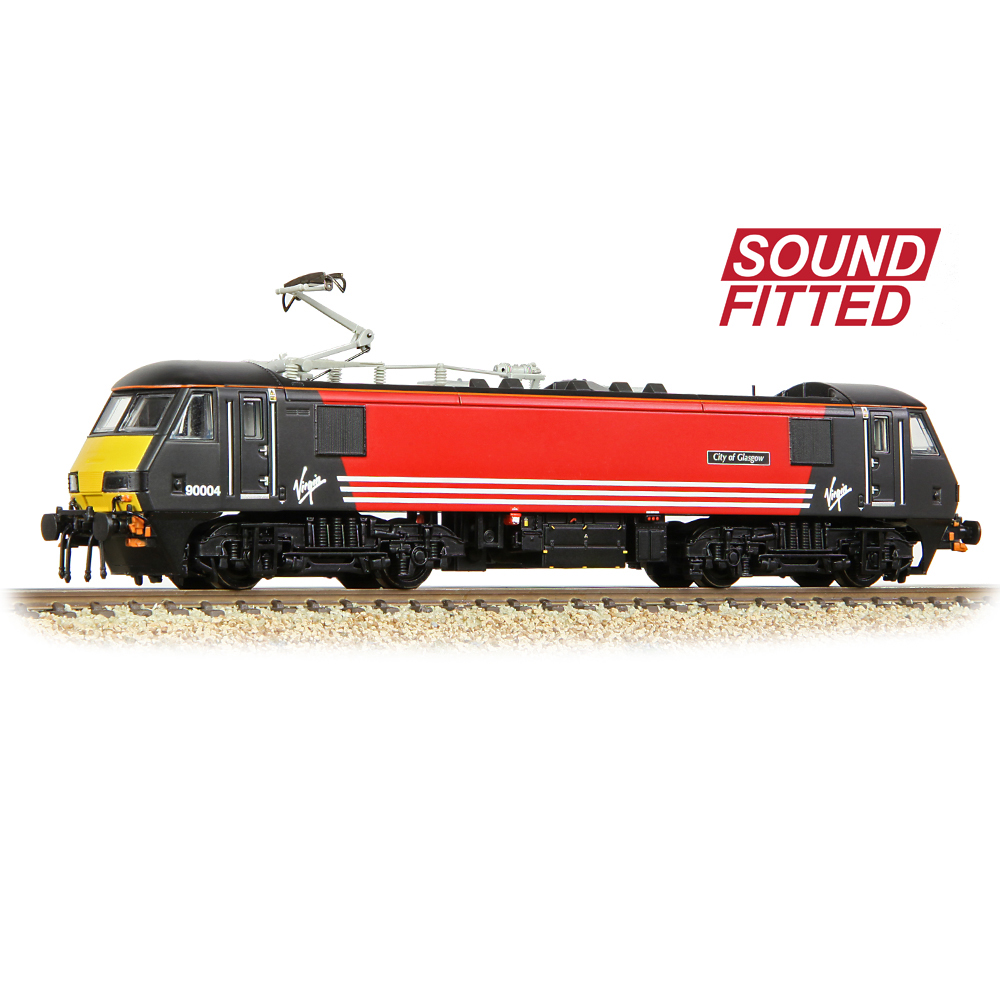
371-783SFClass 90/0 90004 'City of Glasgow' Virgin Trains (Original) With DCC Sound Fitted
'N' GaugeReleased: 15/12/22DCC FittedDCC SoundEra 9SOUNDS
F0 - Directional Lights - On/Off (plus Light Switch Sound)
F1 - Sound - On/Off (plus Battery Switch and Compressor Sounds)
F2 - Brake
F3 - Low Horn (Playable)
F4 - Two-Tone Horn
F5 - Parking Brake On/Off (Loco won’t move with Parking Brake On)
F6 - On - Pantograph Up / Off - Pantograph Down (Sounds only)
F7 - Flange Squeal (Speed Related)
F8 - Windscreen Wipers
F9 - Air Dump
F10 - On - Guard’s Whistle / Off - Driver’s Response
F11 - Spirax Valve
F12 - Station Announcement
F13 - AWS
F14 - Cab Light (non-Pantograph End) On/Off (plus Light Switch Sound)
F15 - Cab Light (Pantograph End) On/Off (plus Light Switch Sound)
F16 - Coupling Up
F17 - Uncoupling
F18 - On - Cab Door Open / Off - Cab Door Shut
F19 - Uncoupling Movement Cycle
F20 - Directional Lights Off (Non-Pantograph End) (plus Light Switch Sound)
F21 - Directional Lights Off (Pantograph End) (plus Light Switch Sound)
F22 - Fire Alarm Test
F23 - Volume Control (6 levels)
Analogue Users: Please note that any automated drive sounds will be played when this model is used on analogue control (DC) straight from the box!
Our Price:
£250.70
£250.70
371-785Class 90/0 90047 Freightliner G&W
'N' GaugeReleased: 15/12/22DCC Ready (Next18)Era 9CLASS 90 HISTORY
Fifty Class 90 locomotives were ordered by British Rail in 1986 to replace the ageing Class 85 fleet on West Coast Main Line duties, whilst also allowing BR to cascade a number of Class 86s to East Anglia. Constructed at British Rail Engineering Limited, Crewe, the new locomotives were initially classified as 87/2s however this was soon changed to Class 90 as the design featured a completely new body-shell – although much of the technology within was shared with the Class 87s.
Construction of the 110mph rated locomotives was completed in 1990 and the fleet was split between different sectors of British Rail – 15 were allocated to InterCity services, five for Rail Express Systems (mail and parcels traffic) and the remaining 30 for Railfreight Distribution. Most of those allocated to Railfreight Distribution would later be downgraded to 75mph and reclassified as 90/1s numbered in the 901xx series following work to isolate the Electric Train Heating and push-pull equipment making them dedicated freight locos.
Upon privatisation the Class 90 fleet was split between Virgin Trains, EWS and Freightliner. By 1999 all of the Class 90/1s acquired by EWS had been converted back to 90/0s due to an increased requirement for passenger locomotives to work contracted ScotRail sleeper trains and for hire to GNER for East Coast Main Line services. Further renumbering by EWS occurred when nine locos were fitted with different brake blocks and these became Class 90/2s numbered in the 902xx series. The Freightliner locos were also converted back to their original specification in the early 2000s.
The Class 90s have carried numerous liveries including three decorated in European liveries for the Freightconnection event in 1992 which coincided with the opening of the Channel Tunnel to freight services. No. 90128 was decorated in SNCB turquoise (Belgium), No. 90129 in DB red (Germany) and No. 90130 in SNCF orange and grey (France) and each carried the name Freightconnection in their respective languages, alongside No. 90022 which was named ‘Freightconnection’ and carried Railfreight Distribution livery.
The majority of the Class have carried names whilst in service and the 90s have appeared a variety of other post-Privatisation liveries such as GNER, DB Schenker, First ScotRail, One (Anglia), Greater Anglia, National Express, DRS and Malcolm Logistics. Today, Class 90s remain in operation with Freightliner, DB Cargo UK (ex-EWS/DB Schenker) and most recently Locomotive Services which has acquired Nos. 90001 and 90002 and repainted them into InterCity Swallow livery for use on charters and excursions.

Our Price:
£165.70
£165.70
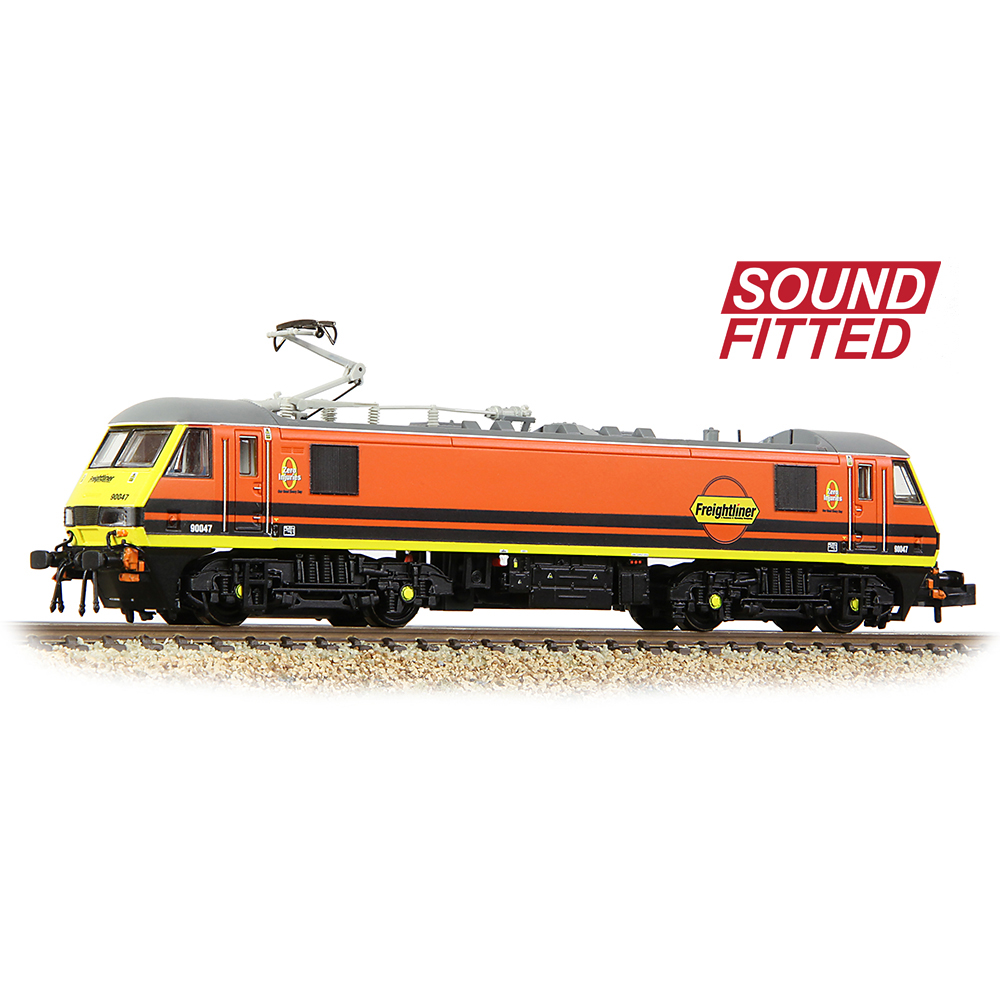
371-785SFClass 90/0 90047 Freightliner G&W With DCC Sound Fitted
'N' GaugeReleased: 15/12/22DCC FittedDCC SoundEra 9SOUNDS
F0 - Directional Lights - On/Off (plus Light Switch Sound)
F1 - Sound - On/Off (plus Battery Switch and Compressor Sounds)
F2 - Brake
F3 - Low Horn (Playable)
F4 - Two-Tone Horn
F5 - Parking Brake On/Off (Loco won’t move with Parking Brake On)
F6 - On - Pantograph Up / Off - Pantograph Down (Sounds only)
F7 - Flange Squeal (Speed Related)
F8 - Windscreen Wipers
F9 - Air Dump
F10 - On - Guard’s Whistle / Off - Driver’s Response
F11 - Spirax Valve
F12 - Station Announcement
F13 - AWS
F14 - Cab Light (non-Pantograph End) On/Off (plus Light Switch Sound)
F15 - Cab Light (Pantograph End) On/Off (plus Light Switch Sound)
F16 - Coupling Up
F17 - Uncoupling
F18 - On - Cab Door Open / Off - Cab Door Shut
F19 - Uncoupling Movement Cycle
F20 - Directional Lights Off (Non-Pantograph End) (plus Light Switch Sound)
F21 - Directional Lights Off (Pantograph End) (plus Light Switch Sound)
F22 - Fire Alarm Test
F23 - Volume Control (6 levels)
Analogue Users: Please note that any automated drive sounds will be played when this model is used on analogue control (DC) straight from the box!
Our Price:
£250.70
£250.70
 R60078
ZUA 'Shark' Ballast Plough, DB993826
'OO' GaugeReleased: 15/12/22Era 8
Our Price:
£38.24
£38.24
R60108BR, Conflat A
'OO' GaugeReleased: 15/12/22Era 4
Our Price:
£19.79
£19.79
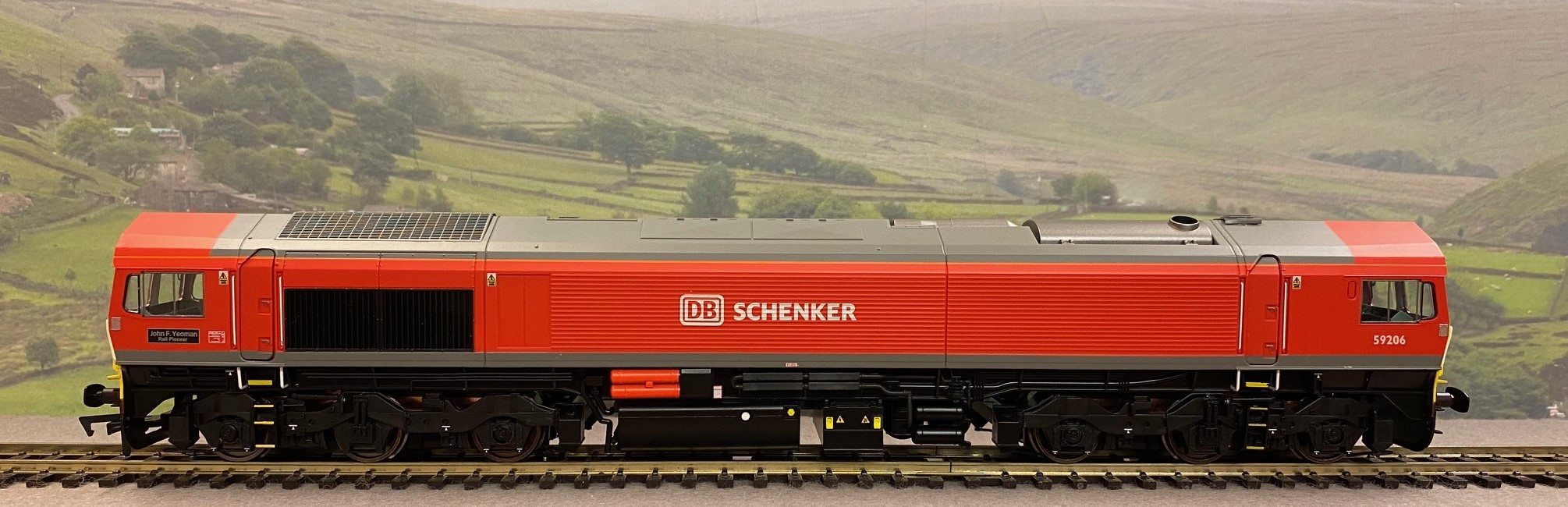
4F-005-002DB SCHENKER CLASS 59 59206 'JOHN F YEOMAN'
'OO' GaugeReleased: 16/12/22DCC Ready (21 Pin)The Class 59.
The Class 59 3,300 bhp Co-Co diesel-electric locomotives were built between 1985 and 1995 by Electro-Motive Diesel for operation in Great Britain. A total of 15 locomotives were built for three different operators.
Our Price:
£147.22
£147.22
 4F-005-003
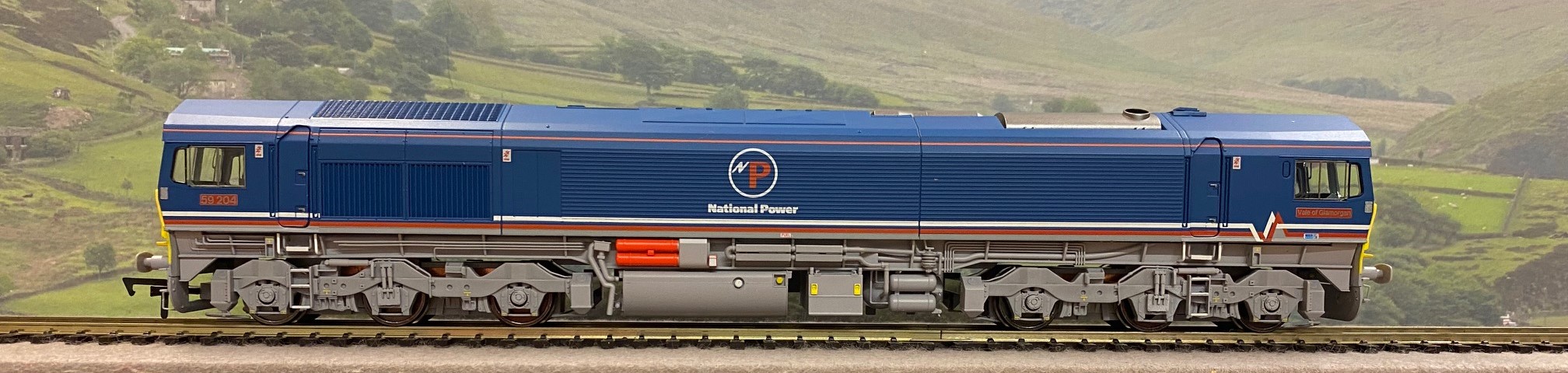
NATIONAL POWER CLASS 59 59204
'OO' GaugeReleased: 16/12/22DCC Ready (21 Pin)The Class 59.
The Class 59 3,300 bhp Co-Co diesel-electric locomotives were built between 1985 and 1995 by Electro-Motive Diesel for operation in Great Britain. A total of 15 locomotives were built for three different operators.
Our Price:
£147.22
£147.22
391-127SFMainline Hunslet 0-4-0ST 'Linda' Penrhyn Quarry Lined Black (Late) [W]
'OO-9' GaugeReleased: 21/12/22DCC FittedDCC SoundEra 4SOUNDS
F1 - Sound - On/Off
F2 - Brake
F3 - Cylinder Drain Cocks
F4 - Bell Whistle (Speed Related)
F5 - Reverser
F6 - On - Firebox Door Open / Off - Firebox Door Closed
F7 - Coal Shovelling (only with F6 On)
F8 - Blower
F9 - Flange Squeal (Speed Related)
F10 - Speed Lock
F11 - Hand Brake (Functional)
F12 - Water Tank Filling
F13 - Coupling Clank
F14 - Light Engine Mode
F15 - Fade All Sounds
F16 - Guard's Whistle
F17 - Enable Auto Wagon Buffering
F18 - Injector
F19 - Alternative Whistle (Speed Related)
F20 - Shunting Mode
F21 - Safety Valves Lifted
F22 - 'Clear my side’
F23 - 'Red light ahead’
F24 - 'Coal on the fire’
F25 - Volume Down
F26 - Volume Up
Analogue Users: Please note that normal load running sounds, acceleration steam chuff sounds and any other automatic and randomised sounds will also operate when this model is used on analogue control (DC) straight from the box!
MAINLINE HUNSLET HISTORY
Most famous for their operation on the North Wales narrow gauge railways, the first main line Hunslet was built in 1882 by the Hunslet Engine Company of Leeds for the Penrhyn Quarry Railway. Named ‘Charles’, the locomotive’s somewhat unconventional appearance, with steeply inclined cylinders and connecting rods located on the inside of the coupling rods, would be repeated eleven years later when ‘Linda’ and ‘Blanche’ were constructed. Known affectionately by many enthusiasts as ‘the Ladies’, they were ostensibly built to the same 0-4-0 saddle tank design as ‘Charles’, although the ‘Ladies’ did incorporate some differences when compared to their elder. They had larger fire grates for one, round spectacle glasses in the front cab sheet rather than the square ones fitted to ‘Charles’ for another, and were also fractionally longer.
Penrhyn Quarry was the largest slate quarry in the world at the end of the nineteenth century and the trio of Hunslets spent their days hauling slate trains over the Penrhyn main line from the vast quarry complex at Coed-y-Parc, near Bethesda, to Port Penrhyn, just a stone’s throw from Bangor on the North Wales coast. Here, slate products were transferred to standard gauge railway wagons or ships for onward transport around the UK and further afield. Whilst smaller locomotive such as the Quarry Hunslets were used to work the quarry’s internal railways, the larger, more powerful Mainline Hunslets worked the full trains from the quarry down to Port Penrhyn and brought the empty wagons back again – similar duties to those for which the Ffestiniog Railway employed the famous Double Fairlies.
During their working lives the three locomotives underwent several changes, all gained full-height rear cab sheets, replacing the original half-height sheets, welded tanks were fitted in place of the original rivetted versions and various sandbox arrangements were seen, amongst other improvements during their time on the Penrhyn line. By the mid-twentieth century traffic on the Penrhyn Quarry Railway was in decline and in 1962 the last trains ran. ‘Charles’ had already been retired in in the mid-1950s, but the Ladies worked on until the very end.
Offered for sale upon closure of the railway, ‘Linda’ was quickly loaned to the Ffestiniog Railway, arriving there only three days after hauling her last train on the Penrhyn Quarry Railway. In 1963 ‘Linda’ was purchased by the Ffestiniog Railway and ‘Blanche’ too was acquired in the same year, arriving at the railway in December 1963. Both Ladies have been modified by the Ffestiniog Railway since their acquisition, most notably with the fitting of front pony wheels and tenders, becoming 2-4-0ST+Ts (saddle tank tender engines). With 2023 marking 60 years since the pair were brought by the Ffestiniog Railway, they are unquestionably two of the most useful engines in the railway’s fleet and are as popular as ever with visitors, staff and volunteers alike.
‘Charles’ was also offered for sale, but with the boiler condemned, the Ffestiniog Railway declined. Instead, ‘Charles’ was loaned to the National Trust and is now displayed at Penrhyn Castle – once the family home of the owners of Penrhyn Quarry.

Our Price:
£254.95
£254.95
R30156BR, Class 60, Co-Co, 60001 'Steadfast'
'OO' GaugeReleased: 19/12/22DCC Ready (21 Pin)Era 8No. 60001, the first of the Class 60s to be delivered, was handed over to British Rail in 1989 after being ordered only 13 months earlier. The locomotive was named 'Steadfast' as the result of a suggestion competition. 'Steadfast' would go on to be operated by EWS until an engine failure in 2006, which forced the locomotive out of service until an overhaul in 2013.

Our Price:
£201.59
£201.59
R30157BR, Class 60, Co-Co, 60002 'Capability Brown' Petroleum Sector
'OO' GaugeReleased: 19/12/22DCC Ready (21 Pin)Era 8BR Class 60 No. 60002 was delivered to British Rail in 1989 before undergoing extensive testing. Due to the many problems the Class 60 initially faced and the requirement for 1000 hours of trouble free running, 'Capability Brown' was only officially accepted into British Rail service at the end of 1992.

Our Price:
£201.59
£201.59
R30153BR, Class 50, Co-Co, 50044 'Exeter'
'OO' GaugeReleased: 11/01/23DCC Ready (21 Pin)Era 7In 1974 50044 was relocated to the Bristol Bath Road Shed where it would remain for the remainder of its life. In a nice mathematic and literary coincidence, exactly 50 of the Class 50 locomotives were built and all of them named, 'Exeter' receiving its name in 1978.

Our Price:
£201.59
£201.59
R30122Departmental, Class A1 'Terrier', 0-6-0, D.S.680
'OO' GaugeReleased: 18/01/23DCC Ready (6 Pin)Era 6Created in 1876 for working on the East London Line, No. 54 'Waddon' was bought by the SE&CR in 1904, acting as a motor train preforming light passenger services across Kent. Later the locomotive was employed on shunting and piloting duties before being re-numbered 680S and refurbished, and again refurbished by BR and numbered D.S680 in 1952. In 1962 the locomotive was presented to the Canada Railway Historical Association and decorated in LB&SCR before being shipped to Canada for exhibition.

Our Price:
£108.89
£108.89
R60101BR, Loriot Y Machinery Truck
'OO' GaugeReleased: 18/01/23Era 4The Loriot Y was a design of well wagon intended to transport machinery that would be too large for the GWR loading gauge. Two wagons were built, and one Loriot Y was used by BR up until the early 90s.

Our Price:
£42.29
£42.29
 908001
GWR Iron Mink pre 1904 No.11152
'OO' GaugeReleased: 08/02/23Era 2
Our Price:
£29.65
£29.65