
Search results
 374-010F
BR Mk1 TSO Tourist Second Open BR Crimson & Cream
 'N' Gauge
 Released: 31/07/23
 Era 4
Era 4The British Railways Mk1 was the designation given to BR’s first standard design of main line coaching stock, and one of its most successful. Built from 1951 until the early 1960s to augment and replace the array of ‘Big Four’ and earlier ‘pre-grouping’ designs inherited from the LMS, LNER, GWR and SR, BR took the best features from several of these types to produce the new steel-bodied design. As a result, the Mk1 was stronger and safer than any of the inherited types that came before it.
Vehicles providing standard accommodation, with first- or second-class seating, or a composite mix of the two, were built in their thousands, along with many specialist types each with their own dedicated purpose. Numerous different catering vehicles were built, offering as little as a counter service right through to a full restaurant dining experience, whilst vehicles which incorporated an area for the Guard were combined with passenger accommodation and varying spaces for the conveyance of luggage, newspapers and parcels. Sleeping cars were also included, along with various general merchandise and specialised Post Office vans – some of which were equipped with apparatus to allow mail to be collected and set down on the move. Such was their success that following withdrawal from BR service, Mk1 coaches have become the mainstay of preservation operations and hundreds of vehicles remain in service today with heritage railways, whilst several still run on the main line in charter formations.

Our Price:
£43.15
£43.15
374-012EBR Mk1 TSO Tourist Second Open BR Maroon
'N' GaugeReleased: 31/07/23Era 5The British Railways Mk1 was the designation given to BR’s first standard design of main line coaching stock, and one of its most successful. Built from 1951 until the early 1960s to augment and replace the array of ‘Big Four’ and earlier ‘pre-grouping’ designs inherited from the LMS, LNER, GWR and SR, BR took the best features from several of these types to produce the new steel-bodied design. As a result, the Mk1 was stronger and safer than any of the inherited types that came before it.
Vehicles providing standard accommodation, with first- or second-class seating, or a composite mix of the two, were built in their thousands, along with many specialist types each with their own dedicated purpose. Numerous different catering vehicles were built, offering as little as a counter service right through to a full restaurant dining experience, whilst vehicles which incorporated an area for the Guard were combined with passenger accommodation and varying spaces for the conveyance of luggage, newspapers and parcels. Sleeping cars were also included, along with various general merchandise and specialised Post Office vans – some of which were equipped with apparatus to allow mail to be collected and set down on the move. Such was their success that following withdrawal from BR service, Mk1 coaches have become the mainstay of preservation operations and hundreds of vehicles remain in service today with heritage railways, whilst several still run on the main line in charter formations.

Our Price:
£43.15
£43.15
374-035BBR Mk1 BG Brake Gangwayed BR Crimson & Cream
'N' GaugeReleased: 31/07/23Era 4The British Railways Mk1 was the designation given to BR’s first standard design of main line coaching stock, and one of its most successful. Built from 1951 until the early 1960s to augment and replace the array of ‘Big Four’ and earlier ‘pre-grouping’ designs inherited from the LMS, LNER, GWR and SR, BR took the best features from several of these types to produce the new steel-bodied design. As a result, the Mk1 was stronger and safer than any of the inherited types that came before it.
Vehicles providing standard accommodation, with first- or second-class seating, or a composite mix of the two, were built in their thousands, along with many specialist types each with their own dedicated purpose. Numerous different catering vehicles were built, offering as little as a counter service right through to a full restaurant dining experience, whilst vehicles which incorporated an area for the Guard were combined with passenger accommodation and varying spaces for the conveyance of luggage, newspapers and parcels. Sleeping cars were also included, along with various general merchandise and specialised Post Office vans – some of which were equipped with apparatus to allow mail to be collected and set down on the move. Such was their success that following withdrawal from BR service, Mk1 coaches have become the mainstay of preservation operations and hundreds of vehicles remain in service today with heritage railways, whilst several still run on the main line in charter formations.

Our Price:
£43.15
£43.15
374-036CBR Mk1 BG Brake Gangwayed BR Maroon
'N' GaugeReleased: 31/07/23Era 5The British Railways Mk1 was the designation given to BR’s first standard design of main line coaching stock, and one of its most successful. Built from 1951 until the early 1960s to augment and replace the array of ‘Big Four’ and earlier ‘pre-grouping’ designs inherited from the LMS, LNER, GWR and SR, BR took the best features from several of these types to produce the new steel-bodied design. As a result, the Mk1 was stronger and safer than any of the inherited types that came before it.
Vehicles providing standard accommodation, with first- or second-class seating, or a composite mix of the two, were built in their thousands, along with many specialist types each with their own dedicated purpose. Numerous different catering vehicles were built, offering as little as a counter service right through to a full restaurant dining experience, whilst vehicles which incorporated an area for the Guard were combined with passenger accommodation and varying spaces for the conveyance of luggage, newspapers and parcels. Sleeping cars were also included, along with various general merchandise and specialised Post Office vans – some of which were equipped with apparatus to allow mail to be collected and set down on the move. Such was their success that following withdrawal from BR service, Mk1 coaches have become the mainstay of preservation operations and hundreds of vehicles remain in service today with heritage railways, whilst several still run on the main line in charter formations.

Our Price:
£43.15
£43.15
374-061DBR Mk1 SK Second Corridor BR Maroon
'N' GaugeReleased: 31/07/23Era 5The British Railways Mk1 was the designation given to BR’s first standard design of main line coaching stock, and one of its most successful. Built from 1951 until the early 1960s to augment and replace the array of ‘Big Four’ and earlier ‘pre-grouping’ designs inherited from the LMS, LNER, GWR and SR, BR took the best features from several of these types to produce the new steel-bodied design. As a result, the Mk1 was stronger and safer than any of the inherited types that came before it.
Vehicles providing standard accommodation, with first- or second-class seating, or a composite mix of the two, were built in their thousands, along with many specialist types each with their own dedicated purpose. Numerous different catering vehicles were built, offering as little as a counter service right through to a full restaurant dining experience, whilst vehicles which incorporated an area for the Guard were combined with passenger accommodation and varying spaces for the conveyance of luggage, newspapers and parcels. Sleeping cars were also included, along with various general merchandise and specialised Post Office vans – some of which were equipped with apparatus to allow mail to be collected and set down on the move. Such was their success that following withdrawal from BR service, Mk1 coaches have become the mainstay of preservation operations and hundreds of vehicles remain in service today with heritage railways, whilst several still run on the main line in charter formations.

Our Price:
£43.15
£43.15
374-065ABR Mk1 SK Second Corridor BR Sealink
'N' GaugeReleased: 31/07/23Era 7The British Railways Mk1 was the designation given to BR’s first standard design of main line coaching stock, and one of its most successful. Built from 1951 until the early 1960s to augment and replace the array of ‘Big Four’ and earlier ‘pre-grouping’ designs inherited from the LMS, LNER, GWR and SR, BR took the best features from several of these types to produce the new steel-bodied design. As a result, the Mk1 was stronger and safer than any of the inherited types that came before it.
Vehicles providing standard accommodation, with first- or second-class seating, or a composite mix of the two, were built in their thousands, along with many specialist types each with their own dedicated purpose. Numerous different catering vehicles were built, offering as little as a counter service right through to a full restaurant dining experience, whilst vehicles which incorporated an area for the Guard were combined with passenger accommodation and varying spaces for the conveyance of luggage, newspapers and parcels. Sleeping cars were also included, along with various general merchandise and specialised Post Office vans – some of which were equipped with apparatus to allow mail to be collected and set down on the move. Such was their success that following withdrawal from BR service, Mk1 coaches have become the mainstay of preservation operations and hundreds of vehicles remain in service today with heritage railways, whilst several still run on the main line in charter formations

Our Price:
£43.15
£43.15
374-257DBR Mk1 CK Composite Corridor BR Maroon
'N' GaugeReleased: 31/07/23Era 5The British Railways Mk1 was the designation given to BR’s first standard design of main line coaching stock, and one of its most successful. Built from 1951 until the early 1960s to augment and replace the array of ‘Big Four’ and earlier ‘pre-grouping’ designs inherited from the LMS, LNER, GWR and SR, BR took the best features from several of these types to produce the new steel-bodied design. As a result, the Mk1 was stronger and safer than any of the inherited types that came before it.
Vehicles providing standard accommodation, with first- or second-class seating, or a composite mix of the two, were built in their thousands, along with many specialist types each with their own dedicated purpose. Numerous different catering vehicles were built, offering as little as a counter service right through to a full restaurant dining experience, whilst vehicles which incorporated an area for the Guard were combined with passenger accommodation and varying spaces for the conveyance of luggage, newspapers and parcels. Sleeping cars were also included, along with various general merchandise and specialised Post Office vans – some of which were equipped with apparatus to allow mail to be collected and set down on the move. Such was their success that following withdrawal from BR service, Mk1 coaches have become the mainstay of preservation operations and hundreds of vehicles remain in service today with heritage railways, whilst several still run on the main line in charter formations.

Our Price:
£43.15
£43.15
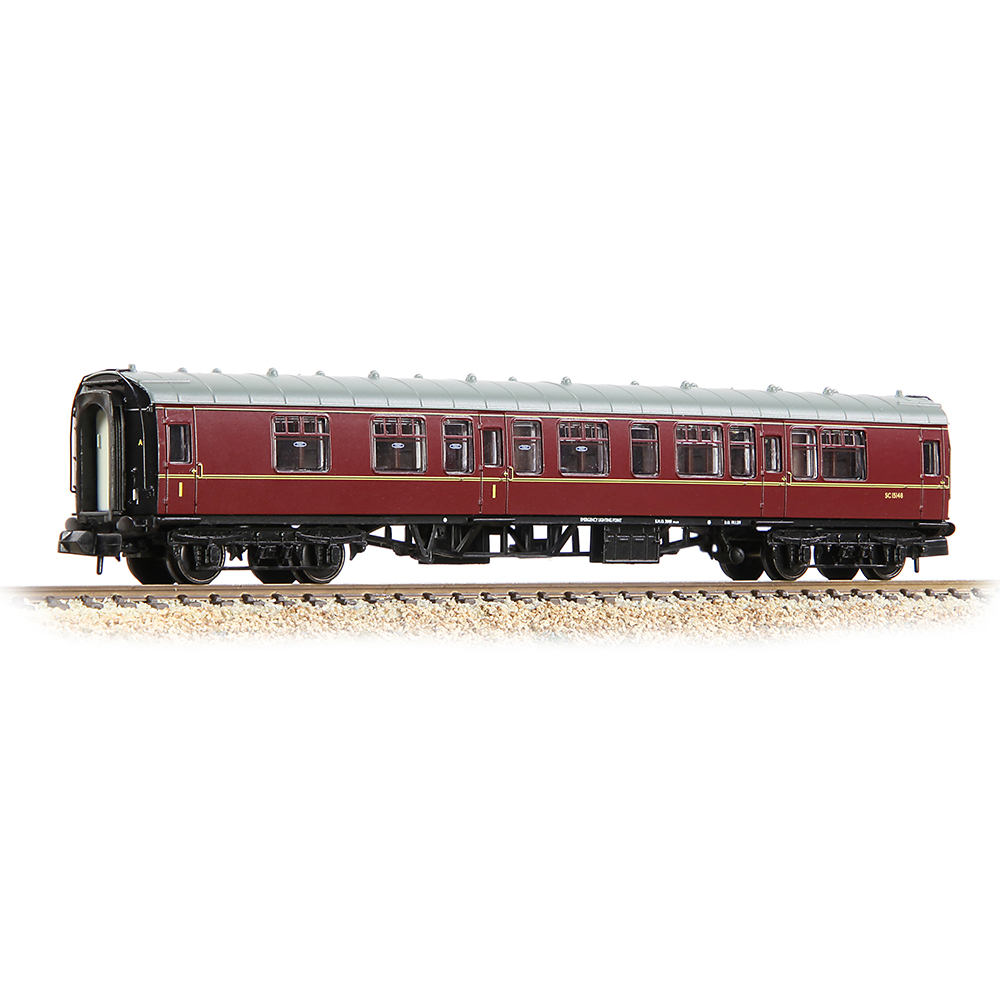
374-257EBR Mk1 CK Composite Corridor BR Maroon
'N' GaugeReleased: 31/07/23Era 5The British Railways Mk1 was the designation given to BR’s first standard design of main line coaching stock, and one of its most successful. Built from 1951 until the early 1960s to augment and replace the array of ‘Big Four’ and earlier ‘pre-grouping’ designs inherited from the LMS, LNER, GWR and SR, BR took the best features from several of these types to produce the new steel-bodied design. As a result, the Mk1 was stronger and safer than any of the inherited types that came before it.
Vehicles providing standard accommodation, with first- or second-class seating, or a composite mix of the two, were built in their thousands, along with many specialist types each with their own dedicated purpose. Numerous different catering vehicles were built, offering as little as a counter service right through to a full restaurant dining experience, whilst vehicles which incorporated an area for the Guard were combined with passenger accommodation and varying spaces for the conveyance of luggage, newspapers and parcels. Sleeping cars were also included, along with various general merchandise and specialised Post Office vans – some of which were equipped with apparatus to allow mail to be collected and set down on the move. Such was their success that following withdrawal from BR service, Mk1 coaches have become the mainstay of preservation operations and hundreds of vehicles remain in service today with heritage railways, whilst several still run on the main line in charter formations.
Our Price:
£43.15
£43.15
377-004BR YGH 'Sealion' Bogie Hopper Wagon LoadHaul Black & Orange
'N' GaugeReleased: 31/07/23Era 9Built by British Rail, these Bogie Ballast Hoppers were some of the largest wagons in the engineer’s fleet. Like most engineer’s wagons, these ballast hoppers received aquatic names and were usually known as Seacows or Sealions, depending on their braking arrangement. Used to carry ballast to work sites where it would be discharged via the chutes at the bottom of the hopper.

Our Price:
£53.95
£53.95
373-901DBR HAA Hopper EWS
'N' GaugeReleased: 02/08/23Era 9
Our Price:
£18.85
£18.85
373-901EBR HAA Hopper EWS
'N' GaugeReleased: 02/08/23Era 9
Our Price:
£18.85
£18.85
373-902DBR HAA Hopper BR Railfreight Coal Sector
'N' GaugeReleased: 02/08/23Era 8
Our Price:
£18.85
£18.85
373-904BR HAA Hopper BR Railfreight Red [W]
'N' GaugeReleased: 02/08/23Era 8
Our Price:
£20.65
£20.65
373-904ABR HAA Hopper BR Railfreight Red [W]
'N' GaugeReleased: 02/08/23Era 8
Our Price:
£20.65
£20.65
373-950CBR HCA Hopper Transrail
'N' GaugeReleased: 02/08/23Era 9
Our Price:
£19.75
£19.75
373-950DBR HCA Hopper Transrail
'N' GaugeReleased: 02/08/23Era 9
Our Price:
£19.75
£19.75
373-951BBR HFA Hopper Mainline Freight (Ex-BR Railfreight Coal Sector) [W]
'N' GaugeReleased: 02/08/23Era 8/9
Our Price:
£21.55
£21.55
373-951CBR HFA Hopper Mainline Freight (Ex-BR Railfreight Coal Sector) [W]
'N' GaugeReleased: 02/08/23Era 9
Our Price:
£21.55
£21.55
374-014BBR Mk1 TSO Tourist Second Open BR (WR) Chocolate & Cream
'N' GaugeReleased: 02/08/23Era 5The British Railways Mk1 was the designation given to BR’s first standard design of main line coaching stock, and one of its most successful. Built from 1951 until the early 1960s to augment and replace the array of ‘Big Four’ and earlier ‘pre-grouping’ designs inherited from the LMS, LNER, GWR and SR, BR took the best features from several of these types to produce the new steel-bodied design. As a result, the Mk1 was stronger and safer than any of the inherited types that came before it.
Vehicles providing standard accommodation, with first- or second-class seating, or a composite mix of the two, were built in their thousands, along with many specialist types each with their own dedicated purpose. Numerous different catering vehicles were built, offering as little as a counter service right through to a full restaurant dining experience, whilst vehicles which incorporated an area for the Guard were combined with passenger accommodation and varying spaces for the conveyance of luggage, newspapers and parcels. Sleeping cars were also included, along with various general merchandise and specialised Post Office vans – some of which were equipped with apparatus to allow mail to be collected and set down on the move. Such was their success that following withdrawal from BR service, Mk1 coaches have become the mainstay of preservation operations and hundreds of vehicles remain in service today with heritage railways, whilst several still run on the main line in charter formations.

Our Price:
£43.15
£43.15
374-014CBR Mk1 TSO Tourist Second Open BR (WR) Chocolate & Cream
'N' GaugeReleased: 02/08/23Era 5The British Railways Mk1 was the designation given to BR’s first standard design of main line coaching stock, and one of its most successful. Built from 1951 until the early 1960s to augment and replace the array of ‘Big Four’ and earlier ‘pre-grouping’ designs inherited from the LMS, LNER, GWR and SR, BR took the best features from several of these types to produce the new steel-bodied design. As a result, the Mk1 was stronger and safer than any of the inherited types that came before it.
Vehicles providing standard accommodation, with first- or second-class seating, or a composite mix of the two, were built in their thousands, along with many specialist types each with their own dedicated purpose. Numerous different catering vehicles were built, offering as little as a counter service right through to a full restaurant dining experience, whilst vehicles which incorporated an area for the Guard were combined with passenger accommodation and varying spaces for the conveyance of luggage, newspapers and parcels. Sleeping cars were also included, along with various general merchandise and specialised Post Office vans – some of which were equipped with apparatus to allow mail to be collected and set down on the move. Such was their success that following withdrawal from BR service, Mk1 coaches have become the mainstay of preservation operations and hundreds of vehicles remain in service today with heritage railways, whilst several still run on the main line in charter formations.

Our Price:
£43.15
£43.15