Search results
 379-062E
BR Mk1 SK Second Corridor BR Blue & Grey
 'N' Gauge
 Released: 10/08/23
 Era 6
Era 6The British Railways Mk1 was the designation given to BR’s first standard design of main line coaching stock, and one of its most successful. Built from 1951 until the early 1960s to augment and replace the array of ‘Big Four’ and earlier ‘pre-grouping’ designs inherited from the LMS, LNER, GWR and SR, BR took the best features from several of these types to produce the new steel-bodied design. As a result, the Mk1 was stronger and safer than any of the inherited types that came before it.
Vehicles providing standard accommodation, with first- or second-class seating, or a composite mix of the two, were built in their thousands, along with many specialist types each with their own dedicated purpose. Numerous different catering vehicles were built, offering as little as a counter service right through to a full restaurant dining experience, whilst vehicles which incorporated an area for the Guard were combined with passenger accommodation and varying spaces for the conveyance of luggage, newspapers and parcels. Sleeping cars were also included, along with various general merchandise and specialised Post Office vans – some of which were equipped with apparatus to allow mail to be collected and set down on the move. Such was their success that following withdrawal from BR service, Mk1 coaches have become the mainstay of preservation operations and hundreds of vehicles remain in service today with heritage railways, whilst several still run on the main line in charter formations

Our Price:
£43.15
£43.15
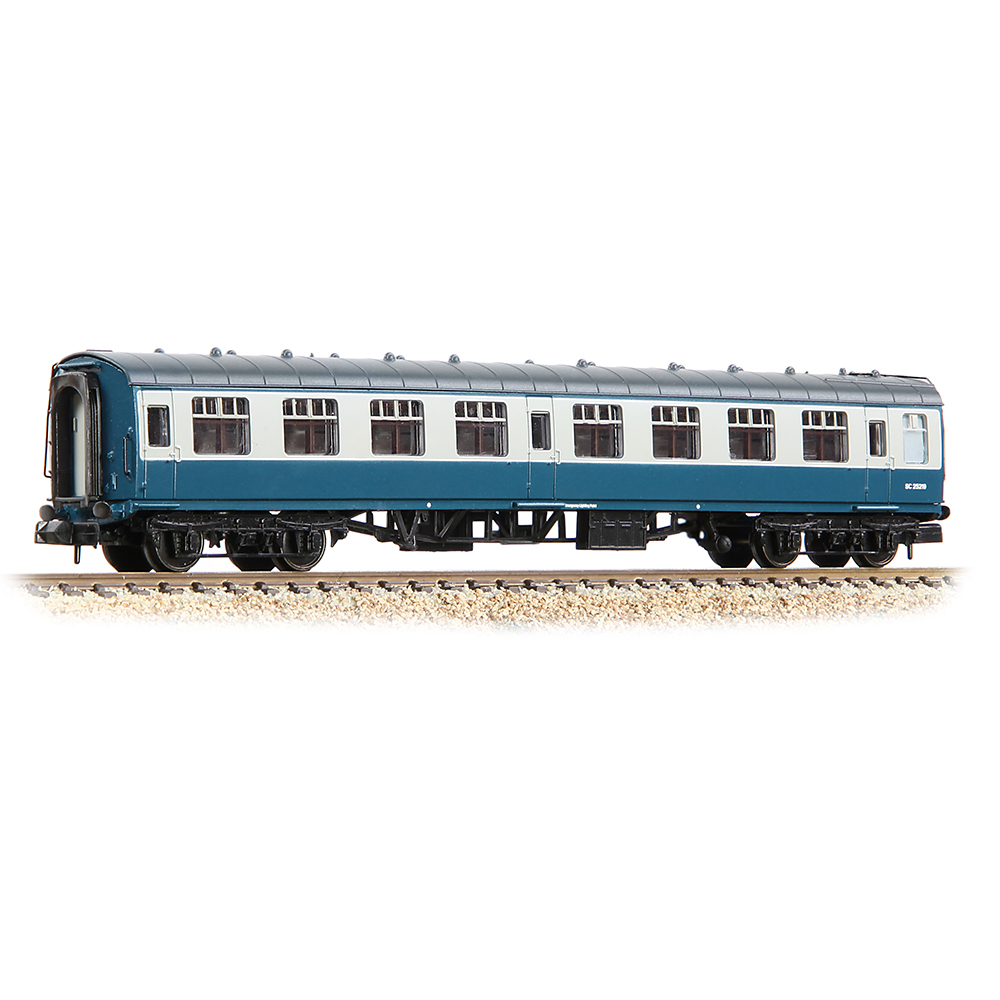
379-062EBR Mk1 SK Second Corridor BR Blue & Grey
'N' GaugeReleased: 10/08/23Era 6The British Railways Mk1 was the designation given to BR’s first standard design of main line coaching stock, and one of its most successful. Built from 1951 until the early 1960s to augment and replace the array of ‘Big Four’ and earlier ‘pre-grouping’ designs inherited from the LMS, LNER, GWR and SR, BR took the best features from several of these types to produce the new steel-bodied design. As a result, the Mk1 was stronger and safer than any of the inherited types that came before it.
Vehicles providing standard accommodation, with first- or second-class seating, or a composite mix of the two, were built in their thousands, along with many specialist types each with their own dedicated purpose. Numerous different catering vehicles were built, offering as little as a counter service right through to a full restaurant dining experience, whilst vehicles which incorporated an area for the Guard were combined with passenger accommodation and varying spaces for the conveyance of luggage, newspapers and parcels. Sleeping cars were also included, along with various general merchandise and specialised Post Office vans – some of which were equipped with apparatus to allow mail to be collected and set down on the move. Such was their success that following withdrawal from BR service, Mk1 coaches have become the mainstay of preservation operations and hundreds of vehicles remain in service today with heritage railways, whilst several still run on the main line in charter formations
Our Price:
£43.15
£43.15
374-062FBR Mk1 SK Second Corridor BR Blue & Grey
'N' GaugeReleased: 10/08/23Era 6The British Railways Mk1 was the designation given to BR’s first standard design of main line coaching stock, and one of its most successful. Built from 1951 until the early 1960s to augment and replace the array of ‘Big Four’ and earlier ‘pre-grouping’ designs inherited from the LMS, LNER, GWR and SR, BR took the best features from several of these types to produce the new steel-bodied design. As a result, the Mk1 was stronger and safer than any of the inherited types that came before it.
Vehicles providing standard accommodation, with first- or second-class seating, or a composite mix of the two, were built in their thousands, along with many specialist types each with their own dedicated purpose. Numerous different catering vehicles were built, offering as little as a counter service right through to a full restaurant dining experience, whilst vehicles which incorporated an area for the Guard were combined with passenger accommodation and varying spaces for the conveyance of luggage, newspapers and parcels. Sleeping cars were also included, along with various general merchandise and specialised Post Office vans – some of which were equipped with apparatus to allow mail to be collected and set down on the move. Such was their success that following withdrawal from BR service, Mk1 coaches have become the mainstay of preservation operations and hundreds of vehicles remain in service today with heritage railways, whilst several still run on the main line in charter formations

Our Price:
£43.15
£43.15
374-258EBR Mk1 CK Composite Corridor BR Blue & Grey
'N' GaugeReleased: 10/08/23Era 6The British Railways Mk1 was the designation given to BR’s first standard design of main line coaching stock, and one of its most successful. Built from 1951 until the early 1960s to augment and replace the array of ‘Big Four’ and earlier ‘pre-grouping’ designs inherited from the LMS, LNER, GWR and SR, BR took the best features from several of these types to produce the new steel-bodied design. As a result, the Mk1 was stronger and safer than any of the inherited types that came before it.
Vehicles providing standard accommodation, with first- or second-class seating, or a composite mix of the two, were built in their thousands, along with many specialist types each with their own dedicated purpose. Numerous different catering vehicles were built, offering as little as a counter service right through to a full restaurant dining experience, whilst vehicles which incorporated an area for the Guard were combined with passenger accommodation and varying spaces for the conveyance of luggage, newspapers and parcels. Sleeping cars were also included, along with various general merchandise and specialised Post Office vans – some of which were equipped with apparatus to allow mail to be collected and set down on the move. Such was their success that following withdrawal from BR service, Mk1 coaches have become the mainstay of preservation operations and hundreds of vehicles remain in service today with heritage railways, whilst several still run on the main line in charter formations.

Our Price:
£43.15
£43.15
 34-604D
BR Mk1 57ft 'Suburban' S Second BR Maroon
'OO' GaugeReleased: 16/08/23Era 5When it comes to coaching stock the non-corridor ‘Suburban’ coaches were certainly not the celebrities, but nonetheless they played a vital role moving hundreds of commuters in and out of cities and providing accommodation on branch lines and local trains. Despite inheriting all manner of non-corridor coaches from its predecessors, BR built its own fleet of standard non-corridor coaches and these popular models depict the 57ft Mk1 ‘Suburbans’.

Our Price:
£31.45
£31.45
34-630CBR Mk1 57ft 'Suburban' BS Brake Second BR Maroon
'OO' GaugeReleased: 16/08/23Era 5When it comes to coaching stock the non-corridor ‘Suburban’ coaches were certainly not the celebrities, but nonetheless they played a vital role moving hundreds of commuters in and out of cities and providing accommodation on branch lines and local trains. Despite inheriting all manner of non-corridor coaches from its predecessors, BR built its own fleet of standard non-corridor coaches and these popular models depict the 57ft Mk1 ‘Suburbans’.

Our Price:
£31.45
£31.45
34-700DBR Mk1 57ft 'Suburban' C Composite BR Maroon
'OO' GaugeReleased: 16/08/23Era 5When it comes to coaching stock the non-corridor ‘Suburban’ coaches were certainly not the celebrities, but nonetheless they played a vital role moving hundreds of commuters in and out of cities and providing accommodation on branch lines and local trains. Despite inheriting all manner of non-corridor coaches from its predecessors, BR built its own fleet of standard non-corridor coaches and these popular models depict the 57ft Mk1 ‘Suburbans’.

Our Price:
£31.45
£31.45
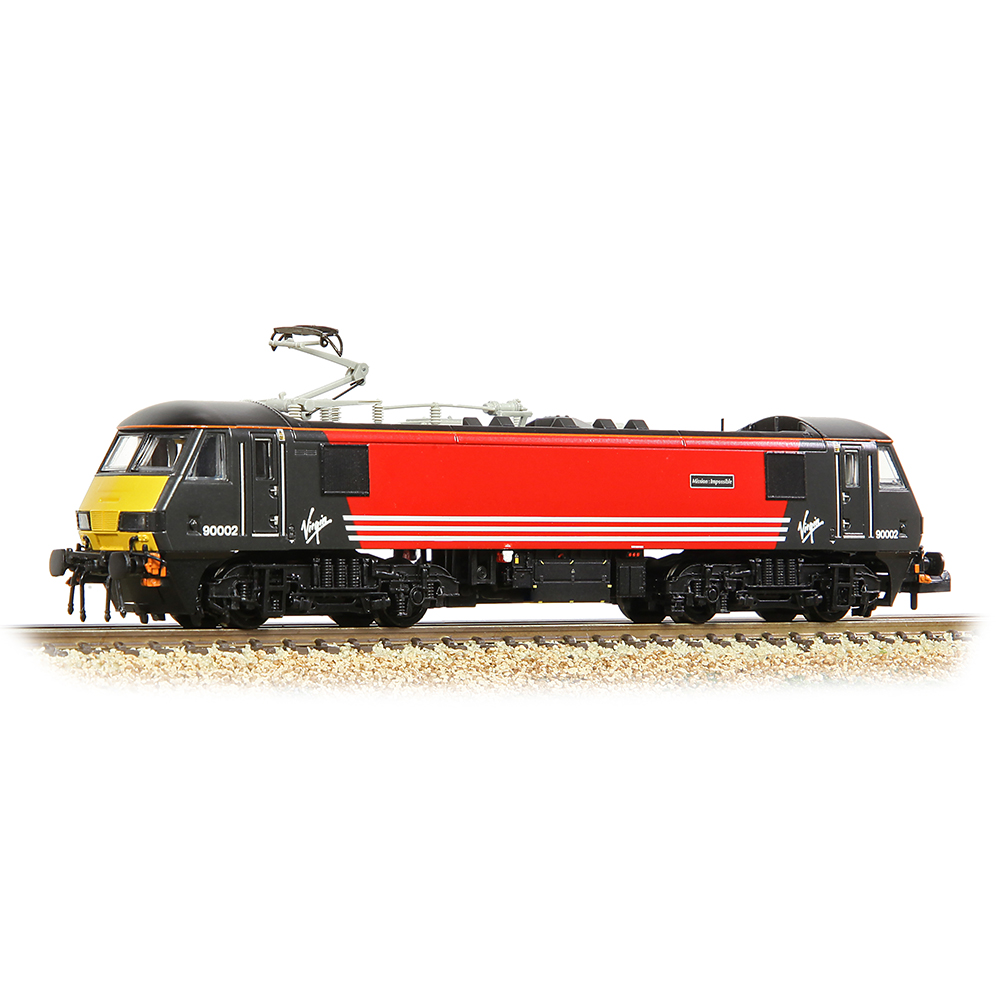
371-783AClass 90/0 90002 'Mission: Impossible' Virgin Trains (Original)
'N' GaugeReleased: 16/08/23 DCC Ready (Next18)Era 9
Fifty Class 90 locomotives were ordered by British Rail in 1986 to replace the ageing Class 85 fleet on West Coast Main Line duties, whilst also allowing BR to cascade a number of Class 86s to East Anglia. Constructed at British Rail Engineering Limited, Crewe, the new locomotives were initially classified as 87/2s however this was soon changed to Class 90 as the design featured a completely new body-shell – although much of the technology within was shared with the Class 87s.
Construction of the 110mph rated locomotives was completed in 1990 and the fleet was split between different sectors of British Rail – 15 were allocated to InterCity services, five for Rail Express Systems (mail and parcels traffic) and the remaining 30 for Railfreight Distribution. Most of those allocated to Railfreight Distribution would later be downgraded to 75mph and reclassified as 90/1s numbered in the 901xx series following work to isolate the Electric Train Heating and push-pull equipment making them dedicated freight locos.
Upon privatisation the Class 90 fleet was split between Virgin Trains, EWS and Freightliner. By 1999 all of the Class 90/1s acquired by EWS had been converted back to 90/0s due to an increased requirement for passenger locomotives to work contracted ScotRail sleeper trains and for hire to GNER for East Coast Main Line services. Further renumbering by EWS occurred when nine locos were fitted with different brake blocks and these became Class 90/2s numbered in the 902xx series. The Freightliner locos were also converted back to their original specification in the early 2000s.
The Class 90s have carried numerous liveries including three decorated in European liveries for the Freightconnection event in 1992 which coincided with the opening of the Channel Tunnel to freight services. No. 90128 was decorated in SNCB turquoise (Belgium), No. 90129 in DB red (Germany) and No. 90130 in SNCF orange and grey (France) and each carried the name Freightconnection in their respective languages, alongside No. 90022 which was named ‘Freightconnection’ and carried Railfreight Distribution livery.
The majority of the Class have carried names whilst in service and the 90s have appeared a variety of other post-Privatisation liveries such as GNER, DB Schenker, First ScotRail, One (Anglia), Greater Anglia, National Express, DRS and Malcolm Logistics. Today, Class 90s remain in operation with Freightliner, DB Cargo UK (ex-EWS/DB Schenker) and most recently Locomotive Services which has acquired Nos. 90001 and 90002 and repainted them into InterCity Swallow livery for use on charters and excursions.
Our Price:
£165.70
£165.70
371-783ASFClass 90/0 90002 'Mission: Impossible' Virgin Trains (Original) With DCC Sound
'N' GaugeReleased: 16/08/23DCC FittedDCC SoundEra 9SOUNDS
F0 - Directional Lights - On/Off (plus Light Switch Sound)
F1 - Sound - On/Off (plus Battery Switch and Compressor Sounds)
F2 - Brake
F3 - Low Horn (Playable)
F4 - Two-Tone Horn
F5 - Parking Brake On/Off (Loco won’t move with Parking Brake On)
F6 - On - Pantograph Up / Off - Pantograph Down (Sounds only)
F7 - Flange Squeal (Speed Related)
F8 - Windscreen Wipers
F9 - Air Dump
F10 - On - Guard’s Whistle / Off - Driver’s Response
F11 - Spirax Valve
F12 - Station Announcement
F13 - AWS
F14 - Cab Light (non-Pantograph End) On/Off (plus Light Switch Sound)
F15 - Cab Light (Pantograph End) On/Off (plus Light Switch Sound)
F16 - Coupling Up
F17 - Uncoupling
F18 - On - Cab Door Open / Off - Cab Door Shut
F19 - Uncoupling Movement Cycle
F20 - Directional Lights Off (Non-Pantograph End) (plus Light Switch Sound)
F21 - Directional Lights Off (Pantograph End) (plus Light Switch Sound)
F22 - Fire Alarm Test
F23 - Volume Control (6 levels)
Analogue Users: Please note that any automated drive sounds will be played when this model is used on analogue control (DC) straight from the box!

Our Price:
£250.70
£250.70
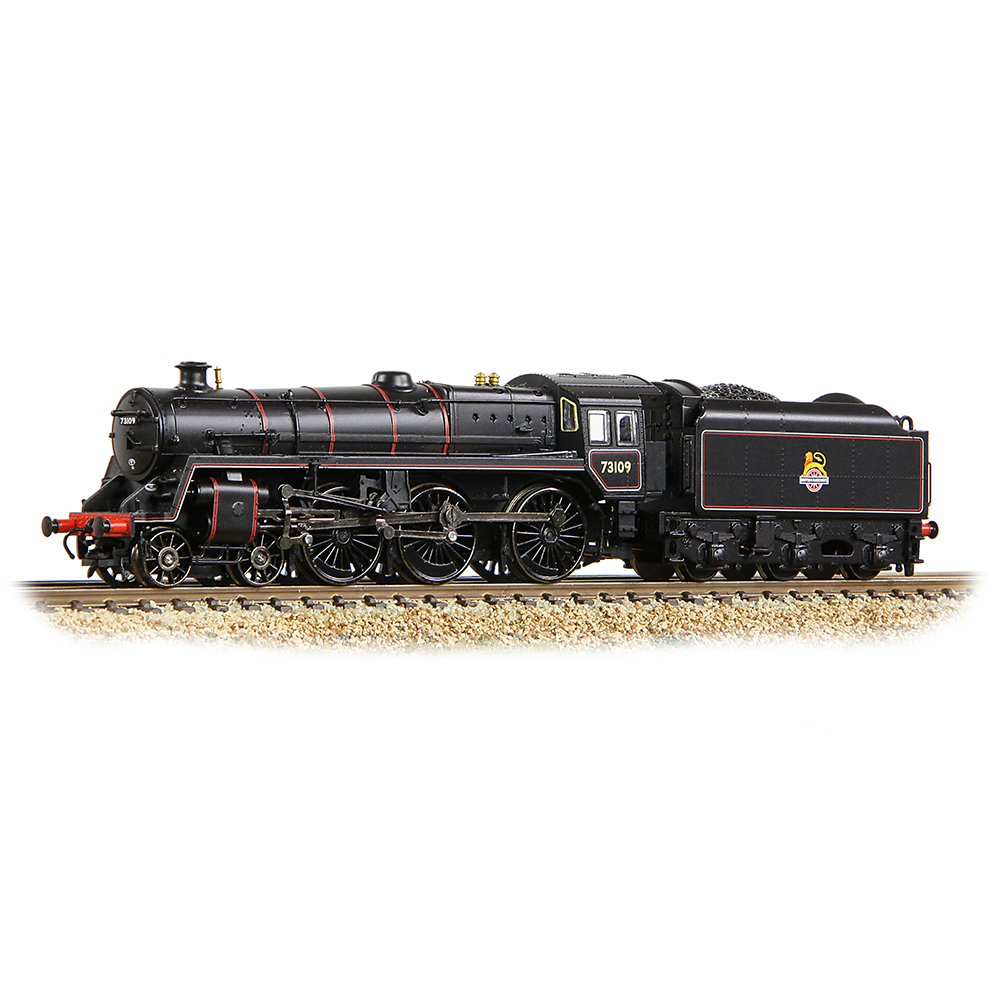
372-727ABR Standard 5MT with BR1B Tender 73109 BR Lined Black (Early Emblem)
'N' GaugeReleased: 16/08/23DCC Ready (Next18)Era 4The BR Standard Class 5MT locomotives were constructed between 1951 and 1957, under the direction of R. A. Riddles. Drawing inspiration from the LMS’s Stanier 5MT ‘Black 5s’, the ‘Standard 5’ had higher running boards and modern features like roller bearings, mechanical lubricators, self-cleaning fireboxes, hopper ashpans and rocking fire grates. In all 172 examples were built at BR’s Derby and Doncaster Works and the Class was widely distributed, with locomotives being allocated to every region of the BR network.
The 5MTs were coupled to a variety of tenders according to the needs of each region and the routes undertaken, for instance those allocated to the Southern Region received tender types with a greater water capacity than some delivered to the Midland Region, due to the lack of water troughs on the electrified Southern network. A significant engineering innovation was the fitting of the BR Caprotti valve gear to 30 members of the class – this part proved to be more mechanically efficient than the standard Walschaerts valve gear and the Caprotti locomotives were consequently more powerful for their size.
Twenty of the Southern Region locomotives were named in 1959, with each name being transferred from SR King Arthur Class locomotives that were being withdrawn. Withdrawals of the Standard 5s commenced in 1964 with just 23 surviving until 1968, when, with steam coming to an end on BR, the final examples were withdrawn. Five locomotives have however been preserved, including one fitted with Caprotti valve gear, and all have steamed in the preservation era.
Our Price:
£152.95
£152.95
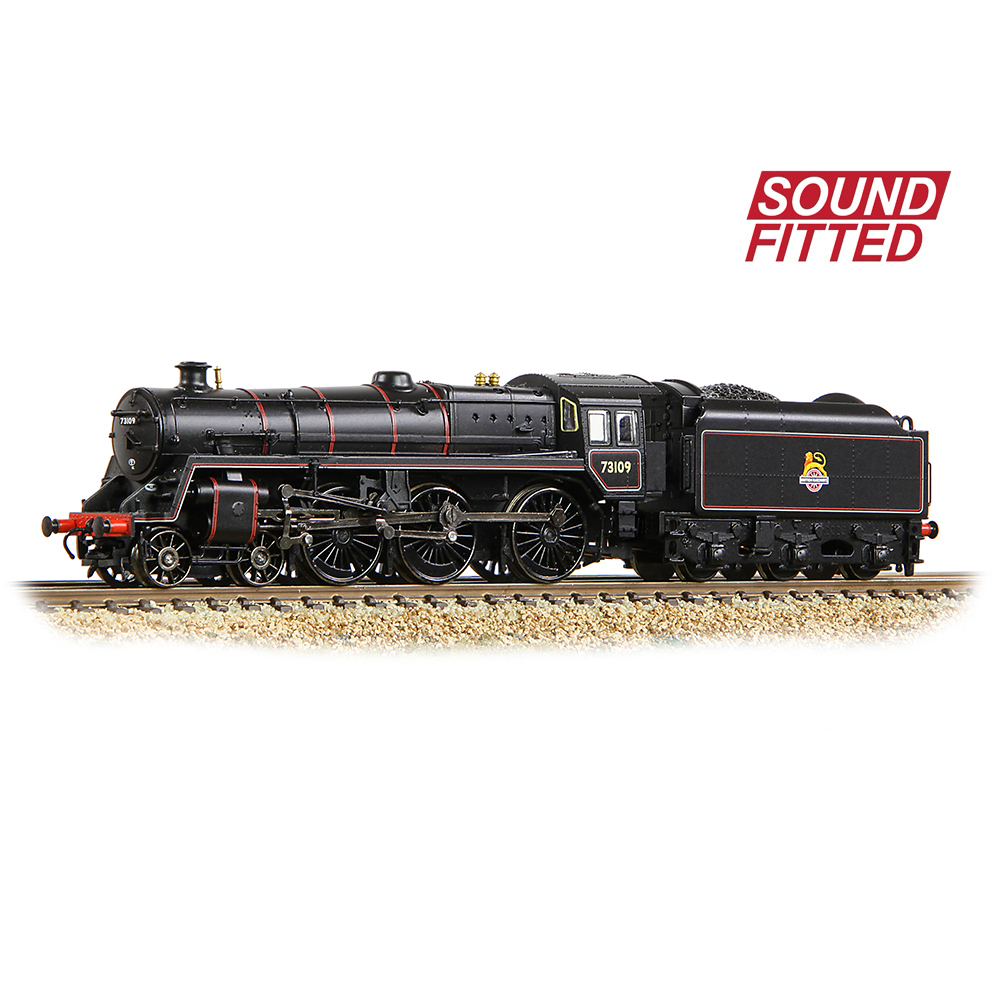
372-727ASFBR Standard 5MT with BR1B Tender 73109 BR Lined Black (Early Emblem) With DCC Sound
'N' GaugeReleased: 16/08/23DCC FittedDCC SoundEra 4SOUNDS
F1 - Sound On / Sound Off
F2 - Brake (Non-Latching)
F3 - Cylinder Drain Cocks
F4 - Single Whistle (Speed Related)
F5 - Reverser
F6 - Shovelling Coal
F7 - Injectors
F8 - Blower
F9 - Flange Squeal (Speed Related)
F10 - Safety Valve
F11 - Handbrake (locomotive will not move with the handbrake applied)
F12 - Water Tank Filling
F13 - Coupling Clank
F14 - Light Engine Mode
F15 - Fade All Sounds
F16 - Guard’s Whistle
F17 - Unfitted Freight Mode
F18 - Chime Whistle (Speed Related)
F19 - Long Duration Whistle
F20 - Short Duration Whistle
F21 - 'Going under Harry’
F22 - 'That’s an all clear from the Guard’
F23 - Guard to Driver - Freight
F24 - ‘Guard to Driver - Passenger
F25 - Volume Down
F26 - Volume Up
Analogue Users: Normal-load running sounds, acceleration steam chuff sounds and any other automatic and randomised sounds can be enjoyed when using this model on analogue control (DC) straight from the box!
Our Price:
£237.95
£237.95
372-729BR Standard 5MT with BR1 Tender 73050 BR Lined Black (Late Crest)
'N' GaugeReleased: 16/08/23DCC Ready (Next18)Era 5The BR Standard Class 5MT locomotives were constructed between 1951 and 1957, under the direction of R. A. Riddles. Drawing inspiration from the LMS’s Stanier 5MT ‘Black 5s’, the ‘Standard 5’ had higher running boards and modern features like roller bearings, mechanical lubricators, self-cleaning fireboxes, hopper ashpans and rocking fire grates. In all 172 examples were built at BR’s Derby and Doncaster Works and the Class was widely distributed, with locomotives being allocated to every region of the BR network.
The 5MTs were coupled to a variety of tenders according to the needs of each region and the routes undertaken, for instance those allocated to the Southern Region received tender types with a greater water capacity than some delivered to the Midland Region, due to the lack of water troughs on the electrified Southern network. A significant engineering innovation was the fitting of the BR Caprotti valve gear to 30 members of the class – this part proved to be more mechanically efficient than the standard Walschaerts valve gear and the Caprotti locomotives were consequently more powerful for their size.
Twenty of the Southern Region locomotives were named in 1959, with each name being transferred from SR King Arthur Class locomotives that were being withdrawn. Withdrawals of the Standard 5s commenced in 1964 with just 23 surviving until 1968, when, with steam coming to an end on BR, the final examples were withdrawn. Five locomotives have however been preserved, including one fitted with Caprotti valve gear, and all have steamed in the preservation era.

Our Price:
£152.95
£152.95
372-729ABR Standard 5MT with BR1 Tender 73006 BR Lined Black (Late Crest)
'N' GaugeReleased: 16/08/23DCC Ready (Next18)Era 5The BR Standard Class 5MT locomotives were constructed between 1951 and 1957, under the direction of R. A. Riddles. Drawing inspiration from the LMS’s Stanier 5MT ‘Black 5s’, the ‘Standard 5’ had higher running boards and modern features like roller bearings, mechanical lubricators, self-cleaning fireboxes, hopper ashpans and rocking fire grates. In all 172 examples were built at BR’s Derby and Doncaster Works and the Class was widely distributed, with locomotives being allocated to every region of the BR network.
The 5MTs were coupled to a variety of tenders according to the needs of each region and the routes undertaken, for instance those allocated to the Southern Region received tender types with a greater water capacity than some delivered to the Midland Region, due to the lack of water troughs on the electrified Southern network. A significant engineering innovation was the fitting of the BR Caprotti valve gear to 30 members of the class – this part proved to be more mechanically efficient than the standard Walschaerts valve gear and the Caprotti locomotives were consequently more powerful for their size.
Twenty of the Southern Region locomotives were named in 1959, with each name being transferred from SR King Arthur Class locomotives that were being withdrawn. Withdrawals of the Standard 5s commenced in 1964 with just 23 surviving until 1968, when, with steam coming to an end on BR, the final examples were withdrawn. Five locomotives have however been preserved, including one fitted with Caprotti valve gear, and all have steamed in the preservation era.

Our Price:
£152.95
£152.95
372-729ASFBR Standard 5MT with BR1 Tender 73006 BR Lined Black (Late Crest) With DCC Sound
'N' GaugeReleased: 16/08/23DCC FittedDCC SoundEra 5SOUNDS
F1 - Sound On / Sound Off
F2 - Brake (Non-Latching)
F3 - Cylinder Drain Cocks
F4 - Single Whistle (Speed Related)
F5 - Reverser
F6 - Shovelling Coal
F7 - Injectors
F8 - Blower
F9 - Flange Squeal (Speed Related)
F10 - Safety Valve
F11 - Handbrake (locomotive will not move with the handbrake applied)
F12 - Water Tank Filling
F13 - Coupling Clank
F14 - Light Engine Mode
F15 - Fade All Sounds
F16 - Guard’s Whistle
F17 - Unfitted Freight Mode
F18 - Chime Whistle (Speed Related)
F19 - Long Duration Whistle
F20 - Short Duration Whistle
F21 - 'Going under Harry’
F22 - 'That’s an all clear from the Guard’
F23 - Guard to Driver - Freight
F24 - ‘Guard to Driver - Passenger
F25 - Volume Down
F26 - Volume Up
Analogue Users: Normal-load running sounds, acceleration steam chuff sounds and any other automatic and randomised sounds can be enjoyed when using this model on analogue control (DC) straight from the box!

Our Price:
£237.95
£237.95
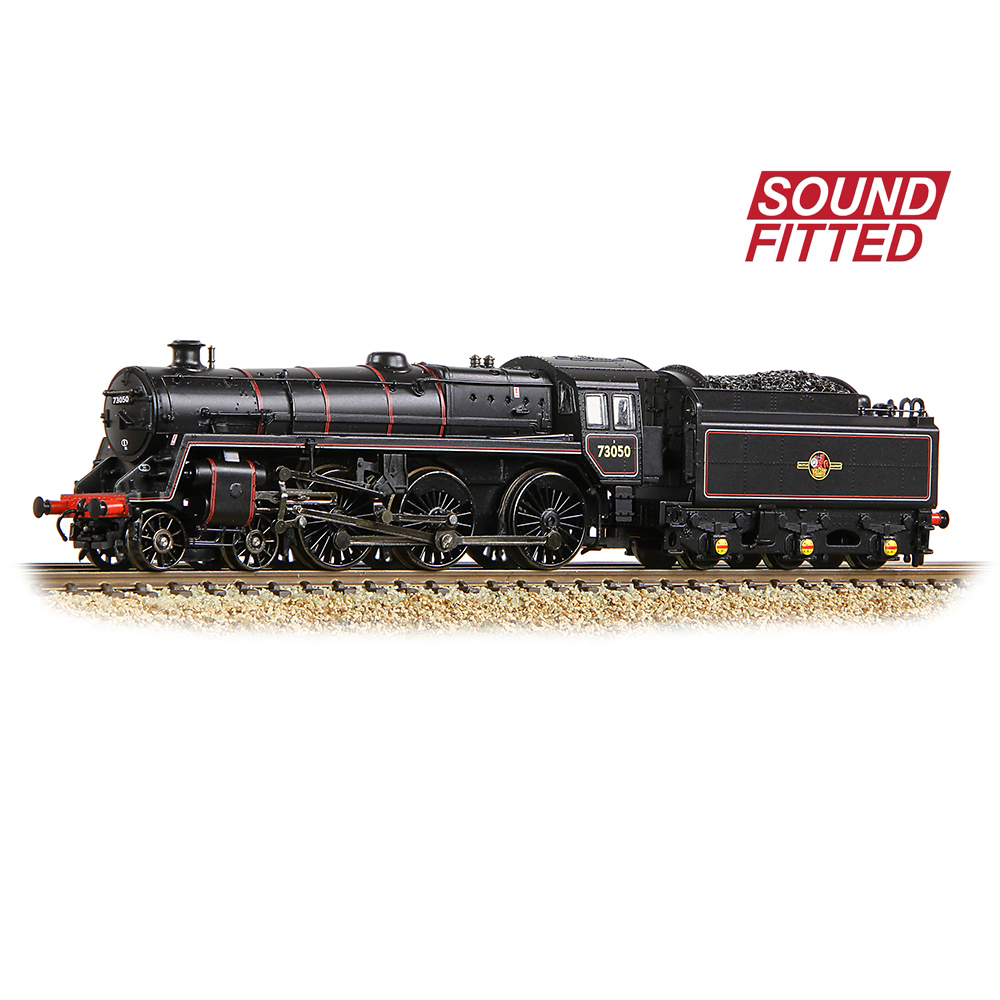
372-729SFBR Standard 5MT with BR1 Tender 73050 BR Lined Black (Late Crest) With DCC Sound
'N' GaugeReleased: 16/08/23Era 5SOUNDS
F1 - Sound On / Sound Off
F2 - Brake (Non-Latching)
F3 - Cylinder Drain Cocks
F4 - Single Whistle (Speed Related)
F5 - Reverser
F6 - Shovelling Coal
F7 - Injectors
F8 - Blower
F9 - Flange Squeal (Speed Related)
F10 - Safety Valve
F11 - Handbrake (locomotive will not move with the handbrake applied)
F12 - Water Tank Filling
F13 - Coupling Clank
F14 - Light Engine Mode
F15 - Fade All Sounds
F16 - Guard’s Whistle
F17 - Unfitted Freight Mode
F18 - Chime Whistle (Speed Related)
F19 - Long Duration Whistle
F20 - Short Duration Whistle
F21 - 'Going under Harry’
F22 - 'That’s an all clear from the Guard’
F23 - Guard to Driver - Freight
F24 - ‘Guard to Driver - Passenger
F25 - Volume Down
F26 - Volume Up
Analogue Users: Normal-load running sounds, acceleration steam chuff sounds and any other automatic and randomised sounds can be enjoyed when using this model on analogue control (DC) straight from the box!
Our Price:
£237.95
£237.95
372-730SFBR Standard 5MT with BR1C Tender 73065 BR Lined Black (Early Emblem) With DCC Sound
'N' GaugeReleased: 16/08/23Era 4SOUNDS
F1 - Sound On / Sound Off
F2 - Brake (Non-Latching)
F3 - Cylinder Drain Cocks
F4 - Single Whistle (Speed Related)
F5 - Reverser
F6 - Shovelling Coal
F7 - Injectors
F8 - Blower
F9 - Flange Squeal (Speed Related)
F10 - Safety Valve
F11 - Handbrake (locomotive will not move with the handbrake applied)
F12 - Water Tank Filling
F13 - Coupling Clank
F14 - Light Engine Mode
F15 - Fade All Sounds
F16 - Guard’s Whistle
F17 - Unfitted Freight Mode
F18 - Chime Whistle (Speed Related)
F19 - Long Duration Whistle
F20 - Short Duration Whistle
F21 - 'Going under Harry’
F22 - 'That’s an all clear from the Guard’
F23 - Guard to Driver - Freight
F24 - ‘Guard to Driver - Passenger
F25 - Volume Down
F26 - Volume Up
Analogue Users: Normal-load running sounds, acceleration steam chuff sounds and any other automatic and randomised sounds can be enjoyed when using this model on analogue control (DC) straight from the box!

Our Price:
£237.95
£237.95
372-730BR Standard 5MT with BR1C Tender 73065 BR Lined Black (Early Emblem)
'N' GaugeReleased: 16/08/23DCC Ready (Next18)Era 4The BR Standard Class 5MT locomotives were constructed between 1951 and 1957, under the direction of R. A. Riddles. Drawing inspiration from the LMS’s Stanier 5MT ‘Black 5s’, the ‘Standard 5’ had higher running boards and modern features like roller bearings, mechanical lubricators, self-cleaning fireboxes, hopper ashpans and rocking fire grates. In all 172 examples were built at BR’s Derby and Doncaster Works and the Class was widely distributed, with locomotives being allocated to every region of the BR network.
The 5MTs were coupled to a variety of tenders according to the needs of each region and the routes undertaken, for instance those allocated to the Southern Region received tender types with a greater water capacity than some delivered to the Midland Region, due to the lack of water troughs on the electrified Southern network. A significant engineering innovation was the fitting of the BR Caprotti valve gear to 30 members of the class – this part proved to be more mechanically efficient than the standard Walschaerts valve gear and the Caprotti locomotives were consequently more powerful for their size.
Twenty of the Southern Region locomotives were named in 1959, with each name being transferred from SR King Arthur Class locomotives that were being withdrawn. Withdrawals of the Standard 5s commenced in 1964 with just 23 surviving until 1968, when, with steam coming to an end on BR, the final examples were withdrawn. Five locomotives have however been preserved, including one fitted with Caprotti valve gear, and all have steamed in the preservation era.

Our Price:
£152.95
£152.95
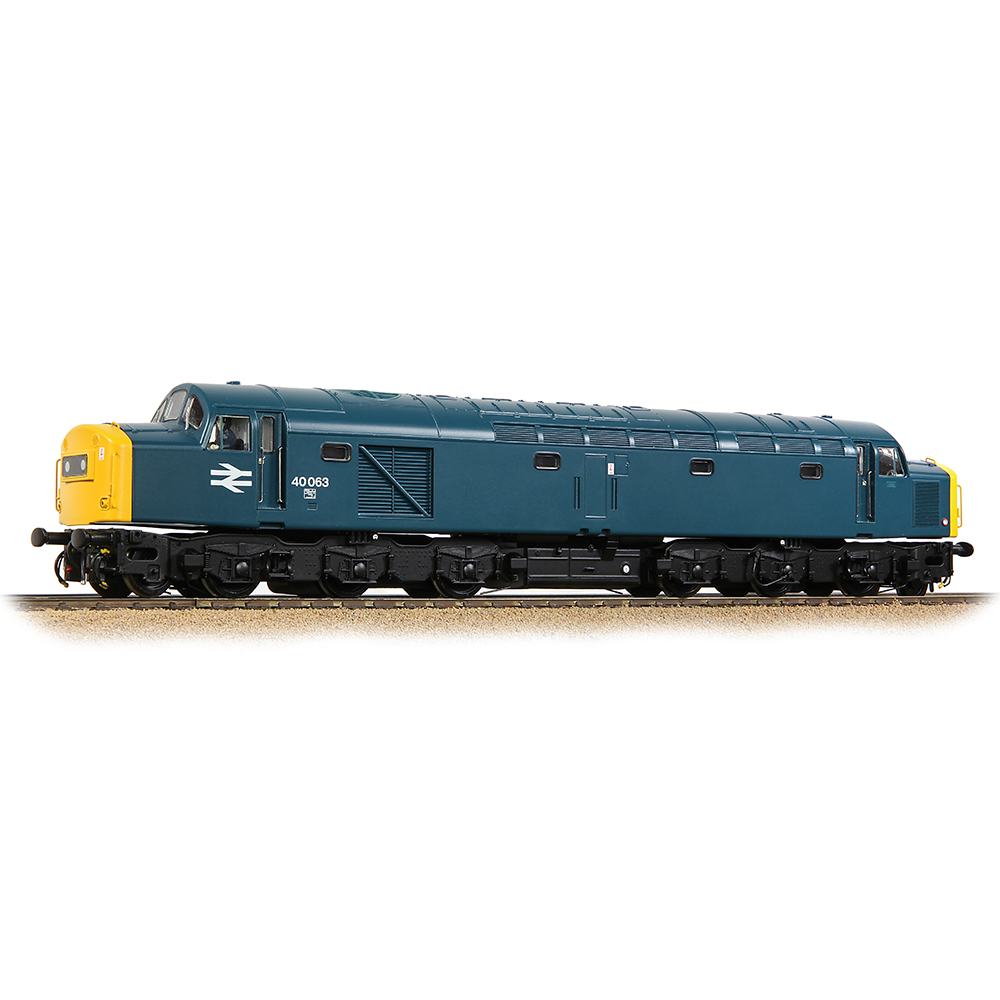
32-490Class 40 Centre Headcode (ScR) 40063 BR Blue
'OO' GaugeReleased: 28/08/23DCC Ready (PluX22)Era 7The Class 40 Diesel Locomotive has long been a highlight of the Bachmann Branchline OO scale fleet, and for 2023 this popular model has been upgraded to bring you more features than ever before. New tooling has also been produced and is employed here to depict this Scottish Region locomotive which has seen its headcode discs and communication doors replaced with central headcode panels. The distinguishing features of these Scottish locos – their square-cornered headcode boxes, the lack of handrails around the headcode boxes and the uneven bottom to the nose – are all present and correct on this model of No. 40063 which carries BR Blue livery.
With the DCC decoder interface upgraded to Plux22; new lighting features and enhanced speaker arrangements have also been employed on the Class 40 to enhance the operating experience. On track the model has a mighty presence, just like the real locomotives and, with its five pole, twin flywheel motor powering all six driving wheels, you can be sure of a performance to match too. This Class 40’s good looks are enriched by the superb livery application using true-to-prototype colours, fonts and logos to produce a model fit for any collection.
Our Price:
£195.45
£195.45
32-492Class 40 Disc Headcode 40039 BR Green (Full Yellow Ends) [W] With DCC Sound fitted
'OO' GaugeReleased: 28/08/23DCC FittedDCC SoundEra 7SOUNDS
F0 - Directional Lights - On/Off (plus Light Switch Sound)
F1 - On - Warm Engine Start / On, Off - Failed Engine Start / On, Off, On - Cold Engine Start
F2 - Brake
F3* - Horn
F4* - Horn
F5 - Heavy Load
F6 - Coasting (Manual notch Down if F22 On)
F7 - Maximum Revs (Manual notch Up if F22 On)
F8** - On - Coupling Up / Off - Uncoupling
F9 - Flange Squeal (Speed Related)
F10 - Fan Noise
F11 - On - Guard’s Whistle / Off - Driver’s Response Horn
F12 - Cab Lights On/Off No. 1 End (plus Light Switch Sound)
F13 - Cab Lights On/Off No. 2 End (plus Light Switch Sound)
F14 - High Intensity Headlight (if fitted, F0 must be ON)
F15 - Auto Uncouple Cycle
F16 - AWS Horn
F17 - AWS Bell
F18 - On - Sound Fades Out / Off - Sound Fades In
F19 - Mute (Latch) / Volume Cycles 6 Levels (Trigger)
F20 - No. 1 End (Fan) Directional Lights Off
F21 - No. 2 End (non-Fan) Directional Lights Off
F22 - Manual Notching Logic On/Off (control with F6 & F7)
F23 - Spirax Valve
F24 - Station Announcement
F25 - On - Driver’s Door Open / Off - Driver’ Door Shut
F26 - Air Dump
F27 - Exhauster
*Alternative Horn sounds and behaviour can be selected via CV changes
** Alternative coupling sounds can be selected via CV changes
Analogue Users: Please note that normal load running sounds and any other automatic or randomised sounds will also operate when this model is used on analogue control (DC) straight from the box!

Our Price:
£288.95
£288.95
32-392Class 40 Disc Headcode 40039 BR Green (Full Yellow Ends) [W]
'OO' GaugeReleased: 28/08/23DCC Ready (PluX22)Era 7CLASS 40 HISTORY
The British Rail Class 40 is a British Railways diesel-electric locomotive, rated at 2,000 hp and classified as a Type 4. A total of 200 were built by English Electric between 1958 and 1962 and numbered in the series D200-D399. They were for a time the pride of the British Rail early diesel fleet. Despite their initial success, by the time the last examples were entering service they were already being replaced on some top-link duties by more powerful locomotives. As they were slowly relegated from express passenger uses, the type found work on secondary passenger and freight services where they worked for many years. The final locomotives ended regular service in 1985.
Class 40s operated in all areas of British Railways although Western and Southern Region workings were less common. After the early trials, the majority of Class 40s were based at depots in northern England; notably Longsight, Carlisle Kingmoor, and Wigan Springs Branch on the Midland Region, and Thornaby and Gateshead on the Eastern Region.
The heyday of the Class was in the early 1960s when they hauled top-link expresses on the West Coast Main Line and in East Anglia. However, the arrival of more powerful diesel locomotives, such as Class 47s and Class 55s, together with the electrification of the West Coast Main Line, meant that the fleet was gradually relegated to more mundane duties. In later life, the locomotives were mainly to be found hauling heavy freight and passenger trains in the north of England and Scotland. As additional new rolling stock was introduced, their passenger work decreased, partly due to their lack of electric train heating for newer passenger coaches. They lost their last front-line passenger duties - in Scotland - in 1980, and the last regular use on passenger trains was on the North Wales Coast Line between Holyhead, Crewe and Manchester, along with regular forays across the Pennines on Liverpool to York and Newcastle services.
Throughout the early 1980s Class 40s were common performers on relief, day excursion (adex) and holidaymaker services along with deputising for electric traction, especially on Sundays between Manchester and Birmingham. This resulted in visits to many distant parts of the network. It would be fair to say that few routes in the London Midland and Eastern regions did not see Class 40-worked passenger services from time to time. Regular destinations included the seaside resorts of Scarborough, Skegness and Cleethorpes on the Eastern region, with Blackpool and Stranraer being regularly visited on the West Coast.

Our Price:
£203.95
£203.95