
Search results
 R30272
GWR, Castle Class, 4-6-0, 4074 'Caldicot Castle': Big Four Centenary Collection
 'OO' Gauge
 Released: 30/10/23
 DCC Ready (21 Pin)
 Era 3
Era 3The Castle Class was designed by Charles Collett, the successor to legendary GWR engineer George Jackson Churchward. In truth, Castle Class is nothing more than a nickname owing to most examples of the class being named after western castles with the official GWR designation being the 4073 class.
This name comes from the first example of the Class 4073 Caerphilly Castle, as was common with GWR classes. Charles Collet improved on the work of Churchward with the Castle Class, with the class proving to be among the most powerful on the GWR network. In a tragic twist of fate, Churchward would go on to be killed when struck by one of the succeeding engineers locomotives 4085 Berkeley Castle.
The first of the class would feature at the British Empire Exhibition in 1924 alongside an equivalent engine from the LNER, one 4472 Flying Scotsman. Over the course of the exhibition the GWR claimed their Castle to be more powerful than the LNER contingent, leading to exchange trials between the GWR and image conscious LNER. In April 1925 4079 Pendennis Castle and 4474 Victor Wild would be exchanged between the two companies.
The Castle Class was lighter than the LNER pacific which proved to be an unexpected positive as the LNER found it still capable of hauling their express services doing so faster and more efficiently than their locomotives of the time. Conversely, the GWR found the LNER locomotive to have too long a wheelbase for their rails, hampering is performance on the twisting and winding curves of the western region.
The Castle Class was lighter than the LNER pacific which proved to be an unexpected positive as the LNER found it still capable of hauling their express services doing so faster and more efficiently than their locomotives of the time. Conversely, the GWR found the LNER locomotive to have too long a wheelbase for their rails, hampering is performance on the twisting and winding curves of the western region.
4074 'Caldicot Castle' was the second of the class to be built, again as a bespoke example following on from 4073 'Caerphilly Castle' some four months later. The locomotive would play a part in the LNER exchange trials, when the A1 Pacific 4474 'Victor Wild' was compared to it on GWR rails. The locomotive would pass into BR service while retaining its 4074 running number before being withdrawn in May of 1963. The locomotive would not become one of the eight preserved.
The Hornby Castle class is fitted with a five pole motor and simple mechanism resulting in fantastic performance. DCC users are catered for via an 8 pin socket inside the tender with space for a speaker to be fitted. This model features special packaging as part of its position in the celebration of the centenary of the Grouping Act coming into affect, resulting in the start of the 'Big Four' era.

Our Price:
£197.09
£197.09
R30270LNER, Class A1, 4-6-2, 4478 'Hermit': Big Four Centenary Collection
'OO' GaugeReleased: 04/11/23DCC Ready (21 Pin)Era 3Nigel Gresley's A1 Pacific class emerged in the twilight years of the Great Northern Railway, a result of an idea that Gresley had nurtured since 1915. The First World War put his plans for new express passenger locomotives on hold but he applied his new three cylinder, conjugated valve gear designs to the O2 and K3 freight locomotives before returning to his plans for an express passenger Pacific in 1920, producing his 4-6-2 A1 design.
No.1470 'Great Northern' was the first to enter service on the 11 April 1922 and Gresley confidently claimed that his A1 class could pull 600 ton trains which in September 1922 no.1471 'Sir Frederick Banbury' did. Compared to the similar LNER design by Vincent Raven, Gresley's A1 consumed less coal and water and was considered the better design, consequently the LNER chose the A1 design over the LNER A2.
The original eleven engines were built to the generous loading gauge of the GNR and after grouping in 1923 had to be modified to fit the loading gauge of the LNER with the chimney and dome both being reduced in height, plus the fitting of shorter safety valves.
The A1s quickly showed their ability to haul heavy loads on the East Coast Main Line but coal and water consumption was inefficient which was highlighted during the 1925 Great Western Exchange Trains with the A1s comparing unfavourably with the Castle class design. Consequent alterations to the steam lap settings and valve travel showed a reduction in coal consumption and this was adopted on all of the A1s by 1931. The piston valve rings were also replaced by the Knorr type piston valves which reduced steam loss.
Gresley had experimented with a different superheater to improve the A1s performance further but lacking significant results decided that he would increase the number of flues in the existing Robinson superheater. This coupled with an increase in boiler pressure led to improved performance and five of these new boilers were ordered in 1927 and were fitted to No.2544 'Lemberg' and No.4480 'Enterprise' later that year.
Trials on these two A1s proved successful and so between 1927 and 1947 all of the A1s were rebuilt as Class A3 with the exception of No.4470 'Great Northern' which was eventually rebuilt by Thompson in 1945 as Class A1/1. Due to the wider header on the A3 boilers the ends projected slightly through the side of the smokebox and so cover plates were fitted to hide these projections becoming the main external distinguishing feature between the A3 and A1 locomotives.
4478 Hermit was among the first 10 of the class to be built, rolling out of Doncaster works in July 1923 and into revenue earning service with the LNER. Just over halfway through its service life the locomotive would be rebuilt into the improved A3 Class with the conversion being undertaken in November of 1943.
Withdrawal for the locomotive would take place in 1962, with all members of the class bar one being scrapped. Hermit, then 40109, was not the preserved example, with Flying Scotsman being saved and passing into railway legend due to its post-service career.
This Hornby model of 'Hermit' not only boasts a five pole skew wound motor but also a diecast running plate which adds increased weight for improved traction. Also worthy of note is the addition of a flickering firebox which illuminates the fully detailed cab.

Our Price:
£197.09
£197.09
 35-025B
GWR 94XX Pannier Tank 9466 GWR Green (GWR)
'OO' GaugeReleased: 16/11/23DCC Ready (Next18)Era 8The 94xx Pannier Tank returns to the Bachmann Branchline range and with its unconventional appearance – with large water tanks and extended smokebox – this model will bring a real presence to any model railway. A quintessential part of the GWR for many decades, the Pannier Tank design was developed and refined before the 94xx, the final design of GWR tank engine, was produced. No. 9466, as depicted by this model, one of only two preserved examples, found fame after returning to steam in the mid-1980s and operated on the mainline hauling ‘Steam on the Met’ rail tours.
Take a closer look at the Branchline model and you will see a wealth of detail, from the separately fitted pipe runs that extend all the way from the front bufferbeam to the back, to the modelling of the inside motion which is authentically decorated too. There are handrails aplenty – all separately fitted of course – whilst the metal lamp brackets, separate smokebox door dart and whilst with guard and supply pipes all catch the eye. Sprung buffers are fitted at the front and rear along with a copper cap to the chimney. Look inside the cab and a full complement of controls and dials is present, all decorated accordingly, which is only added to by the firebox lighting system which adds a further dimension of realism to every model.
Technically the 94xx shines as well, with a Next18 DCC decoder socket paired with an integrated speaker making SOUND FITTED models an option if you wish to enjoy sound effects when operating your model railway. The powerful coreless motor drives the rear axle and electrical collection comes from all wheels, whilst each axle is fitted with a pair of separate metal bearings.

Our Price:
£140.20
£140.20
35-026ASFGWR 94XX Pannier Tank 9481 BR Black (Early Emblem) With DCC Sound Fitted
'OO' GaugeReleased: 16/11/23DCC FittedDCC SoundEra 4SOUNDS
F1 - Sound On / Sound Off
F2 - Brake (Non-Latching)
F3 - Cylinder Drain Cocks
F4 - Whistle, High Tone (Playable)
F5 - Normal Load / Heavy Load
F6 (STATIONARY) - Firebox Door Open (red firebox light flickers)
F6 (MOVING) - Firebox Door Open (red firebox light flickers and yellow light pulses in time with the exhaust)
F7 - Injectors
F8 - Whistle, Low Tone (Playable)
F9 - Flange Squeal
F10 - Shovelling Coal (F6 must be On to activate this function)
F11 - Blower (with F6 On and the locomotive stopped the red and yellow firebox lights will also flicker)
F12 - Hand Brake (locomotive will not move with the Hand Brake applied)
F13 - Water Tank Filling
F14 - Coupling/un-Coupling Clank
F15 - Safety Valve
F16 - Guard’s Whistle & Driver’s Response Toot
F17 - Coasting
F18 - Rail Join Clatter (Speed Variable)
F19 - Shunt Mode (reduces speed)
F20 - Acceleration/Deceleration inertia off
F21 - Volume Control (LATCH = Volume On/Off) or (TRIGGER = cycles 6 Volume Levels)
Analogue Users: Normal-load running sounds, acceleration steam chuff sounds and any other automatic and randomised sounds can be enjoyed when using this model on analogue control (DC) straight from the box - these sounds will play automatically when power is applied!

Our Price:
£225.20
£225.20
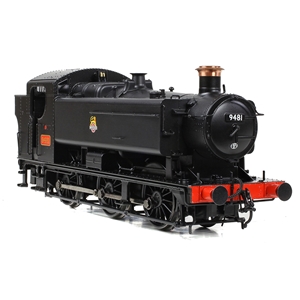
35-026AGWR 94XX Pannier Tank 9481 BR Black (Early Emblem)
'OO' GaugeReleased: 16/11/23DCC Ready (Next18)Era 4The 94xx Pannier Tank returns to the Bachmann Branchline range and with its unconventional appearance – with large water tanks and extended smokebox – this model will bring a real presence to any model railway. A quintessential part of the GWR for many decades, the Pannier Tank design was developed and refined before the 94xx, the final design of GWR tank engine, was produced.
Take a closer look at the Branchline model and you will see a wealth of detail, from the separately fitted pipe runs that extend all the way from the front bufferbeam to the back, to the modelling of the inside motion which is authentically decorated too. There are handrails aplenty – all separately fitted of course – whilst the metal lamp brackets, separate smokebox door dart and whilst with guard and supply pipes all catch the eye. Sprung buffers are fitted at the front and rear along with a copper cap to the chimney. Look inside the cab and a full complement of controls and dials is present, all decorated accordingly, which is only added to by the firebox lighting system which adds a further dimension of realism to every model.
Technically the 94xx shines as well, with a Next18 DCC decoder socket paired with an integrated speaker making SOUND FITTED models an option if you wish to enjoy sound effects when operating your model railway. The powerful coreless motor drives the rear axle and electrical collection comes from all wheels, whilst each axle is fitted with a pair of separate metal bearings.
Our Price:
£140.20
£140.20
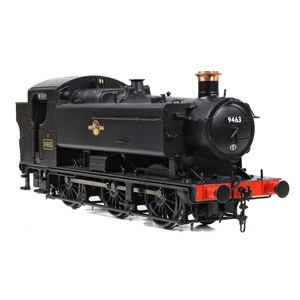
35-027AGWR 94XX Pannier Tank 9463 BR Black (Late Crest)
'OO' GaugeReleased: 16/11/23DCC Ready (Next18)Era 5The 94xx Pannier Tank returns to the Bachmann Branchline range and with its unconventional appearance – with large water tanks and extended smokebox – this model will bring a real presence to any model railway. A quintessential part of the GWR for many decades, the Pannier Tank design was developed and refined before the 94xx, the final design of GWR tank engine, was produced.
Take a closer look at the Branchline model and you will see a wealth of detail, from the separately fitted pipe runs that extend all the way from the front bufferbeam to the back, to the modelling of the inside motion which is authentically decorated too. There are handrails aplenty – all separately fitted of course – whilst the metal lamp brackets, separate smokebox door dart and whilst with guard and supply pipes all catch the eye. Sprung buffers are fitted at the front and rear along with a copper cap to the chimney. Look inside the cab and a full complement of controls and dials is present, all decorated accordingly, which is only added to by the firebox lighting system which adds a further dimension of realism to every model.
Technically the 94xx shines as well, with a Next18 DCC decoder socket paired with an integrated speaker making SOUND FITTED models an option if you wish to enjoy sound effects when operating your model railway. The powerful coreless motor drives the rear axle and electrical collection comes from all wheels, whilst each axle is fitted with a pair of separate metal bearings.
Our Price:
£140.20
£140.20
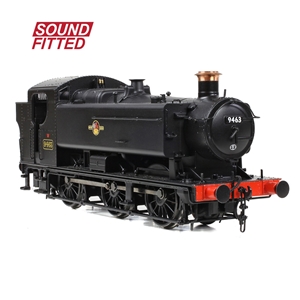
35-027ASFGWR 94XX Pannier Tank 9463 BR Black (Late Crest) With DCC Sound Fitted
'OO' GaugeReleased: 16/11/23DCC FittedDCC SoundEra 5SOUNDS
F1 - Sound On / Sound Off
F2 - Brake (Non-Latching)
F3 - Cylinder Drain Cocks
F4 - Whistle, High Tone (Playable)
F5 - Normal Load / Heavy Load
F6 (STATIONARY) - Firebox Door Open (red firebox light flickers)
F6 (MOVING) - Firebox Door Open (red firebox light flickers and yellow light pulses in time with the exhaust)
F7 - Injectors
F8 - Whistle, Low Tone (Playable)
F9 - Flange Squeal
F10 - Shovelling Coal (F6 must be On to activate this function)
F11 - Blower (with F6 On and the locomotive stopped the red and yellow firebox lights will also flicker)
F12 - Hand Brake (locomotive will not move with the Hand Brake applied)
F13 - Water Tank Filling
F14 - Coupling/un-Coupling Clank
F15 - Safety Valve
F16 - Guard’s Whistle & Driver’s Response Toot
F17 - Coasting
F18 - Rail Join Clatter (Speed Variable)
F19 - Shunt Mode (reduces speed)
F20 - Acceleration/Deceleration inertia off
F21 - Volume Control (LATCH = Volume On/Off) or (TRIGGER = cycles 6 Volume Levels)
Analogue Users: Normal-load running sounds, acceleration steam chuff sounds and any other automatic and randomised sounds can be enjoyed when using this model on analogue control (DC) straight from the box - these sounds will play automatically when power is applied!
Our Price:
£225.20
£225.20
 PN187
PN187OLD FACTORY
'N' GaugeReleased: 15/11/23
Our Price:
£14.00
£14.00
PN188BREWERY
'N' GaugeReleased: 15/11/23
Our Price:
£13.00
£13.00
PN991OLD MILL CHIMNEY STACK
'N' GaugeReleased: 15/11/23
Our Price:
£7.00
£7.00
PO287OLD FACTORY
'OO' GaugeReleased: 15/11/23
Our Price:
£18.00
£18.00
PO288BREWERY
'OO' GaugeReleased: 15/11/23
Our Price:
£19.00
£19.00
PO401OLD MILL CHIMNEY STACK
'OO' GaugeReleased: 15/11/23
Our Price:
£7.50
£7.50
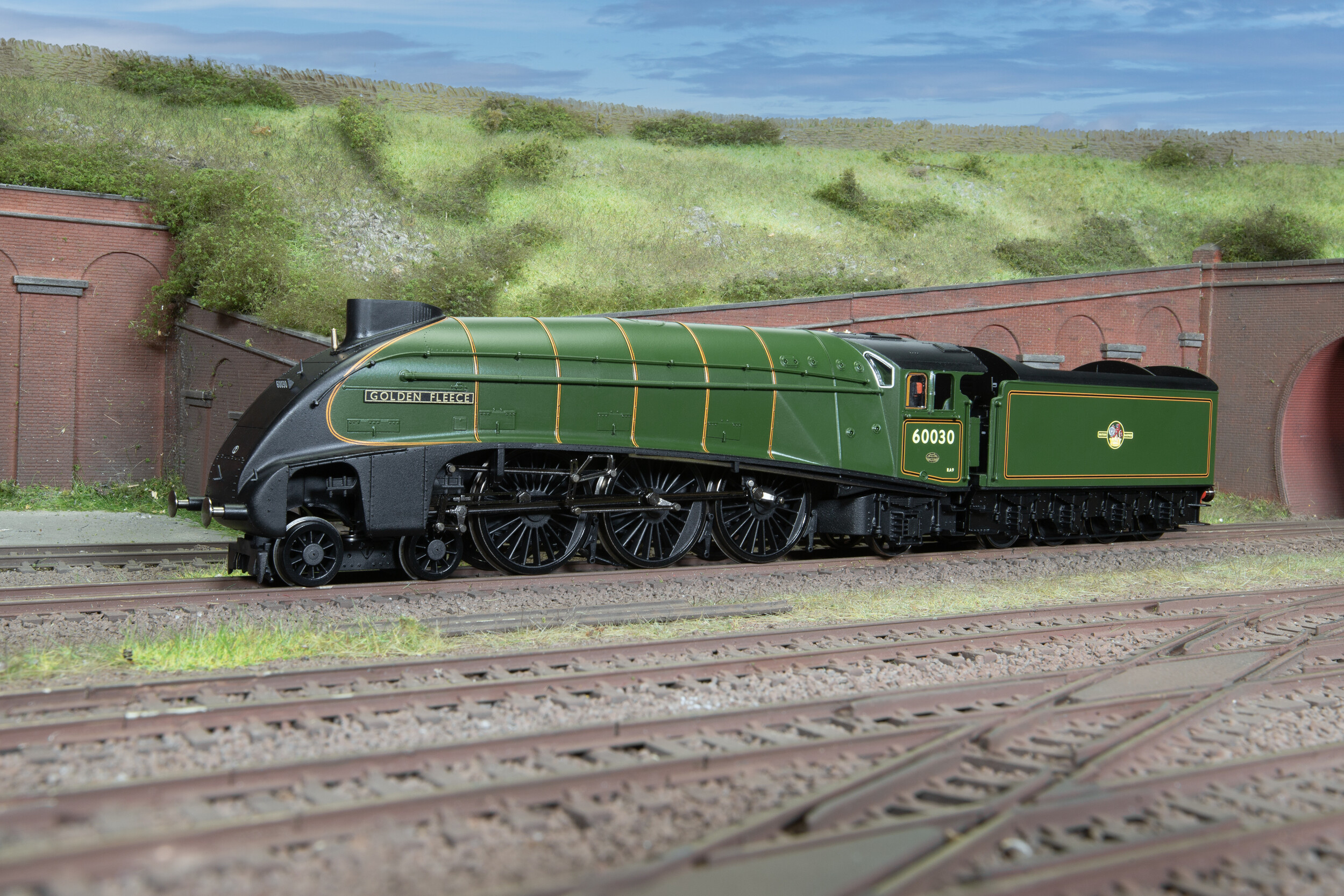
R3994BR, A4 Class, 4-6-2, 60030 'Golden Fleece'
'OO' GaugeReleased: 22/12/23DCC Ready (21 Pin)Era 5LNER 4495 'Great Snipe', soon after renamed 'Golden Fleece' was delivered from Doncaster Works in 1937. After entering service 'Golden Fleece' was chosen to haul the 'West Riding Limited', effectively another 'Coronation' express but serving Newcastle and Bradford rather than Edinburgh. Under Thompson's 1946 numbering scheme the locomotive became No. 30, later becoming British Railways 60030 following nationalization. The locomotive was eventually withdrawn in 1962.
Our Price:
£196.19
£196.19
R30171RailRoad Plus MetroTrain Class 110 2 Car Train Pack E52075
'OO' GaugeReleased: 21/12/23DCC Ready (8 Pin)Era 7Engineered to deal with the steep gradients of the Calder Valley route which it became synonymous with them being named 'Calder Valley sets', the Class 110 was one of the first DMU's with the highest power to weight ratio of any naturally aspirated unit. In 1982 the middle trailer car was removed from most sets to reduce maintenance costs and further improve acceleration along the northern route.

Our Price:
£134.99
£134.99
R30197RailRoad Plus BR Departmental RTC Train Testing, Class 31, A1A-A1A, 97203
'OO' GaugeReleased: 20/12/23DCC Ready (8 Pin)Era 8British Rail Class 31 diesel locomotives, also known as the Brush Type 2 and originally as Class 30, were built by Brush Traction from 1957-62. They were numbered in two series, D5500-D5699 and D5800-D5862. Construction of the first locomotive was completed in the final week of September 1957, and the handing-over took place on 31 October. The first Class 31 entered service in November 1957, after the launch of the Class 20 locomotive and was one of the Pilot Scheme locomotives ordered by British Railways to replace steam traction.The Railway Technical Centre (RTC) in London Road, Derby, England, was the technical headquarters of the British Railways Board, and was built in the early 1960s. British Rail described it as the largest railway research complex in the world, and certain Class 31s served in a capacity as locomotives aiding experiements and research.

Our Price:
£87.29
£87.29
E82001SR Bulleid Booster CC1 SR Grey
'OO' GaugeReleased: 29/12/23DCC Ready (21 Pin)Era 3The Southern Railway was an early adopter of electric traction, quickly building a network of electrified lines and creating what was once the world’s largest electrified railway system. Electric Multiple Units were principally employed on these electric routes, but as the system expanded beyond the suburbs, the Southern’s Chief Mechanical Engineer Oliver Bulleid and Chief Electric Engineer Alfred Raworth recognised the potential of electricity to power locomotives that could haul coaching stock and freight too. And so, the pair designed a Co-Co electric locomotive, the first of which was built in 1941. The design of the two cabs shared many features with EMUs of the time, whilst between them, within the body of the locomotive, could be found the electrical equipment.
With a much shorter distance between their front and rear pickups, when compared to a multiple unit, locomotives could be prone to losing electrical pickup if any gap in the conductor rail was greater than the distance between the pickups – known as ‘gapping’. To overcome this, two motor generator sets and flywheels were included in the design with the power collected from the third rail used to drive the generators, fitted with heavy flywheels, which then powered the motors. Thus, power to the traction motors would be maintained by the motor generator sets being driven by the flywheel when the traction supply was briefly lost in the event of ‘gapping’. These motor-generator-flywheel sets were referred to as ‘Boosters’, giving the type its nickname. Pantographs were also fitted for overhead pickup in sidings and depots where a conductor rail presented danger to staff.
The first locomotive, No. CC1 (renumbered to No. 20001 by BR) was outshopped by Ashford Works in 1941. Carrying Photographic Grey livery, three horizontal stripes were applied to the bodysides, culminating at the cab end in what we would now call speed whiskers. Being wartime, the cab windows had metal plates added to the top and bottom to reduce the aperture. Next, No. CC1 carried Malachite Green livery with ‘Sunshine’ Southern lettering and yellow lines at solebar and cantrail level. The second locomotive, No. CC2 (BR No. 20002) was built in 1945 and emerged in the same livery. Both were used on express passenger and goods trains.
Passing into BR ownership in 1948, the pair continued in use, with various modifications over the years. A third locomotive, No. 20003 was completed by BR in 1948 however its appearance differed somewhat, having a cab design based on that of more contemporary EMUs with a slab front. Whilst successful locomotives, being a class of three non-standard types, the ‘Boosters’ eventually succumbed to withdrawal with No. 20003 the first to go in October 1968. No. 20002 was withdrawn in December 1968 and No. 20001 survived until January 1969, having been decorated earlier in BR Blue livery with full yellow ends. The trio were classified as Class 70 under the Total Operations Processing System (TOPS), however their withdrawal by 1969, and subsequent scrapping, prevented any of the locomotives from carrying TOPS numbers.

Our Price:
£157.20
£157.20
E82005SR Bulleid Booster 20001 BR Blue
'OO' GaugeReleased: 29/12/23DCC Ready (21 Pin)Era 6The Southern Railway was an early adopter of electric traction, quickly building a network of electrified lines and creating what was once the world’s largest electrified railway system. Electric Multiple Units were principally employed on these electric routes, but as the system expanded beyond the suburbs, the Southern’s Chief Mechanical Engineer Oliver Bulleid and Chief Electric Engineer Alfred Raworth recognised the potential of electricity to power locomotives that could haul coaching stock and freight too. And so, the pair designed a Co-Co electric locomotive, the first of which was built in 1941. The design of the two cabs shared many features with EMUs of the time, whilst between them, within the body of the locomotive, could be found the electrical equipment.
With a much shorter distance between their front and rear pickups, when compared to a multiple unit, locomotives could be prone to losing electrical pickup if any gap in the conductor rail was greater than the distance between the pickups – known as ‘gapping’. To overcome this, two motor generator sets and flywheels were included in the design with the power collected from the third rail used to drive the generators, fitted with heavy flywheels, which then powered the motors. Thus, power to the traction motors would be maintained by the motor generator sets being driven by the flywheel when the traction supply was briefly lost in the event of ‘gapping’. These motor-generator-flywheel sets were referred to as ‘Boosters’, giving the type its nickname. Pantographs were also fitted for overhead pickup in sidings and depots where a conductor rail presented danger to staff.
The first locomotive, No. CC1 (renumbered to No. 20001 by BR) was outshopped by Ashford Works in 1941. Carrying Photographic Grey livery, three horizontal stripes were applied to the bodysides, culminating at the cab end in what we would now call speed whiskers. Being wartime, the cab windows had metal plates added to the top and bottom to reduce the aperture. Next, No. CC1 carried Malachite Green livery with ‘Sunshine’ Southern lettering and yellow lines at solebar and cantrail level. The second locomotive, No. CC2 (BR No. 20002) was built in 1945 and emerged in the same livery. Both were used on express passenger and goods trains.
Passing into BR ownership in 1948, the pair continued in use, with various modifications over the years. A third locomotive, No. 20003 was completed by BR in 1948 however its appearance differed somewhat, having a cab design based on that of more contemporary EMUs with a slab front. Whilst successful locomotives, being a class of three non-standard types, the ‘Boosters’ eventually succumbed to withdrawal with No. 20003 the first to go in October 1968. No. 20002 was withdrawn in December 1968 and No. 20001 survived until January 1969, having been decorated earlier in BR Blue livery with full yellow ends. The trio were classified as Class 70 under the Total Operations Processing System (TOPS), however their withdrawal by 1969, and subsequent scrapping, prevented any of the locomotives from carrying TOPS numbers.

Our Price:
£157.20
£157.20
35-354Class 20/0 Headcode Box 20158 BR Blue
'OO' GaugeReleased: 08/01/24DCC Ready (PluX22)Era 7The British Railways Board's (BRB) 1955 modernisation plan called for a change to alternative forms of traction and manufacturers were asked to produce trial or initial designs for evaluation. English Electric adapted an existing design based on an export model for a 1,000bhp diesel and 20 were built as a pilot scheme for assessment.
The first batch was built in 1957 and the diesels were assigned to work from Devon's Road depot, East London. The design was a success from the start and by 1962 a total of 127 had been built. Following assessment of all the Type 1 diesels, BRB placed a further order increasing the total to 228 by 1968 and the design became the BR standard for 1,000bhp diesel locomotives. With the introduction of TOPS the locomotives were designated Class 20 and renumbered 20001 to 20228. The locomotives were principally designed for freight work but also saw service on summer passenger trains where train heating was not required. The Class 20s worked over the Eastern, London Midland and Scottish regions as well as into Wales and were commonly associated with coal traffic. The only drawback the Class had was its single end cab, unlike modern designs that have a cab at each end. BR resolved this problem by regularly operating the Class 20s as pairs, nose to nose, and with the combined power of 2,000bhp they were able to haul the heavier block freight trains.
BR's decision to switch to Type 5 and in particular Class 60 diesels in the late 1980s started a gradual withdrawal of the fleet, with just 28 left by 1994. A tribute to the design is that after 45 years the Class is still in service with DRS on mainline duties following refurbishment, the resulting locomotives being designated Class 20/3s. At least 28 of the class are now preserved.

Our Price:
£191.20
£191.20
35-354SFClass 20/0 Headcode Box 20158 BR Blue With DCC Sound Fitted
'OO' GaugeReleased: 08/01/24DCC FittedDCC SoundEra 7SOUNDS
F0 - Directional Lights - On / Off (plus Light Switch Sound)
F1 - On - Warm Engine Start / On (with F8 On) - Cold Engine Start
F2 - Brake
F3 - Single Horn (Speed Related)
F4 - Two Tone Horn (Speed Related)
F5 - On - Light Train Mode / Off - Heavy Train Mode
F6 - Engine Idle / Coasting
F7 - Speed Lock
F8 - Cold Start
F9 - Flange Squeal (Speed Related)
F10 - Guard's Whistle
F11 - Buffer Up
F12 - Coupling
F13 - Cab End High Intensity Light (If Fitted)
F14 - On - Night Mode Directional Lights / Off - Day Mode Directional lights (If Fitted)
F15 - Detonators
F16 - Priming Pump
F17 - Wagon Snatching & Buffering
F18 - On - Driver's Door Open / Off - Driver's Door Closed
F19 - Fade All Sounds
F20 - Nose End Directional Lights Off
F21 - Cab End Directional Lights Off
F22 - Cab Light On (Only when Stationary)
F23 - Windscreen Wipers
F24 - Compressor
F25 - Spirax Valves
F26 - Shunt Mode
F27 - Volume Down
F28 - Volume Up
Analogue Users: Please note that normal load running sounds and any other automatic or randomised sounds will also operate when this model is used on analogue control (DC) straight from the box!

Our Price:
£276.20
£276.20