Search results
 PO287
PO287OLD FACTORY
 'OO' Gauge
 Released: 15/11/23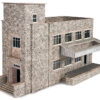
Our Price:
£18.00
£18.00
PO288BREWERY
'OO' GaugeReleased: 15/11/23
Our Price:
£19.00
£19.00
PO401OLD MILL CHIMNEY STACK
'OO' GaugeReleased: 15/11/23
Our Price:
£7.50
£7.50
 R3994
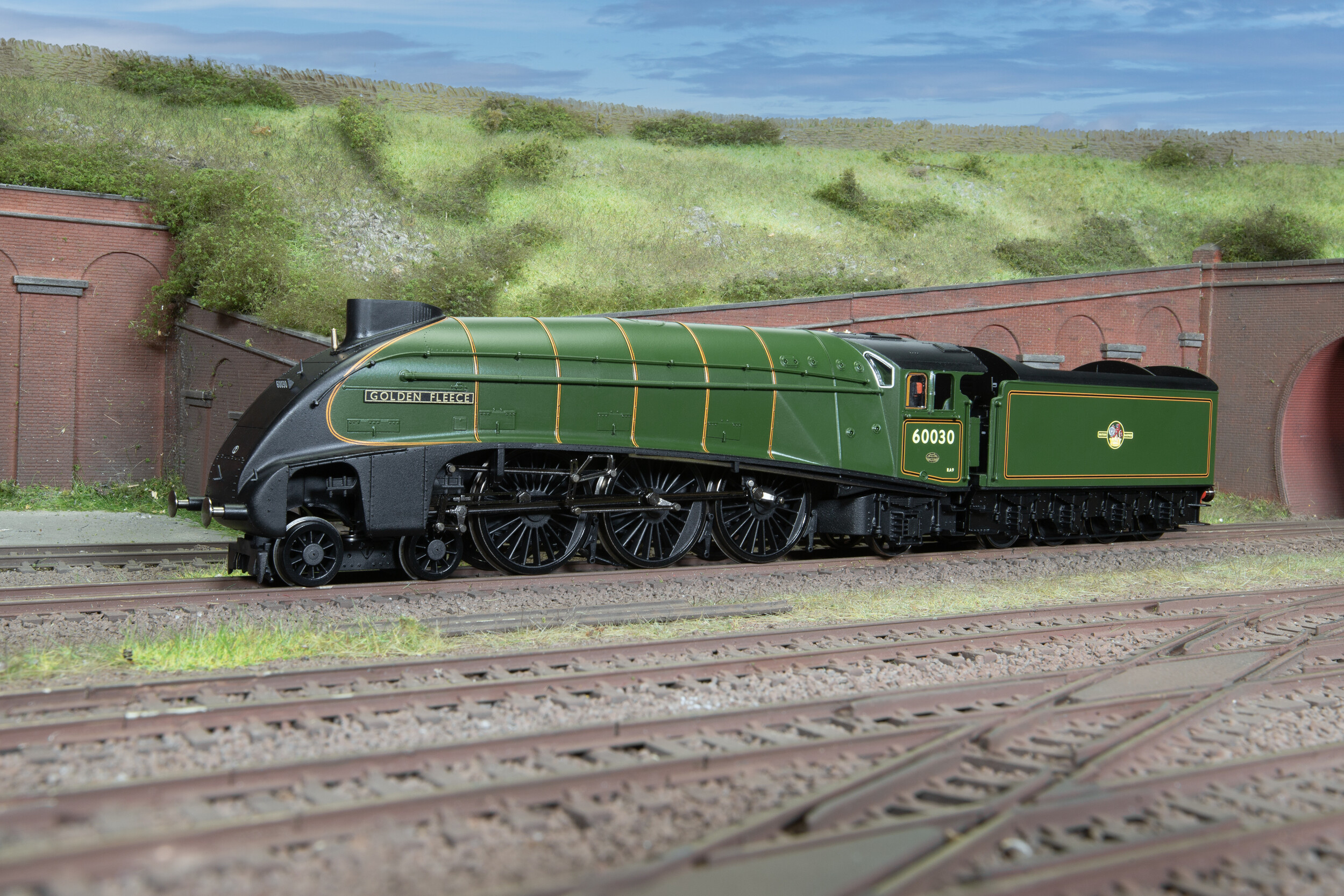
R3994BR, A4 Class, 4-6-2, 60030 'Golden Fleece'
'OO' GaugeReleased: 22/12/23 DCC Ready (21 Pin)
 Era 5
Era 5LNER 4495 'Great Snipe', soon after renamed 'Golden Fleece' was delivered from Doncaster Works in 1937. After entering service 'Golden Fleece' was chosen to haul the 'West Riding Limited', effectively another 'Coronation' express but serving Newcastle and Bradford rather than Edinburgh. Under Thompson's 1946 numbering scheme the locomotive became No. 30, later becoming British Railways 60030 following nationalization. The locomotive was eventually withdrawn in 1962.
Our Price:
£196.19
£196.19
R30171RailRoad Plus MetroTrain Class 110 2 Car Train Pack E52075
'OO' GaugeReleased: 21/12/23DCC Ready (8 Pin)Era 7Engineered to deal with the steep gradients of the Calder Valley route which it became synonymous with them being named 'Calder Valley sets', the Class 110 was one of the first DMU's with the highest power to weight ratio of any naturally aspirated unit. In 1982 the middle trailer car was removed from most sets to reduce maintenance costs and further improve acceleration along the northern route.

Our Price:
£134.99
£134.99
R30197RailRoad Plus BR Departmental RTC Train Testing, Class 31, A1A-A1A, 97203
'OO' GaugeReleased: 20/12/23DCC Ready (8 Pin)Era 8British Rail Class 31 diesel locomotives, also known as the Brush Type 2 and originally as Class 30, were built by Brush Traction from 1957-62. They were numbered in two series, D5500-D5699 and D5800-D5862. Construction of the first locomotive was completed in the final week of September 1957, and the handing-over took place on 31 October. The first Class 31 entered service in November 1957, after the launch of the Class 20 locomotive and was one of the Pilot Scheme locomotives ordered by British Railways to replace steam traction.The Railway Technical Centre (RTC) in London Road, Derby, England, was the technical headquarters of the British Railways Board, and was built in the early 1960s. British Rail described it as the largest railway research complex in the world, and certain Class 31s served in a capacity as locomotives aiding experiements and research.

Our Price:
£87.29
£87.29
 E82001
SR Bulleid Booster CC1 SR Grey
'OO' GaugeReleased: 29/12/23DCC Ready (21 Pin)Era 3The Southern Railway was an early adopter of electric traction, quickly building a network of electrified lines and creating what was once the world’s largest electrified railway system. Electric Multiple Units were principally employed on these electric routes, but as the system expanded beyond the suburbs, the Southern’s Chief Mechanical Engineer Oliver Bulleid and Chief Electric Engineer Alfred Raworth recognised the potential of electricity to power locomotives that could haul coaching stock and freight too. And so, the pair designed a Co-Co electric locomotive, the first of which was built in 1941. The design of the two cabs shared many features with EMUs of the time, whilst between them, within the body of the locomotive, could be found the electrical equipment.
With a much shorter distance between their front and rear pickups, when compared to a multiple unit, locomotives could be prone to losing electrical pickup if any gap in the conductor rail was greater than the distance between the pickups – known as ‘gapping’. To overcome this, two motor generator sets and flywheels were included in the design with the power collected from the third rail used to drive the generators, fitted with heavy flywheels, which then powered the motors. Thus, power to the traction motors would be maintained by the motor generator sets being driven by the flywheel when the traction supply was briefly lost in the event of ‘gapping’. These motor-generator-flywheel sets were referred to as ‘Boosters’, giving the type its nickname. Pantographs were also fitted for overhead pickup in sidings and depots where a conductor rail presented danger to staff.
The first locomotive, No. CC1 (renumbered to No. 20001 by BR) was outshopped by Ashford Works in 1941. Carrying Photographic Grey livery, three horizontal stripes were applied to the bodysides, culminating at the cab end in what we would now call speed whiskers. Being wartime, the cab windows had metal plates added to the top and bottom to reduce the aperture. Next, No. CC1 carried Malachite Green livery with ‘Sunshine’ Southern lettering and yellow lines at solebar and cantrail level. The second locomotive, No. CC2 (BR No. 20002) was built in 1945 and emerged in the same livery. Both were used on express passenger and goods trains.
Passing into BR ownership in 1948, the pair continued in use, with various modifications over the years. A third locomotive, No. 20003 was completed by BR in 1948 however its appearance differed somewhat, having a cab design based on that of more contemporary EMUs with a slab front. Whilst successful locomotives, being a class of three non-standard types, the ‘Boosters’ eventually succumbed to withdrawal with No. 20003 the first to go in October 1968. No. 20002 was withdrawn in December 1968 and No. 20001 survived until January 1969, having been decorated earlier in BR Blue livery with full yellow ends. The trio were classified as Class 70 under the Total Operations Processing System (TOPS), however their withdrawal by 1969, and subsequent scrapping, prevented any of the locomotives from carrying TOPS numbers.

Our Price:
£157.20
£157.20
E82005SR Bulleid Booster 20001 BR Blue
'OO' GaugeReleased: 29/12/23DCC Ready (21 Pin)Era 6The Southern Railway was an early adopter of electric traction, quickly building a network of electrified lines and creating what was once the world’s largest electrified railway system. Electric Multiple Units were principally employed on these electric routes, but as the system expanded beyond the suburbs, the Southern’s Chief Mechanical Engineer Oliver Bulleid and Chief Electric Engineer Alfred Raworth recognised the potential of electricity to power locomotives that could haul coaching stock and freight too. And so, the pair designed a Co-Co electric locomotive, the first of which was built in 1941. The design of the two cabs shared many features with EMUs of the time, whilst between them, within the body of the locomotive, could be found the electrical equipment.
With a much shorter distance between their front and rear pickups, when compared to a multiple unit, locomotives could be prone to losing electrical pickup if any gap in the conductor rail was greater than the distance between the pickups – known as ‘gapping’. To overcome this, two motor generator sets and flywheels were included in the design with the power collected from the third rail used to drive the generators, fitted with heavy flywheels, which then powered the motors. Thus, power to the traction motors would be maintained by the motor generator sets being driven by the flywheel when the traction supply was briefly lost in the event of ‘gapping’. These motor-generator-flywheel sets were referred to as ‘Boosters’, giving the type its nickname. Pantographs were also fitted for overhead pickup in sidings and depots where a conductor rail presented danger to staff.
The first locomotive, No. CC1 (renumbered to No. 20001 by BR) was outshopped by Ashford Works in 1941. Carrying Photographic Grey livery, three horizontal stripes were applied to the bodysides, culminating at the cab end in what we would now call speed whiskers. Being wartime, the cab windows had metal plates added to the top and bottom to reduce the aperture. Next, No. CC1 carried Malachite Green livery with ‘Sunshine’ Southern lettering and yellow lines at solebar and cantrail level. The second locomotive, No. CC2 (BR No. 20002) was built in 1945 and emerged in the same livery. Both were used on express passenger and goods trains.
Passing into BR ownership in 1948, the pair continued in use, with various modifications over the years. A third locomotive, No. 20003 was completed by BR in 1948 however its appearance differed somewhat, having a cab design based on that of more contemporary EMUs with a slab front. Whilst successful locomotives, being a class of three non-standard types, the ‘Boosters’ eventually succumbed to withdrawal with No. 20003 the first to go in October 1968. No. 20002 was withdrawn in December 1968 and No. 20001 survived until January 1969, having been decorated earlier in BR Blue livery with full yellow ends. The trio were classified as Class 70 under the Total Operations Processing System (TOPS), however their withdrawal by 1969, and subsequent scrapping, prevented any of the locomotives from carrying TOPS numbers.

Our Price:
£157.20
£157.20
35-354Class 20/0 Headcode Box 20158 BR Blue
'OO' GaugeReleased: 08/01/24DCC Ready (PluX22)Era 7The British Railways Board's (BRB) 1955 modernisation plan called for a change to alternative forms of traction and manufacturers were asked to produce trial or initial designs for evaluation. English Electric adapted an existing design based on an export model for a 1,000bhp diesel and 20 were built as a pilot scheme for assessment.
The first batch was built in 1957 and the diesels were assigned to work from Devon's Road depot, East London. The design was a success from the start and by 1962 a total of 127 had been built. Following assessment of all the Type 1 diesels, BRB placed a further order increasing the total to 228 by 1968 and the design became the BR standard for 1,000bhp diesel locomotives. With the introduction of TOPS the locomotives were designated Class 20 and renumbered 20001 to 20228. The locomotives were principally designed for freight work but also saw service on summer passenger trains where train heating was not required. The Class 20s worked over the Eastern, London Midland and Scottish regions as well as into Wales and were commonly associated with coal traffic. The only drawback the Class had was its single end cab, unlike modern designs that have a cab at each end. BR resolved this problem by regularly operating the Class 20s as pairs, nose to nose, and with the combined power of 2,000bhp they were able to haul the heavier block freight trains.
BR's decision to switch to Type 5 and in particular Class 60 diesels in the late 1980s started a gradual withdrawal of the fleet, with just 28 left by 1994. A tribute to the design is that after 45 years the Class is still in service with DRS on mainline duties following refurbishment, the resulting locomotives being designated Class 20/3s. At least 28 of the class are now preserved.

Our Price:
£191.20
£191.20
35-354SFClass 20/0 Headcode Box 20158 BR Blue With DCC Sound Fitted
'OO' GaugeReleased: 08/01/24DCC FittedDCC SoundEra 7SOUNDS
F0 - Directional Lights - On / Off (plus Light Switch Sound)
F1 - On - Warm Engine Start / On (with F8 On) - Cold Engine Start
F2 - Brake
F3 - Single Horn (Speed Related)
F4 - Two Tone Horn (Speed Related)
F5 - On - Light Train Mode / Off - Heavy Train Mode
F6 - Engine Idle / Coasting
F7 - Speed Lock
F8 - Cold Start
F9 - Flange Squeal (Speed Related)
F10 - Guard's Whistle
F11 - Buffer Up
F12 - Coupling
F13 - Cab End High Intensity Light (If Fitted)
F14 - On - Night Mode Directional Lights / Off - Day Mode Directional lights (If Fitted)
F15 - Detonators
F16 - Priming Pump
F17 - Wagon Snatching & Buffering
F18 - On - Driver's Door Open / Off - Driver's Door Closed
F19 - Fade All Sounds
F20 - Nose End Directional Lights Off
F21 - Cab End Directional Lights Off
F22 - Cab Light On (Only when Stationary)
F23 - Windscreen Wipers
F24 - Compressor
F25 - Spirax Valves
F26 - Shunt Mode
F27 - Volume Down
F28 - Volume Up
Analogue Users: Please note that normal load running sounds and any other automatic or randomised sounds will also operate when this model is used on analogue control (DC) straight from the box!

Our Price:
£276.20
£276.20
 371-850
Class 158 2-Car DMU 158849 BR Regional Railways
'N' GaugeReleased: 08/01/24DCC Ready (Next18)Era 8The British Rail Class 158 Express Sprinter is a Diesel Multiple Unit (DMU), built specifically for British Rail's Provincial Services sector between 1989 and 1992 by British Rail Engineering Limited (BREL) at Derby Litchurch Lane Works and outshopped in Regional Railways Provincial livery. They were built to replace many locomotive-hauled passenger trains, thereby reducing cost of operation, and to allow cascading of existing Sprinter units to replace elderly 'heritage' DMUs. The majority of the 182-strong fleet of Class 158 units were built as two-car sets, with 17 three-car units constructed specifically for use on Trans-Pennine services. Similar three-car units were built for use by Network SouthEast but these were converted to Class 159 specification before introduced into service, with toilet retention tanks and other modifications to operate over the third-rail network.
All but one of the Class 158s remain in service today (2023), with operators including ScotRail, Northern, Great Western (GWR), East Midlands Trains (now EMR), and Transport for Wales (formerly Arriva). Former operators include Central Trains. The Class has worked extensively across the UK network, even into East Anglia as far as Stansted Airport and Norwich. Some 158s have been converted to additional Class 159s and now operate for South Western alongside their original classmates.

Our Price:
£220.95
£220.95
371-850SFClass 158 2-Car DMU 158849 BR Regional Railways With DCC Sound Fitted
'N' GaugeReleased: 08/01/24DCC FittedDCC SoundEra 8SOUNDS
F0 - Directional Lights - On / Off
F1 - On - Warm Start / F5 - On, then F1 - On - Cold Start
F2 - Brake (Non-Latching)
F3 - Single Horn
F4 - Two-Tone Horn
F5 - Light Engine / Cold Engine Start
F6 - Engine Idle / Coasting
F7 - Flange Squeal
F8 - On - Doors Opening (F1 On) / Off - Doors Closing (F1 On)
F9 - Dispatch Whistle
F10 - On - Guard's Buzzer (Single) / Driver's Response Buzzer (Single)
F11 - On - Guard's Buzzer (Double) / Driver's Response Buzzer (Double)
F12 - Engine Speed Up
F13 - Air Conditioning Fan
F14 - Windscreen Wipers
F15 - On - Doors Opening (F1 Off) / Off - Doors Closing (F1 Off)
F16 - Fade All Sounds
F17 - Directional Lights Off (Car A, 57xxx)
F18 - Directional Lights Off (Car B, 52xxx)
F19 - Station Ambience
F20 - Remote Telephone Test
F21 - Detonators
F22 - AWS
F23 - F26 - No User Access
F27 - Volume Down
F28 - Volume Up
Analogue Users: Please note that basic prime mover sounds will operate and will vary according to use when this model is used on analogue control (DC) straight from the box! Directional lights and passenger compartment lights will also illuminate when power is applied.
Our Price:
£314.45
£314.45
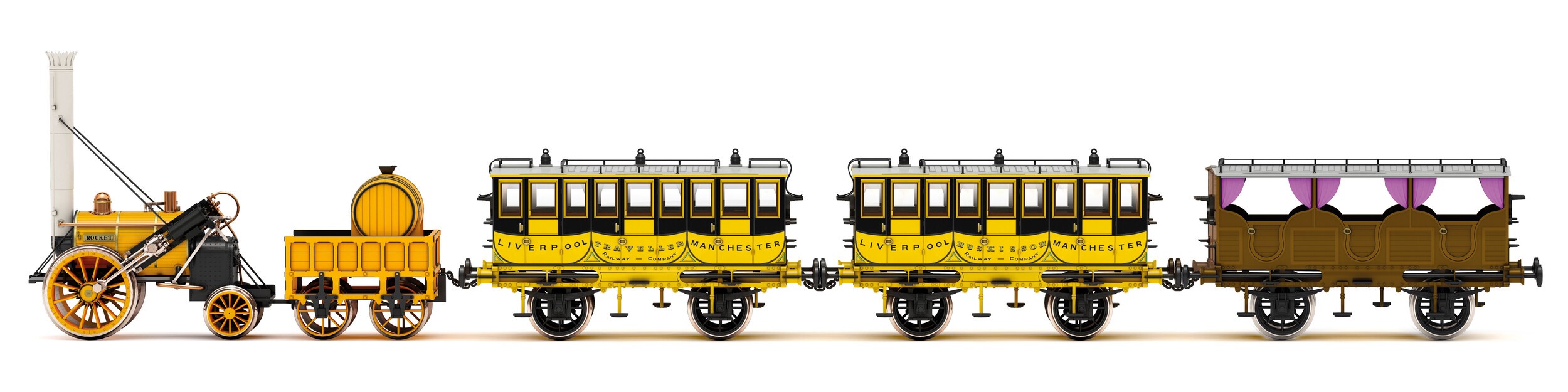
R30090L&MR, Stephenson's Rocket Train Pack
'OO' GaugeReleased: 15/01/24DCC Ready (6 Pin)Era 1Rocket was designed and built as a direct response to the invitation to the Rainhill Trials issued by the Directors of the Liverpool and Manchester Railway on April 25, 1829 for "a Locomotive Engine, which shall be a decided improvement on any hitherto constructed, subject to certain stipulations and conditions.â€
Initially known as the premium locomotive engine, design and development work on the locomotive took place at Robert Stephenson & Co's Newcastle factory, and while George Stephenson is acknowledged as the engineer responsible for Rocket, much of the work was carried out by his son Robert, in conjunction with his draftsman George Phipps and Works Manager William Hutchinson.
Rocket was completed to Robert Stephenson's satisfaction on September 2, 1829 and was transported to Killingworth Colliery for steam and load haul testing prior to the Rainhill Trials. Rocket's livery of yellow and black, with a white chimney, mirrored that of the L&MR's existing first class coaches which, in turn, copied that of the fastest road coaches at the time and was chosen by George Stephenson in 1828 to suggest speed and reliability to a new class of travelling public.
The outcome of the Rainhill Trials established Rocket as the clear winner and the L&MR Board awarded Robert Stephenson and Co. the contract to produce four further 'Rocket' type locomotives, all of which were to incorporate improvements highlighted by the Rainhill Trials. Over the next three years, Rocket itself was gradually improved, until February 1833 when the locomotive was relegated to secondary and standby duties.
Rocket was purchased by Thompson & Sons of Kirkhouse for operating mineral trains on the Brampton Railway, but could not cope with the heavy trains and was withdrawn from service in 1840. In 1850 Rocket was moved to the Newcastle works of Robert Stephenson & Co. and in 1862 was donated to the Patent Museum, the forerunner of the Science Museum, by the Thompson family.
Our Price:
£217.79
£217.79
35-358Class 20/0 Headcode Box 20173 'Wensleydale' BR Blue (Red Solebar)
'OO' GaugeReleased: 17/01/24DCC Ready (PluX22)Era 8The British Railways Board's (BRB) 1955 modernisation plan called for a change to alternative forms of traction and manufacturers were asked to produce trial or initial designs for evaluation. English Electric adapted an existing design based on an export model for a 1,000bhp diesel and 20 were built as a pilot scheme for assessment.
The first batch was built in 1957 and the diesels were assigned to work from Devon's Road depot, East London. The design was a success from the start and by 1962 a total of 127 had been built. Following assessment of all the Type 1 diesels, BRB placed a further order increasing the total to 228 by 1968 and the design became the BR standard for 1,000bhp diesel locomotives. With the introduction of TOPS the locomotives were designated Class 20 and renumbered 20001 to 20228. The locomotives were principally designed for freight work but also saw service on summer passenger trains where train heating was not required. The Class 20s worked over the Eastern, London Midland and Scottish regions as well as into Wales and were commonly associated with coal traffic. The only drawback the Class had was its single end cab, unlike modern designs that have a cab at each end. BR resolved this problem by regularly operating the Class 20s as pairs, nose to nose, and with the combined power of 2,000bhp they were able to haul the heavier block freight trains.
BR's decision to switch to Type 5 and in particular Class 60 diesels in the late 1980s started a gradual withdrawal of the fleet, with just 28 left by 1994. A tribute to the design is that after 45 years the Class is still in service with DRS on mainline duties following refurbishment, the resulting locomotives being designated Class 20/3s. At least 28 of the class are now preserved.

Our Price:
£191.20
£191.20
35-358SFClass 20/0 Headcode Box 20173 'Wensleydale' BR Blue (Red Solebar) With DCC Sound Fitted
'OO' GaugeReleased: 17/01/24DCC FittedDCC SoundEra 8SOUNDS
F0 - Directional Lights - On / Off (plus Light Switch Sound)
F1 - On - Warm Engine Start / On (with F8 On) - Cold Engine Start
F2 - Brake
F3 - Single Horn (Speed Related)
F4 - Two Tone Horn (Speed Related)
F5 - On - Light Train Mode / Off - Heavy Train Mode
F6 - Engine Idle / Coasting
F7 - Speed Lock
F8 - Cold Start
F9 - Flange Squeal (Speed Related)
F10 - Guard's Whistle
F11 - Buffer Up
F12 - Coupling
F13 - Cab End High Intensity Light (If Fitted)
F14 - On - Night Mode Directional Lights / Off - Day Mode Directional lights (If Fitted)
F15 - Detonators
F16 - Priming Pump
F17 - Wagon Snatching & Buffering
F18 - On - Driver's Door Open / Off - Driver's Door Closed
F19 - Fade All Sounds
F20 - Nose End Directional Lights Off
F21 - Cab End Directional Lights Off
F22 - Cab Light On (Only when Stationary)
F23 - Windscreen Wipers
F24 - Compressor
F25 - Spirax Valves
F26 - Shunt Mode
F27 - Volume Down
F28 - Volume Up
Analogue Users: Please note that normal load running sounds and any other automatic or randomised sounds will also operate when this model is used on analogue control (DC) straight from the box!

Our Price:
£276.20
£276.20
35-359Class 20/0 Headcode Box D8308 BR Blue
'OO' GaugeReleased: 17/01/24DCC Ready (PluX22)Era 6The British Railways Board's (BRB) 1955 modernisation plan called for a change to alternative forms of traction and manufacturers were asked to produce trial or initial designs for evaluation. English Electric adapted an existing design based on an export model for a 1,000bhp diesel and 20 were built as a pilot scheme for assessment.
The first batch was built in 1957 and the diesels were assigned to work from Devon's Road depot, East London. The design was a success from the start and by 1962 a total of 127 had been built. Following assessment of all the Type 1 diesels, BRB placed a further order increasing the total to 228 by 1968 and the design became the BR standard for 1,000bhp diesel locomotives. With the introduction of TOPS the locomotives were designated Class 20 and renumbered 20001 to 20228. The locomotives were principally designed for freight work but also saw service on summer passenger trains where train heating was not required. The Class 20s worked over the Eastern, London Midland and Scottish regions as well as into Wales and were commonly associated with coal traffic. The only drawback the Class had was its single end cab, unlike modern designs that have a cab at each end. BR resolved this problem by regularly operating the Class 20s as pairs, nose to nose, and with the combined power of 2,000bhp they were able to haul the heavier block freight trains.
BR's decision to switch to Type 5 and in particular Class 60 diesels in the late 1980s started a gradual withdrawal of the fleet, with just 28 left by 1994. A tribute to the design is that after 45 years the Class is still in service with DRS on mainline duties following refurbishment, the resulting locomotives being designated Class 20/3s. At least 28 of the class are now preserved.

Our Price:
£191.20
£191.20
371-851Class 158 2-Car DMU 158711 ScotRail Saltire
'N' GaugeReleased: 17/01/24DCC Ready (Next18)Era 9The British Rail Class 158 Express Sprinter is a Diesel Multiple Unit (DMU), built specifically for British Rail's Provincial Services sector between 1989 and 1992 by British Rail Engineering Limited (BREL) at Derby Litchurch Lane Works and outshopped in Regional Railways Provincial livery. They were built to replace many locomotive-hauled passenger trains, thereby reducing cost of operation, and to allow cascading of existing Sprinter units to replace elderly 'heritage' DMUs. The majority of the 182-strong fleet of Class 158 units were built as two-car sets, with 17 three-car units constructed specifically for use on Trans-Pennine services. Similar three-car units were built for use by Network SouthEast but these were converted to Class 159 specification before introduced into service, with toilet retention tanks and other modifications to operate over the third-rail network.
All but one of the Class 158s remain in service today (2023), with operators including ScotRail, Northern, Great Western (GWR), East Midlands Trains (now EMR), and Transport for Wales (formerly Arriva). Former operators include Central Trains. The Class has worked extensively across the UK network, even into East Anglia as far as Stansted Airport and Norwich. Some 158s have been converted to additional Class 159s and now operate for South Western alongside their original classmates.

Our Price:
£220.95
£220.95
371-851SFClass 158 2-Car DMU 158711 ScotRail Saltire With DCC Sound Fitted
'N' GaugeReleased: 17/01/24DCC FittedDCC SoundEra 9SOUNDS
F0 - Directional Lights - On / Off
F1 - On - Warm Start / F5 - On, then F1 - On - Cold Start
F2 - Brake (Non-Latching)
F3 - Single Horn
F4 - Two-Tone Horn
F5 - Light Engine / Cold Engine Start
F6 - Engine Idle / Coasting
F7 - Flange Squeal
F8 - On - Doors Opening (F1 On) / Off - Doors Closing (F1 On)
F9 - Dispatch Whistle
F10 - On - Guard's Buzzer (Single) / Driver's Response Buzzer (Single)
F11 - On - Guard's Buzzer (Double) / Driver's Response Buzzer (Double)
F12 - Engine Speed Up
F13 - Air Conditioning Fan
F14 - Windscreen Wipers
F15 - On - Doors Opening (F1 Off) / Off - Doors Closing (F1 Off)
F16 - Fade All Sounds
F17 - Directional Lights Off (Car A, 57xxx)
F18 - Directional Lights Off (Car B, 52xxx)
F19 - Station Ambience
F20 - Remote Telephone Test
F21 - Detonators
F22 - AWS
F23 - F26 - No User Access
F27 - Volume Down
F28 - Volume Up
Analogue Users: Please note that basic prime mover sounds will operate and will vary according to use when this model is used on analogue control (DC) straight from the box! Directional lights and passenger compartment lights will also illuminate when power is applied.

Our Price:
£314.45
£314.45
371-854Class 158 2-Car DMU 158824 Arriva Trains Wales (Revised)
'N' GaugeReleased: 17/01/24DCC Ready (Next18)Era 9CLASS 158 DMU HISTORY
The British Rail Class 158 Express Sprinter is a Diesel Multiple Unit (DMU), built specifically for British Rail's Provincial Services sector between 1989 and 1992 by British Rail Engineering Limited (BREL) at Derby Litchurch Lane Works and outshopped in Regional Railways Provincial livery. They were built to replace many locomotive-hauled passenger trains, thereby reducing cost of operation, and to allow cascading of existing Sprinter units to replace elderly 'heritage' DMUs. The majority of the 182-strong fleet of Class 158 units were built as two-car sets, with 17 three-car units constructed specifically for use on Trans-Pennine services. Similar three-car units were built for use by Network SouthEast but these were converted to Class 159 specification before introduced into service, with toilet retention tanks and other modifications to operate over the third-rail network.
All but one of the Class 158s remain in service today (2023), with operators including ScotRail, Northern, Great Western (GWR), East Midlands Trains (now EMR), and Transport for Wales (formerly Arriva). Former operators include Central Trains. The Class has worked extensively across the UK network, even into East Anglia as far as Stansted Airport and Norwich. Some 158s have been converted to additional Class 159s and now operate for South Western alongside their original classmates

Our Price:
£220.95
£220.95
 2D-022-014
TRANSPENNINE EXPRESS CLASS 68 'SPLENDID' 68027
'N' GaugeReleased: 25/01/24DCC Ready (Next18)Era 11
Our Price:
£127.50
£127.50