Search results

Your search found 1479 results.

Filter your search results using the options below:

Manufacturer
Gauge
Category
Digital features
 
Era
 
Number of items to display per page: 5 | 10 | 20 | Show All
PT-61
FLEXI LOCO LIFT (DOUBLE)(LOCO NOT INCLUDED)
Released: 01/12/21
Designed as a replacement for the old SL-43 Loco Lift, this new versatile system still has the features that made the SL-43 so popular, such as the ability to directly drive the locomotive on and off the track. But that was limited to OO/HO scale and this new system has been developed to adapt to all scales from N through to EM, including OO-9 (HOe), HOn3, TT, HOm and OO/HO. The modeller simply selects the gauge that they want by sliding the two halves together until the right gauge has been selected (there are guide marks on the mouldings to help with that) and then self-tapping screws secure things in place. When placed on the track, the metal plates that act as the track ensure that locomotives can be driven on and off with ease. Each Flexi Loco Lift is supplied with two sliding shutter doors, provided to make sure nothing falls out whilst being transported, and these are trimmed to suit the gauge selected. It is as simple as that! No gluing required.
Our Price:
£18.50
35-411
Class 47/0 47012 BR Blue
'OO' Gauge
Released: 13/12/21
DCC Ready (PluX22)
Era 7
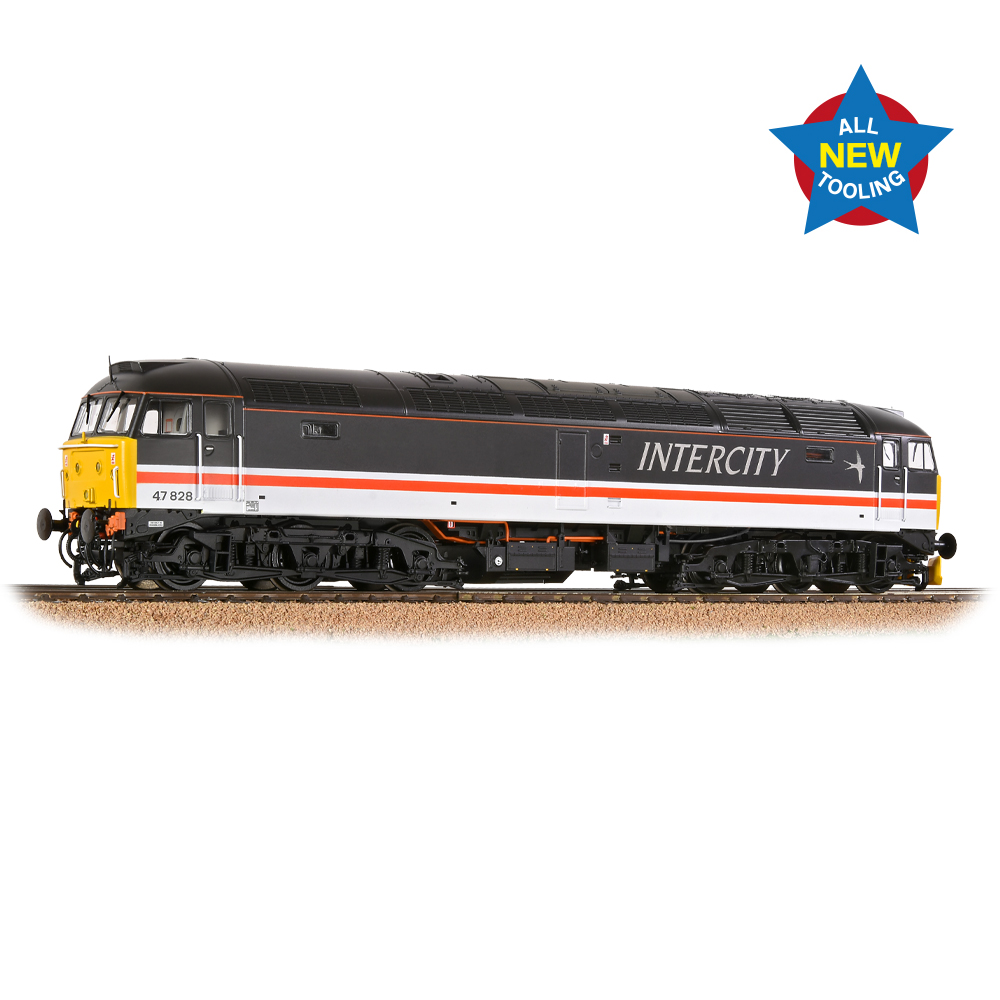
CLASS 47 HISTORY Towards the end of the 1950s, British Railways began planning a new fleet of diesel locomotives and after investigating several prototypes, BR decided to place an order with Brush Engineering for 20 locomotives during February 1961. The resulting design became the iconic Brush Type 4 Diesel locomotive, a practical, versatile design with a very distinctive cab. Powered with a Sulzer engine and initially rated at 2,750hp, the locomotive could achieve a top speed of 75mph with a tractive effort of 55,000lb. Building commenced in January 1962 and the first locomotive No. D1500 appeared in late September of the same year with test runs on the London Midland Region and Western Region. The design was a success and BR went on to order a total of 512 with continuous production through to early 1967, forming the largest single class of main-line diesel locomotives in the UK. During this time and subsequent years, several variations appeared with an increase in speed and tractive effort to 95mph and 62,000lb respectively. Originally fitted with four character train reporting head-codes, these changed to marker lights, with the addition of high intensity lights and roof aerials in the late 1980s. Other variations involved the fitting of different types of steam heating boiler for early BR coaching stock, later replaced with electric train heating for use with modern rolling stock. The numbering system started with four figures but changed to five with the introduction of the TOPS coding system which saw the locomotives classified as Class 47 Diesels with variations such as 47/0, 47/2, 47/3, 47/4 and 47/7. By the end of the 1990s, half of the Class 47 fleet had been withdrawn or scrapped, 33 have been converted into Class 57 locomotives and several have been preserved, including the original No. D1500, now numbered 47401.
Our Price: £203.95
Bargain Price:
£179.95
35-418
Class 47/0 47004 BR Railfreight Construction Sector
'OO' Gauge
Released: 13/12/21
DCC Ready (PluX22)
Era 8
CLASS 47 HISTORY Towards the end of the 1950s, British Railways began planning a new fleet of diesel locomotives and after investigating several prototypes, BR decided to place an order with Brush Engineering for 20 locomotives during February 1961. The resulting design became the iconic Brush Type 4 Diesel locomotive, a practical, versatile design with a very distinctive cab. Powered with a Sulzer engine and initially rated at 2,750hp, the locomotive could achieve a top speed of 75mph with a tractive effort of 55,000lb. Building commenced in January 1962 and the first locomotive No. D1500 appeared in late September of the same year with test runs on the London Midland Region and Western Region. The design was a success and BR went on to order a total of 512 with continuous production through to early 1967, forming the largest single class of main-line diesel locomotives in the UK. During this time and subsequent years, several variations appeared with an increase in speed and tractive effort to 95mph and 62,000lb respectively. Originally fitted with four character train reporting head-codes, these changed to marker lights, with the addition of high intensity lights and roof aerials in the late 1980s. Other variations involved the fitting of different types of steam heating boiler for early BR coaching stock, later replaced with electric train heating for use with modern rolling stock. The numbering system started with four figures but changed to five with the introduction of the TOPS coding system which saw the locomotives classified as Class 47 Diesels with variations such as 47/0, 47/2, 47/3, 47/4 and 47/7. By the end of the 1990s, half of the Class 47 fleet had been withdrawn or scrapped, 33 have been converted into Class 57 locomotives and several have been preserved, including the original No. D1500, now numbered 47401.
Our Price:
£203.95
35-419
Class 47/3 47375 'Tinsley Traction Depot' BR RF Distribution European
'OO' Gauge
Released: 13/12/21
DCC Ready (PluX22)
Era 8
CLASS 47 HISTORY Towards the end of the 1950s, British Railways began planning a new fleet of diesel locomotives and after investigating several prototypes, BR decided to place an order with Brush Engineering for 20 locomotives during February 1961. The resulting design became the iconic Brush Type 4 Diesel locomotive, a practical, versatile design with a very distinctive cab. Powered with a Sulzer engine and initially rated at 2,750hp, the locomotive could achieve a top speed of 75mph with a tractive effort of 55,000lb. Building commenced in January 1962 and the first locomotive No. D1500 appeared in late September of the same year with test runs on the London Midland Region and Western Region. The design was a success and BR went on to order a total of 512 with continuous production through to early 1967, forming the largest single class of main-line diesel locomotives in the UK. During this time and subsequent years, several variations appeared with an increase in speed and tractive effort to 95mph and 62,000lb respectively. Originally fitted with four character train reporting head-codes, these changed to marker lights, with the addition of high intensity lights and roof aerials in the late 1980s. Other variations involved the fitting of different types of steam heating boiler for early BR coaching stock, later replaced with electric train heating for use with modern rolling stock. The numbering system started with four figures but changed to five with the introduction of the TOPS coding system which saw the locomotives classified as Class 47 Diesels with variations such as 47/0, 47/2, 47/3, 47/4 and 47/7. By the end of the 1990s, half of the Class 47 fleet had been withdrawn or scrapped, 33 have been converted into Class 57 locomotives and several have been preserved, including the original No. D1500, now numbered 47401.
Our Price: £203.95
Bargain Price:
£179.95
R30026
GBRF, Class 60, Co-Co, 60026
'OO' Gauge
Released: 10/01/22
DCC Ready (8 Pin)
Era 11
The last mainline diesel locomotive type built for British Rail, the Class 60 arose from the arrival, and subsequent success, of the Class 59 locomotive. With a haulage capacity and reliability superior to the Class 31, 37 and 47 locomotives in sector service at the time, Trainload Petroleum, Metals, Construction and Coal were prompted to lobby for a new UK designed locomotive to match it. British Rail Board eventually secured the necessary treasury funding and following a difficult procurement process, the contract was finally awarded to Brush Electrical Machines of Loughborough on May 17, 1988 for 100 locomotives. Brush's design incorporated many features from the Class 59's specification, as well as their own Sepex traction control system, tested on the Class 58, to improve adhesion. The Class 60s were geared for a maximum speed of 62 mph, the power units being eight cylinder, 145 litre Blackstone 8MB275T diesel traction engines built by Mirrlees at their Stockport works, delivering a maximum power output of 3,100hp at 1000rpm. The bodyshell, shared with the Class 92 locomotives, was of a monocoque, stressed skin construction with diagonal trusses, the external bodywork providing support for the internal components and all were built by Procor (UK) of Wakefield. The first locomotive was handed over to Railfreight on time, in June 1989, but extensive teething problems (many involving computer software), meant that it took sixteen months before the first of the Class were accepted and nearly four years to introduce all 100 of the Class 60 locomotives to service. By the time the Class 60 fleet entered service, Trainload's Sector businesses had given way to 'shadow' privatisation and the formation, in 1994, of Loadhaul, Transrail and Mainline Freight with the Class 60 fleet split equally between them. English, Welsh and Scottish Railway bought the whole Class 60 fleet as part of British Railway's privatisation, reallocating the entire Class 60 fleet to Toton as a cost cutting measure and to pool common parts. By 2003/4, a number of locomotives were stored as surplus to operational requirements. In 2007 EWS became part of DB Schenker and at the end of October 2010, the entire Class 60 fleet was mothballed, with the exception of 60040 The Territorial Army Centenary and 60074 Teenage Cancer Trust. By the end of 2011, two more locomotives were returned to service, followed by an announcement that 21 further Class 60s were to be overhauled in 2012, this being completed by the end of 2013. Since then, the fortunes of the Class 60 Fleet have ebbed and flowed, with locomotives being sold, re-sold and leased, but in 2019 the majority of locomotives are owned by DB Cargo (UK), with Beacon Rail and GBRf also owning vehicles. Of the 100 locomotives in operation, 71 are in storage; DB Cargo (UK) preferring to rotate its operational Class 60s, with around fourteen being in service at any one time. Following their acquisition of ten Class 66 locomotives from DB Cargo and a further sixteen Class 56 locomotives, in June 2018 GBRf continued the expansion of their heavy rail fleet by reaching an agreement with Colas Rail to take over the operation of that company's fleet of ten Class 60 units. On 2 October 2019, in partnership with Beacon Rail Leasing, GBRf released the newly named 60026 Helvellyn into traffic wearing Beacon Rail's Royal Blue livery, with GBRf branding. 60026 was named Helvellyn after one of the original Class 44 Peak locomotives and the style of the locomotive's new nameplate reflected that heritage.
Our Price:
£206.09