Search results
 35-430SF
Class 47/3 47376 'Freightliner 1995' Freightliner Grey [W] With DCC Sound
 'OO' Gauge
 Released: 30/09/22
 DCC FittedDCC Sound
 Era 9
Era 9SOUNDS
F0 - Directional Lights - On/Off (plus Light Switch Sound)
F1 - On - Warm Engine Start / On, Off - Failed Engine Start / On, Off, On - Cold Engine Start
F2 - Brake
F3* - Horn (Playable)
F4* - Two-Tone Horn
F5 - Heavy Load
F6 - Coasting (Manual notch Down if F22 On)
F7 - Maximum Revs (Manual notch Up if F22 On)
F8** - On - Coupling Up / Off - Uncoupling
F9 - Flange Squeal (Speed Related)
F10 - Fan Noise
F11 - Engine Room Lights On/Off (plus Light Switch Sound)
F12 - On - Guard’s Whistle / Off - Driver’s Response Horn
F13 - Cab Lights On/Off No. 1 (plus Light Switch Sound)
F14 - Cab Lights On/Off No. 2 (plus Light Switch Sound)
F15 - Auto Uncouple Cycle
F16 - AWS Horn
F17 - AWS Bell
F18 - On - Sound Fades Out / Off - Sound Fades In
F19 - Mute (Latch) / Volume Cycles 6 Levels (Trigger)
F20 - No. 1 End (Fan) Directional Lights Off
F21 - No. 2 End (non-Fan) Directional Lights Off
F22 - Manual Notching Logic On/Off (control with F6 & F7)
F23 - Spirax Valve
F24 - Station Announcement
F25 - On - Driver’s Door Open / Off - Driver’ Door Shut
F26 - Air Dump
*Alternative Horn sounds and behaviour can be selected via CV changes
** Alternative coupling sounds can be selected via CV changes
Analogue Users: Please note that normal load running sounds and any other automatic or randomised sounds will also operate when this model is used on analogue control (DC) straight from the box!
CLASS 47 HISTORY
Towards the end of the 1950s, British Railways began planning a new fleet of diesel locomotives and after investigating several prototypes, BR decided to place an order with Brush Engineering for 20 locomotives during February 1961. The resulting design became the iconic Brush Type 4 Diesel locomotive, a practical, versatile design with a very distinctive cab. Powered with a Sulzer engine and initially rated at 2,750hp, the locomotive could achieve a top speed of 75mph with a tractive effort of 55,000lb. Building commenced in January 1962 and the first locomotive No. D1500 appeared in late September of the same year with test runs on the London Midland Region and Western Region. The design was a success and BR went on to order a total of 512 with continuous production through to early 1967, forming the largest single class of main-line diesel locomotives in the UK.
During this time and subsequent years, several variations appeared with an increase in speed and tractive effort to 95mph and 62,000lb respectively. Originally fitted with four character train reporting head-codes, these changed to marker lights, with the addition of high intensity lights and roof aerials in the late 1980s. Other variations involved the fitting of different types of steam heating boiler for early BR coaching stock, later replaced with electric train heating for use with modern rolling stock. The numbering system started with four figures but changed to five with the introduction of the TOPS coding system which saw the locomotives classified as Class 47 Diesels with variations such as 47/0, 47/2, 47/3, 47/4 and 47/7. By the end of the 1990s, half of the Class 47 fleet had been withdrawn or scrapped, 33 have been converted into Class 57 locomotives and several have been preserved, including the original No. D1500, now numbered 47401.

Our Price:
£301.70
£301.70
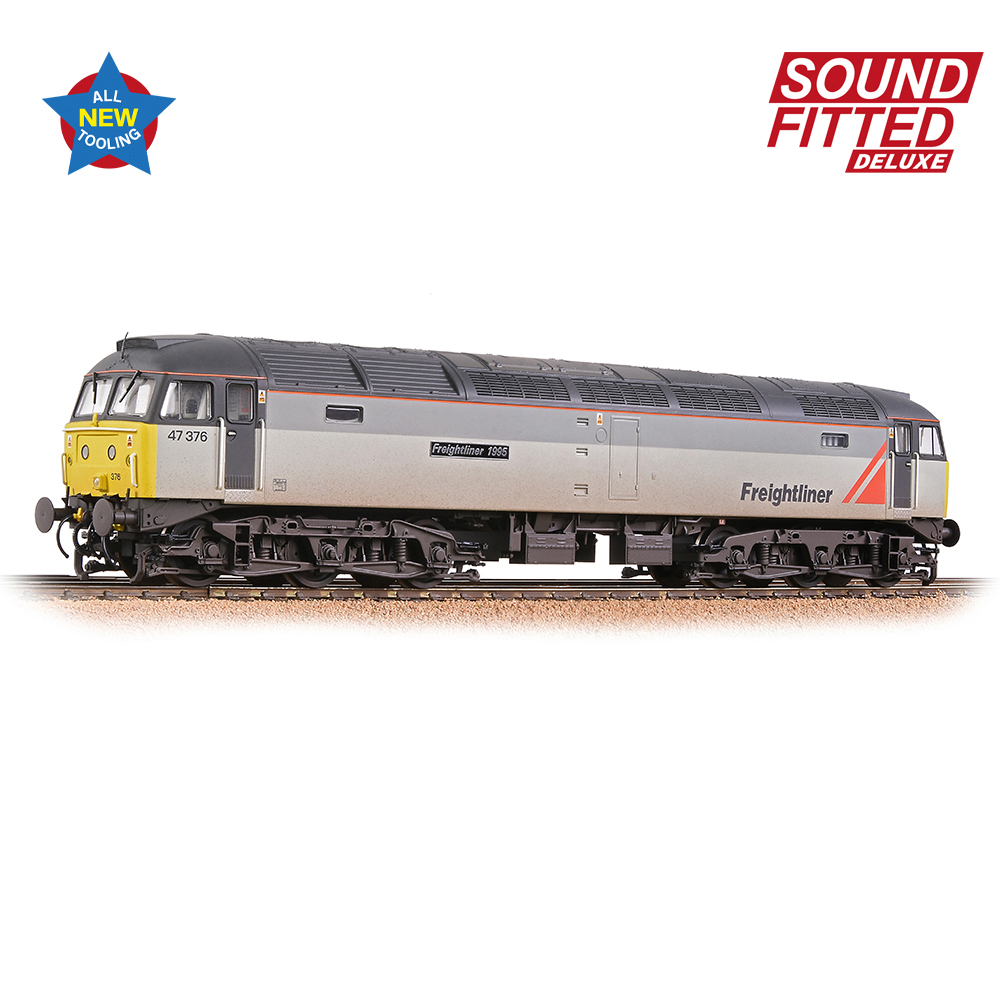
35-430SFXClass 47/3 47376 'Freightliner 1995' Freightliner Grey [W] With DCC Sound & Working Fans
'OO' GaugeReleased: 30/09/22DCC FittedDCC SoundEra 9SOUNDS
F0 - Directional Lights - On/Off (plus Light Switch Sound)
F1 - On - Warm Engine Start / On, Off - Failed Engine Start / On, Off, On - Cold Engine Start
F2 - Brake
F3* - Horn (Playable)
F4* - Two-Tone Horn
F5 - Heavy Load
F6 - Coasting (Manual notch Down if F22 On)
F7 - Maximum Revs (Manual notch Up if F22 On)
F8** - On - Coupling Up / Off - Uncoupling
F9 - Flange Squeal (Speed Related)
F10 - Fan Noise
F11 - Engine Room Lights On/Off (plus Light Switch Sound)
F12 - On - Guard’s Whistle / Off - Driver’s Response Horn
F13 - Cab Lights On/Off No. 1 (plus Light Switch Sound)
F14 - Cab Lights On/Off No. 2 (plus Light Switch Sound)
F15 - Auto Uncouple Cycle
F16 - AWS Horn
F17 - AWS Bell
F18 - On - Sound Fades Out / Off - Sound Fades In
F19 - Mute (Latch) / Volume Cycles 6 Levels (Trigger)
F20 - No. 1 End (Fan) Directional Lights Off
F21 - No. 2 End (non-Fan) Directional Lights Off
F22 - Manual Notching Logic On/Off (control with F6 & F7)
F23 - Spirax Valve
F24 - Station Announcement
F25 - On - Driver’s Door Open / Off - Driver’ Door Shut
F26 - Air Dump
*Alternative Horn sounds and behaviour can be selected via CV changes
** Alternative coupling sounds can be selected via CV changes
Analogue Users: Please note that normal load running sounds and any other automatic or randomised sounds will also operate when this model is used on analogue control (DC) straight from the box!
CLASS 47 HISTORY
Towards the end of the 1950s, British Railways began planning a new fleet of diesel locomotives and after investigating several prototypes, BR decided to place an order with Brush Engineering for 20 locomotives during February 1961. The resulting design became the iconic Brush Type 4 Diesel locomotive, a practical, versatile design with a very distinctive cab. Powered with a Sulzer engine and initially rated at 2,750hp, the locomotive could achieve a top speed of 75mph with a tractive effort of 55,000lb. Building commenced in January 1962 and the first locomotive No. D1500 appeared in late September of the same year with test runs on the London Midland Region and Western Region. The design was a success and BR went on to order a total of 512 with continuous production through to early 1967, forming the largest single class of main-line diesel locomotives in the UK.
During this time and subsequent years, several variations appeared with an increase in speed and tractive effort to 95mph and 62,000lb respectively. Originally fitted with four character train reporting head-codes, these changed to marker lights, with the addition of high intensity lights and roof aerials in the late 1980s. Other variations involved the fitting of different types of steam heating boiler for early BR coaching stock, later replaced with electric train heating for use with modern rolling stock. The numbering system started with four figures but changed to five with the introduction of the TOPS coding system which saw the locomotives classified as Class 47 Diesels with variations such as 47/0, 47/2, 47/3, 47/4 and 47/7. By the end of the 1990s, half of the Class 47 fleet had been withdrawn or scrapped, 33 have been converted into Class 57 locomotives and several have been preserved, including the original No. D1500, now numbered 47401.
Our Price:
£327.20
£327.20
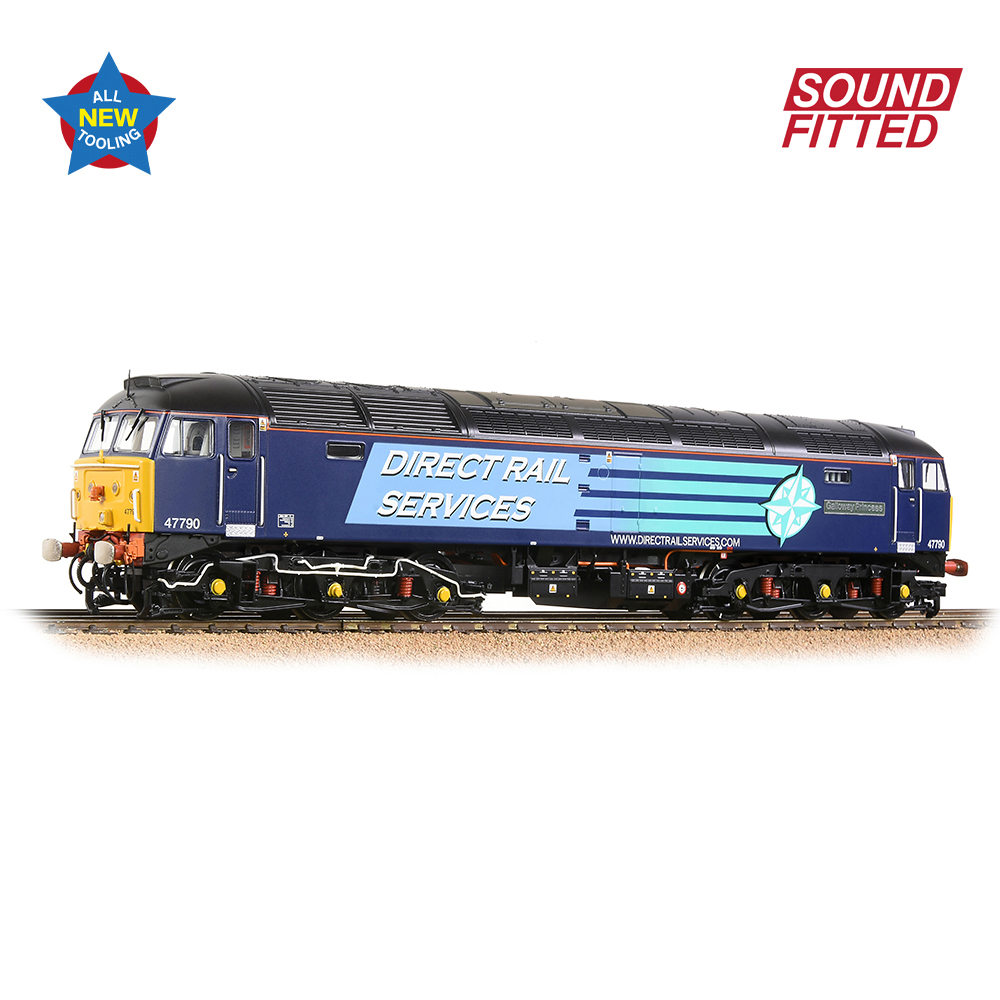
35-432Class 47/7 47790 'Galloway Princess' DRS Compass (Original)
'OO' GaugeReleased: 30/09/22DCC Ready (PluX22)Era 9CLASS 47 HISTORY
Towards the end of the 1950s, British Railways began planning a new fleet of diesel locomotives and after investigating several prototypes, BR decided to place an order with Brush Engineering for 20 locomotives during February 1961. The resulting design became the iconic Brush Type 4 Diesel locomotive, a practical, versatile design with a very distinctive cab. Powered with a Sulzer engine and initially rated at 2,750hp, the locomotive could achieve a top speed of 75mph with a tractive effort of 55,000lb. Building commenced in January 1962 and the first locomotive No. D1500 appeared in late September of the same year with test runs on the London Midland Region and Western Region. The design was a success and BR went on to order a total of 512 with continuous production through to early 1967, forming the largest single class of main-line diesel locomotives in the UK.
During this time and subsequent years, several variations appeared with an increase in speed and tractive effort to 95mph and 62,000lb respectively. Originally fitted with four character train reporting head-codes, these changed to marker lights, with the addition of high intensity lights and roof aerials in the late 1980s. Other variations involved the fitting of different types of steam heating boiler for early BR coaching stock, later replaced with electric train heating for use with modern rolling stock. The numbering system started with four figures but changed to five with the introduction of the TOPS coding system which saw the locomotives classified as Class 47 Diesels with variations such as 47/0, 47/2, 47/3, 47/4 and 47/7. By the end of the 1990s, half of the Class 47 fleet had been withdrawn or scrapped, 33 have been converted into Class 57 locomotives and several have been preserved, including the original No. D1500, now numbered 47401.

Our Price:
£203.95
£203.95
35-432SFClass 47/7 47790 'Galloway Princess' DRS Compass (Original) With DCC Sound
'OO' GaugeReleased: 30/09/22DCC FittedDCC SoundEra 9SOUNDS
F0 - Directional Lights - On/Off (plus Light Switch Sound)
F1 - On - Warm Engine Start / On, Off - Failed Engine Start / On, Off, On - Cold Engine Start
F2 - Brake
F3* - Horn (Playable)
F4* - Two-Tone Horn
F5 - Heavy Load
F6 - Coasting (Manual notch Down if F22 On)
F7 - Maximum Revs (Manual notch Up if F22 On)
F8** - On - Coupling Up / Off - Uncoupling
F9 - Flange Squeal (Speed Related)
F10 - Fan Noise
F11 - Engine Room Lights On/Off (plus Light Switch Sound)
F12 - On - Guard’s Whistle / Off - Driver’s Response Horn
F13 - Cab Lights On/Off No. 1 (plus Light Switch Sound)
F14 - Cab Lights On/Off No. 2 (plus Light Switch Sound)
F15 - Auto Uncouple Cycle
F16 - AWS Horn
F17 - AWS Bell
F18 - On - Sound Fades Out / Off - Sound Fades In
F19 - Mute (Latch) / Volume Cycles 6 Levels (Trigger)
F20 - No. 1 End (Fan) Directional Lights Off
F21 - No. 2 End (non-Fan) Directional Lights Off
F22 - Manual Notching Logic On/Off (control with F6 & F7)
F23 - Spirax Valve
F24 - Station Announcement
F25 - On - Driver’s Door Open / Off - Driver’ Door Shut
F26 - Air Dump
*Alternative Horn sounds and behaviour can be selected via CV changes
** Alternative coupling sounds can be selected via CV changes
Analogue Users: Please note that normal load running sounds and any other automatic or randomised sounds will also operate when this model is used on analogue control (DC) straight from the box!
CLASS 47 HISTORY
Towards the end of the 1950s, British Railways began planning a new fleet of diesel locomotives and after investigating several prototypes, BR decided to place an order with Brush Engineering for 20 locomotives during February 1961. The resulting design became the iconic Brush Type 4 Diesel locomotive, a practical, versatile design with a very distinctive cab. Powered with a Sulzer engine and initially rated at 2,750hp, the locomotive could achieve a top speed of 75mph with a tractive effort of 55,000lb. Building commenced in January 1962 and the first locomotive No. D1500 appeared in late September of the same year with test runs on the London Midland Region and Western Region. The design was a success and BR went on to order a total of 512 with continuous production through to early 1967, forming the largest single class of main-line diesel locomotives in the UK.
During this time and subsequent years, several variations appeared with an increase in speed and tractive effort to 95mph and 62,000lb respectively. Originally fitted with four character train reporting head-codes, these changed to marker lights, with the addition of high intensity lights and roof aerials in the late 1980s. Other variations involved the fitting of different types of steam heating boiler for early BR coaching stock, later replaced with electric train heating for use with modern rolling stock. The numbering system started with four figures but changed to five with the introduction of the TOPS coding system which saw the locomotives classified as Class 47 Diesels with variations such as 47/0, 47/2, 47/3, 47/4 and 47/7. By the end of the 1990s, half of the Class 47 fleet had been withdrawn or scrapped, 33 have been converted into Class 57 locomotives and several have been preserved, including the original No. D1500, now numbered 47401.
Our Price:
£288.95
£288.95
 371-358A
Class 60 60096 Colas Rail Freight
'N' GaugeReleased: 30/09/22DCC Ready (Next18)Era 9CLASS 60 HISTORY
The British Rail Class 60 is a Class of Diesel-Electric Locomotive built by Brush Traction in Loughborough, Leicestershire between 1989 and 1993. Affectionately known as ‘Tugs’ by enthusiasts due to their Mirrlees marine-derived powerplant, 100 locomotives were built and the first entered service in late-1990 – more than a year after the first example had been ceremoniously handed over to BR – after various technical issues were uncovered during testing of the first locos. Designed for heavy freight trains, the Class 60s entered service at a time when BR’s Railfreight operations had been split into various sub-sectors and locomotives were assigned to the Coal, Metals, Construction and Petroleum divisions of BR Railfreight, with each carrying the triple-grey base livery with the addition of the relevant graphics for the sub-sector and depot plaques.
In 1994 and in the runup to the Privatisation of British Rail, the Class 60 fleet was split between three of the shadow freight operators – Loadhaul, Mainline and Transrail – that had been created to handle BR’s freight business. All three operators were purchased by EWS in 1996, resulting in the entire class falling under EWS ownership. With the introduction of the Class 66s at the end of the century and coupled with a decline in EWS heavy freight traffic, several Class 60s were put into store and the future of the fleet was uncertain at times. However, a number of locomotives were retained as the heaviest trains could not be hauled by a single Class 66 and instead required the superior power of a Class 60. EWS was acquired by DB Schenker in 2007 (later renamed DB Cargo) and the new owners put several Class 60s up for sale, however they also announced overhauls for some 60s, giving the class glimmers of hopes for the future.
In 2014 Colas Rail purchased ten Class 60s and these remained with the company until 2018 when they were replaced by Class 70s. These ten Class 60s were subsequently sold to GB Railfreight who still operate the fleet which includes No. 60002 that was named ‘Graham Farish – 50th Anniversary 1970 – 2020’ to mark 50th anniversary of production of British N scale models by the brand which is now owned by Bachmann Europe.
Despite their ups and downs, the Class 60s continue to serve DB Cargo, GB Railfreight and other private operators including DC Rail and the class remains a popular sight across the UK where they can be found hauling the heavy freight trains for which they were originally designed.

Our Price:
£135.95
£135.95