
Search results
 R60108
BR, Conflat A
 'OO' Gauge
 Released: 15/12/22
 Era 4
Era 4
Our Price:
£19.79
£19.79
 4F-005-002
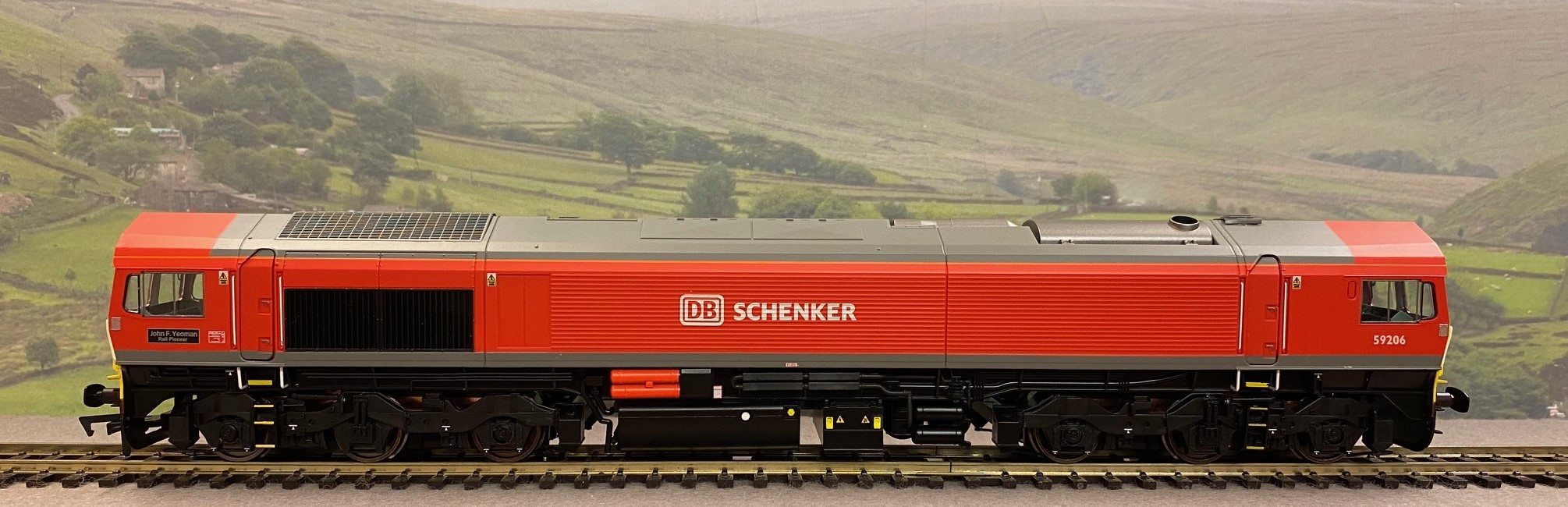
DB SCHENKER CLASS 59 59206 'JOHN F YEOMAN'
'OO' GaugeReleased: 16/12/22 DCC Ready (21 Pin)
The Class 59.
The Class 59 3,300 bhp Co-Co diesel-electric locomotives were built between 1985 and 1995 by Electro-Motive Diesel for operation in Great Britain. A total of 15 locomotives were built for three different operators.
Our Price:
£147.22
£147.22
 4F-005-003
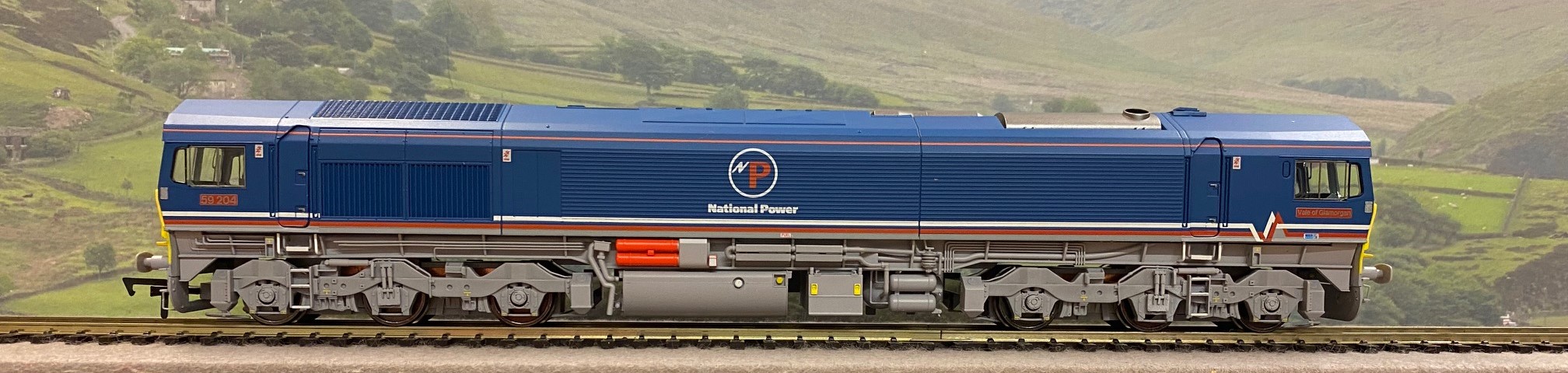
NATIONAL POWER CLASS 59 59204
'OO' GaugeReleased: 16/12/22DCC Ready (21 Pin)The Class 59.
The Class 59 3,300 bhp Co-Co diesel-electric locomotives were built between 1985 and 1995 by Electro-Motive Diesel for operation in Great Britain. A total of 15 locomotives were built for three different operators.
Our Price:
£147.22
£147.22
 391-127SF
Mainline Hunslet 0-4-0ST 'Linda' Penrhyn Quarry Lined Black (Late) [W]
'OO-9' GaugeReleased: 21/12/22DCC FittedDCC SoundEra 4SOUNDS
F1 - Sound - On/Off
F2 - Brake
F3 - Cylinder Drain Cocks
F4 - Bell Whistle (Speed Related)
F5 - Reverser
F6 - On - Firebox Door Open / Off - Firebox Door Closed
F7 - Coal Shovelling (only with F6 On)
F8 - Blower
F9 - Flange Squeal (Speed Related)
F10 - Speed Lock
F11 - Hand Brake (Functional)
F12 - Water Tank Filling
F13 - Coupling Clank
F14 - Light Engine Mode
F15 - Fade All Sounds
F16 - Guard's Whistle
F17 - Enable Auto Wagon Buffering
F18 - Injector
F19 - Alternative Whistle (Speed Related)
F20 - Shunting Mode
F21 - Safety Valves Lifted
F22 - 'Clear my side’
F23 - 'Red light ahead’
F24 - 'Coal on the fire’
F25 - Volume Down
F26 - Volume Up
Analogue Users: Please note that normal load running sounds, acceleration steam chuff sounds and any other automatic and randomised sounds will also operate when this model is used on analogue control (DC) straight from the box!
MAINLINE HUNSLET HISTORY
Most famous for their operation on the North Wales narrow gauge railways, the first main line Hunslet was built in 1882 by the Hunslet Engine Company of Leeds for the Penrhyn Quarry Railway. Named ‘Charles’, the locomotive’s somewhat unconventional appearance, with steeply inclined cylinders and connecting rods located on the inside of the coupling rods, would be repeated eleven years later when ‘Linda’ and ‘Blanche’ were constructed. Known affectionately by many enthusiasts as ‘the Ladies’, they were ostensibly built to the same 0-4-0 saddle tank design as ‘Charles’, although the ‘Ladies’ did incorporate some differences when compared to their elder. They had larger fire grates for one, round spectacle glasses in the front cab sheet rather than the square ones fitted to ‘Charles’ for another, and were also fractionally longer.
Penrhyn Quarry was the largest slate quarry in the world at the end of the nineteenth century and the trio of Hunslets spent their days hauling slate trains over the Penrhyn main line from the vast quarry complex at Coed-y-Parc, near Bethesda, to Port Penrhyn, just a stone’s throw from Bangor on the North Wales coast. Here, slate products were transferred to standard gauge railway wagons or ships for onward transport around the UK and further afield. Whilst smaller locomotive such as the Quarry Hunslets were used to work the quarry’s internal railways, the larger, more powerful Mainline Hunslets worked the full trains from the quarry down to Port Penrhyn and brought the empty wagons back again – similar duties to those for which the Ffestiniog Railway employed the famous Double Fairlies.
During their working lives the three locomotives underwent several changes, all gained full-height rear cab sheets, replacing the original half-height sheets, welded tanks were fitted in place of the original rivetted versions and various sandbox arrangements were seen, amongst other improvements during their time on the Penrhyn line. By the mid-twentieth century traffic on the Penrhyn Quarry Railway was in decline and in 1962 the last trains ran. ‘Charles’ had already been retired in in the mid-1950s, but the Ladies worked on until the very end.
Offered for sale upon closure of the railway, ‘Linda’ was quickly loaned to the Ffestiniog Railway, arriving there only three days after hauling her last train on the Penrhyn Quarry Railway. In 1963 ‘Linda’ was purchased by the Ffestiniog Railway and ‘Blanche’ too was acquired in the same year, arriving at the railway in December 1963. Both Ladies have been modified by the Ffestiniog Railway since their acquisition, most notably with the fitting of front pony wheels and tenders, becoming 2-4-0ST+Ts (saddle tank tender engines). With 2023 marking 60 years since the pair were brought by the Ffestiniog Railway, they are unquestionably two of the most useful engines in the railway’s fleet and are as popular as ever with visitors, staff and volunteers alike.
‘Charles’ was also offered for sale, but with the boiler condemned, the Ffestiniog Railway declined. Instead, ‘Charles’ was loaned to the National Trust and is now displayed at Penrhyn Castle – once the family home of the owners of Penrhyn Quarry.

Our Price:
£254.95
£254.95
R30156BR, Class 60, Co-Co, 60001 'Steadfast'
'OO' GaugeReleased: 19/12/22DCC Ready (21 Pin)Era 8No. 60001, the first of the Class 60s to be delivered, was handed over to British Rail in 1989 after being ordered only 13 months earlier. The locomotive was named 'Steadfast' as the result of a suggestion competition. 'Steadfast' would go on to be operated by EWS until an engine failure in 2006, which forced the locomotive out of service until an overhaul in 2013.

Our Price:
£201.59
£201.59