
Search results
 R30186
RailRoad Plus BR Infrastructure, Class 47, Co-Co, 47803
 'OO' Gauge
 Released: 28/06/23
 DCC Ready (8 Pin)
 Era 8
Era 8The British Rail Class 47 is a class of British railway diesel-electric locomotive that was developed in the 1960s by Brush Traction. A total of 512 Class 47s were built at Crewe Works and Brush's Falcon Works, Loughborough between 1962 and 1968, which made them the most numerous Class of British mainline diesel locomotive. They were classified as Type 4s.They were fitted with the Sulzer 12LDA28C twin-bank twelve-cylinder unit producing 2,750 bhp (2,050 kW) - though this was later derated to 2,580 bhp (1,920 kW) to improve reliability - and have been used on both passenger and freight trains on Britain's railways for over 50 years. Despite the introduction of more modern types of traction, a significant number are still in use, both on the mainline and on heritage railways. As of October 2016, 81 locomotives still exist as Class 47s, with further examples having been converted to other classes; 30 retain "operational status" on the mainline.By 1986, only five of the original 512 locomotives had been withdrawn from service, all because of serious accident damage. However, with work for the Class declining due to the introduction of new rolling stock and spare parts becoming difficult to source, some inroads started being made.The first locomotives to be targeted were the non-standard pilot batch of 20, now numbered 47 401-47 420. Three locomotives were withdrawn as life-expired in February 1986 and the remainder of the batch that had not recently been overhauled followed in the next two years. All 20 were withdrawn by 1992.Meanwhile, BR drew up a 'hit-list' of locomotives for early withdrawal, mainly including those with non-standard electrical equipment, known as series parallel locomotives. In the outset, withdrawals were slow, mainly due to the surplus of spare parts and new flows of freight traffic which required extra locomotives; only 61 locomotives had been withdrawn by the end of 1992. However, with the introduction of new locomotives, the rate of withdrawal quickly rose, with 86 more 47s reaching the end of their lives in the next three years. With most of the non-standard locomotives withdrawn, the reduction of the fleet again proceeded more slowly. The privatisation of British Rail also produced new independent rail companies needing available traction until they could order new locomotives. From 1996 to 2006, an average of around fifteen locomotives per year were taken out of service.

Our Price:
£87.29
£87.29
 917001
GWR LORIOT Y 41989
'OO' GaugeReleased: 04/07/23Era 3The GWR allocated the code ‘Loriot’ to flat wagons designed to move earth moving and plant machinery. The first appeared in 1892 and a family look soon evolved, with the wagon’s deck angled upwards at each end to clear the axles.
One new ‘Loriot’ was built in 1937. It was built to Diagram G39 and coded ‘Loriot Y’. But it didn’t look like the rest of the ‘Loriot’ family.
Originally, the GWR considered it to be an addition to its ‘Loriot W’ fleet. However, it was built from assembled ‘I’ beam girders rather than rolled beams, a feature first used on the ‘Crocodile’ bogie well wagons of 1908. Consequently, it was re-classified ‘Loriot Y’. A second ‘Loriot Y’ was built in 1939.
Both were painted with instructions that, when empty, they must be returned to Swindon. They would have run over large areas of the GWR’s network, moving excavators and other plant, particularly during the Second World War.
However, records for these two vehicles are few and far between. No. 41989 found fame when it starred in The Titfield Thunderbolt, where it was pressed into service to carry Dan’s house. It is believed to have been scrapped not long after the filming in 1953.
Sister ‘Loriot Y’ No. 41990 fared better. It remained in revenue-earning service until at least 1990 at Radyr Engineers Yard. Eventually, as DW41990 (coded ‘ZXP’ on TOPS), it moved to Bescot from where it was condemned in 1994. Saved at the 11th hour, it moved to the Severn Valley Railway where it remains to this day.

Our Price:
£35.95
£35.95
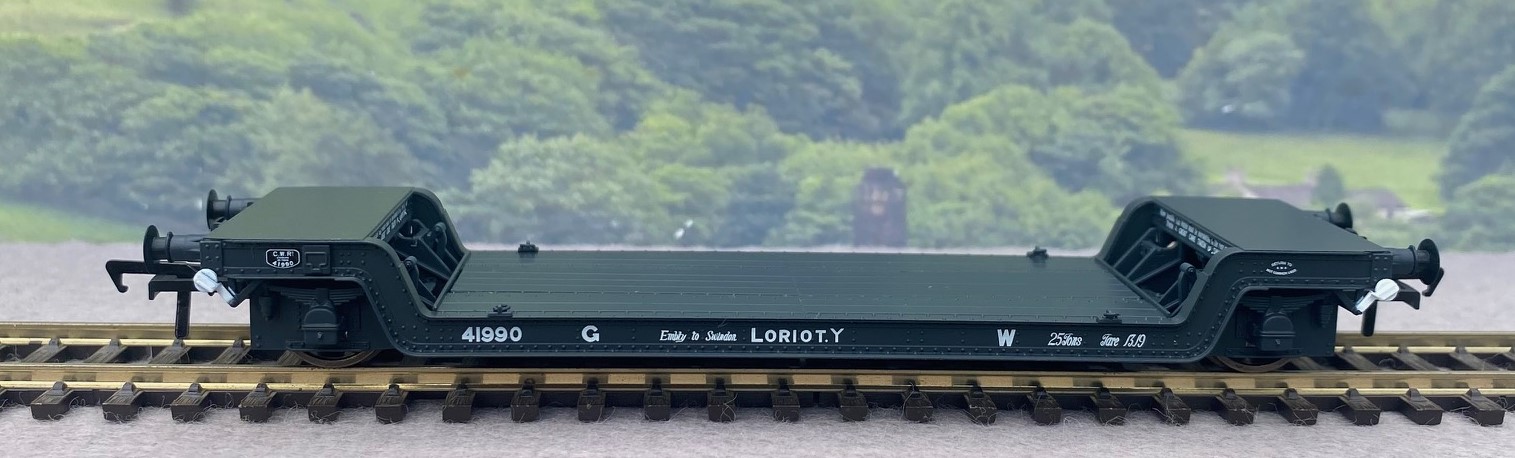
917002GWR LORIOT Y 41990
'OO' GaugeReleased: 04/07/23Era 3The GWR allocated the code ‘Loriot’ to flat wagons designed to move earth moving and plant machinery. The first appeared in 1892 and a family look soon evolved, with the wagon’s deck angled upwards at each end to clear the axles.
One new ‘Loriot’ was built in 1937. It was built to Diagram G39 and coded ‘Loriot Y’. But it didn’t look like the rest of the ‘Loriot’ family.
Originally, the GWR considered it to be an addition to its ‘Loriot W’ fleet. However, it was built from assembled ‘I’ beam girders rather than rolled beams, a feature first used on the ‘Crocodile’ bogie well wagons of 1908. Consequently, it was re-classified ‘Loriot Y’. A second ‘Loriot Y’ was built in 1939.
Both were painted with instructions that, when empty, they must be returned to Swindon. They would have run over large areas of the GWR’s network, moving excavators and other plant, particularly during the Second World War.
However, records for these two vehicles are few and far between. No. 41989 found fame when it starred in The Titfield Thunderbolt, where it was pressed into service to carry Dan’s house. It is believed to have been scrapped not long after the filming in 1953.
Sister ‘Loriot Y’ No. 41990 fared better. It remained in revenue-earning service until at least 1990 at Radyr Engineers Yard. Eventually, as DW41990 (coded ‘ZXP’ on TOPS), it moved to Bescot from where it was condemned in 1994. Saved at the 11th hour, it moved to the Severn Valley Railway where it remains to this day.
Our Price:
£35.95
£35.95
917003BR LORIOT Y 'DW41990 CODE ZXP'
'OO' GaugeReleased: 04/07/23Era 4/5/6The GWR allocated the code ‘Loriot’ to flat wagons designed to move earth moving and plant machinery. The first appeared in 1892 and a family look soon evolved, with the wagon’s deck angled upwards at each end to clear the axles.
One new ‘Loriot’ was built in 1937. It was built to Diagram G39 and coded ‘Loriot Y’. But it didn’t look like the rest of the ‘Loriot’ family.
Originally, the GWR considered it to be an addition to its ‘Loriot W’ fleet. However, it was built from assembled ‘I’ beam girders rather than rolled beams, a feature first used on the ‘Crocodile’ bogie well wagons of 1908. Consequently, it was re-classified ‘Loriot Y’. A second ‘Loriot Y’ was built in 1939.
Both were painted with instructions that, when empty, they must be returned to Swindon. They would have run over large areas of the GWR’s network, moving excavators and other plant, particularly during the Second World War.
However, records for these two vehicles are few and far between. No. 41989 found fame when it starred in The Titfield Thunderbolt, where it was pressed into service to carry Dan’s house. It is believed to have been scrapped not long after the filming in 1953.
Sister ‘Loriot Y’ No. 41990 fared better. It remained in revenue-earning service until at least 1990 at Radyr Engineers Yard. Eventually, as DW41990 (coded ‘ZXP’ on TOPS), it moved to Bescot from where it was condemned in 1994. Saved at the 11th hour, it moved to the Severn Valley Railway where it remains to this day.

Our Price:
£35.95
£35.95
918009BR WR DEPARTMENTAL GREY TOAD BRAKE VAN DW17247
'HO' GaugeReleased: 29/06/23Era 6/7It was required by law that all goods trains had to have a brake van at the rear and the Great Western Railway settled upon a design that was as recognisable as its locomotives. The first ‘van with the single ended veranda and large, enclosed body for the use of the guard appeared circa 1871 and variants based on this configuration continued to be built into the 1950s.
The GWR allocated telegraphic codes to its goods vehicles and brake vans were dubbed ‘Toad’. Consequently, this name is how both railwaymen and enthusiasts referred to these vehicles.
Internally, the vans feature a desk, seating, storage lockers for equipment and a stove for keeping warm. Internal lighting was not provided. Sand boxes and sanders were fitted to both ends of the vans to aid with braking whilst the handbrake was fitted externally on the veranda along with the levers for operating the sanders. Full length footboards and handrails allowed the guard stand on the side of the vehicle during shunting operations.
The GWR allocated diagram numbers in the ‘AA’ series to 23 versions of post-1888 built ‘Toads’. Our model depicts the ‘AA20’, which was introduced in 1934.
The requirement for brake vans ended in 1968 but that didn’t mean the end of the ‘Toads’. Many lasted into Departmental and even industrial use and a large number of ‘Toads’, including several ‘AA20s’, have been preserved.
The model includes a full interior alongside a removable roof.

Our Price:
£35.95
£35.95